Research Use Only. The information presented here is for scientific and educational purposes. These compounds are not intended for human consumption, self-administration, or therapeutic use.
Introduction
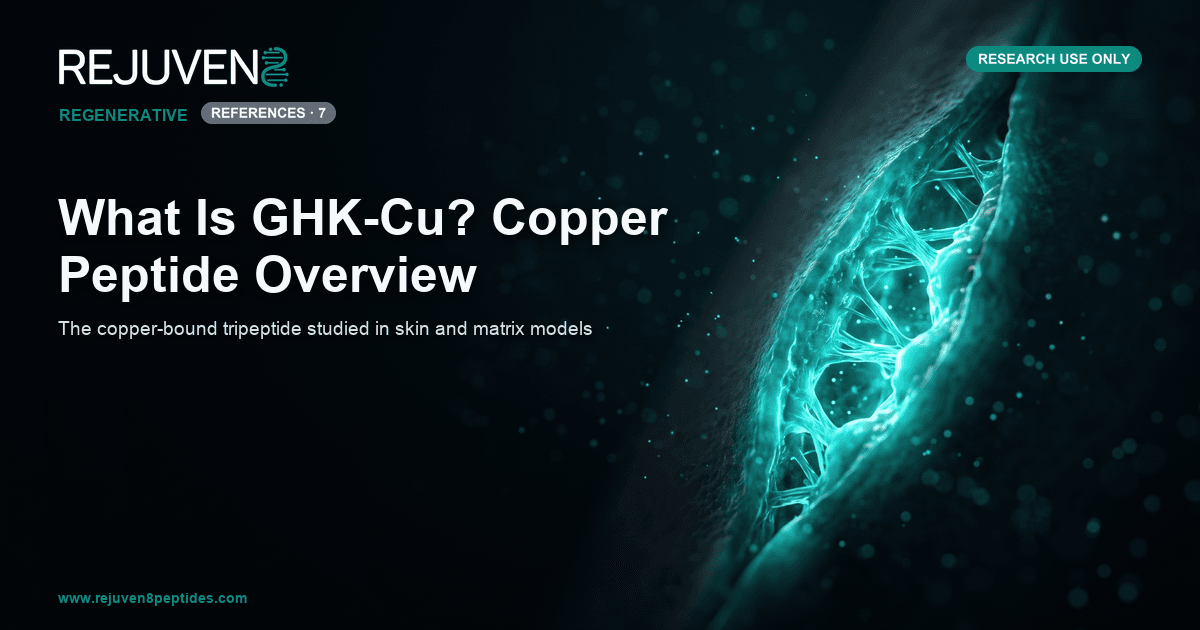
GHK-Cu is the copper(II) complex of a naturally occurring tripeptide, glycyl-L-histidyl-L-lysine, and it is one of the most widely studied small peptides in skin, connective-tissue, and wound-model research. First isolated from human plasma by Loren Pickart in 1973, GHK was later found to bind copper with high affinity, and it is the copper-loaded form that most of the modern literature examines. Its blue-violet color, its small size, and its apparent ability to shift fibroblast behavior toward a remodeling state have kept it under continuous investigation for five decades.
This overview answers the question “what is GHK-Cu” from the research side: where the peptide comes from, how the copper complex is structured, what laboratories have investigated it for in cell culture and animal models, how 2025 and 2026 work has extended those findings, and how the material is handled at the bench. Everything here is for research use only, not for human consumption.
What Is GHK-Cu? Identity and Origin
A Tripeptide Released From the Matrix
The GHK sequence appears within larger extracellular-matrix proteins, including type I collagen and the matricellular protein SPARC, and is thought to be liberated by proteolysis when tissue is injured. This places GHK in the class of matrikines: small fragments of matrix proteins that act as signals in their own right. Free GHK circulates in plasma and has been detected in saliva and urine, and Pickart’s group reported that plasma levels fall with age, from roughly 200 ng/mL in young adults to about 80 ng/mL by age 60. That decline is one reason the peptide interests researchers studying why repair slows in aging tissue.
The Copper Complex
GHK binds copper(II) through the terminal amine of glycine, the backbone amide nitrogen between glycine and histidine, and the imidazole nitrogen of the histidine side chain, producing a roughly square-planar arrangement around the metal. The lysine side chain remains free and positively charged. The complex forms readily at physiological pH, and copper-free GHK shows weaker activity in many assay systems, so the metal is regarded as part of the active molecule rather than a contaminant. The values below reflect commonly reported laboratory attributes and are provided for comparison only.
| Attribute | Reported Value |
|---|---|
| Sequence | Glycyl-L-histidyl-L-lysine (Gly-His-Lys) |
| Class | Copper-binding tripeptide; matrikine |
| Sequence length | 3 amino acids |
| Free peptide formula and weight | C14H24N6O4; about 340.4 g/mol |
| Copper complex weight | About 402 g/mol (listed as 401.9 to 403.9 depending on protonation state) |
| Appearance | Blue to blue-violet lyophilized powder; blue solution |
| Natural occurrence | Human plasma, saliva, urine; sequence within collagen and SPARC |
| Research supply format | Lyophilized powder, typically 50 mg or 100 mg vials |
What GHK Cu Peptide Is Studied For
Collagen and the Extracellular Matrix
The founding in-vitro result is that GHK-Cu increases collagen synthesis in cultured dermal fibroblasts, reported by Maquart and colleagues in 1988. Later culture and wound-model work described increased glycosaminoglycans and small proteoglycans and a pattern investigators call balanced remodeling: increased matrix metalloproteinase activity alongside increased tissue inhibitors of metalloproteinases, so that damaged matrix is turned over rather than simply accumulated. Because lysyl oxidase, the enzyme that cross-links collagen and elastin, depends on copper, the complex’s copper-delivery and signaling functions are difficult to separate, and both remain active research questions.
Wound Models
GHK-Cu has been examined in rodent excisional wounds, in irradiated-skin rat models where healing is impaired, and in porcine skin, with endpoints including wound contraction, re-epithelialization, angiogenesis, and matrix deposition. A 2025 study in Nature Communications incorporated a dimeric GHK-copper derivative into a reactive-oxygen-species-responsive hydrogel and, in diabetic mouse wounds, reported macrophage polarization toward the M2 phenotype, lower TNF-alpha and IL-6, higher VEGF and CD31 signals, and improved collagen organization. A 2025 review of tripeptides in wound-healing and skin-regeneration research listed GHK-Cu among the best characterized, citing fibroblast proliferation, angiogenesis, elastase inhibition, and reduced oxidative stress in wound models.
Inflammation, Oxidative Stress, and Gene Expression
In cell-based systems GHK-Cu has been associated with reduced NF-kB signaling, lower pro-inflammatory cytokine output, and higher activity of the copper-dependent antioxidant enzyme superoxide dismutase. The broadest claims come from transcriptomics. Campbell and colleagues, using a connectivity-map approach in 2012, identified GHK computationally as a compound that reversed an emphysema-related destructive gene signature in cultured human lung fibroblasts, and Pickart and Margolina’s 2018 review collated dataset analyses associating GHK with expression changes across thousands of genes tied to remodeling, antioxidant defense, and DNA repair. These are bioinformatic and in-vitro findings that generate hypotheses rather than confirm them.
Hair Follicle and Dermal Papilla Research
Copper-binding peptides, GHK-Cu among them, have been studied in rodent and cell models for effects on follicle size and dermal papilla cell activity, connecting the matrix and angiogenic findings to the follicle microenvironment. It remains a smaller body of work than the skin and wound literature and is summarized in a 2026 dermatological review of copper peptides.
GHK-Cu Among Regenerative Research Peptides
GHK-Cu is the matrix-remodeling component of the multi-peptide GLOW Blend and KLOW Blend. The table contrasts it with the two peptides it is most often paired with; these values reflect commonly reported laboratory attributes and are provided for comparison only.
| Peptide | Origin | Primary Studied Target | Common Model Systems |
|---|---|---|---|
| GHK-Cu | Human plasma; collagen-derived matrikine | Copper delivery, fibroblast gene expression, matrix remodeling | Dermal fibroblast culture, rodent and porcine wounds, transcriptomic datasets |
| BPC-157 | Partial sequence of a gastric protective protein | VEGFR2 signaling, nitric oxide system, cytoprotection | Endothelial culture, rodent tendon, muscle, and gut injury models |
| TB-500 | Thymosin beta-4 derived peptide | G-actin sequestration, cell migration | Migration assays, rodent wound and cardiac models |
Each occupies a different arm of the repair process in preclinical descriptions, which is why combination research tends to handle them as separate variables. The recovery and tissue-repair peptide comparison covers this landscape in more detail.
Handling GHK-Cu in the Laboratory
Color, Light, and Copper Integrity
The copper center is both the peptide’s defining feature and its handling constraint. Lyophilized GHK-Cu is a blue powder and should stay that way; a solution should be clear and blue. Copper(II) complexes are sensitive to light, to pH extremes that compete for the coordinating nitrogens, and to reducing agents that convert copper(II) to copper(I); a drift toward green, brown, or colorless indicates that the complex has changed. Lyophilized material is stored cold, dry, and dark, and reconstituted solutions are refrigerated at 2 to 8 C in light-protected vials and used within a defined window. The peptide storage and handling guide covers these conditions in more depth.
A Worked Concentration Example
Reconstituting a 50 mg vial with 2.5 mL of bacteriostatic water gives 20 mg/mL (50 mg divided by 2.5 mL); a 100 mg vial with 5 mL gives the same figure. Because GHK-Cu is highly water soluble, the powder dissolves with gentle swirling. The bacteriostatic water reconstitution guide covers technique, and a lot-specific certificate of analysis should confirm identity by mass spectrometry and purity by HPLC; the guide to reading a peptide COA explains those fields.
In summary, GHK-Cu is a copper-bound matrikine tripeptide studied for collagen and matrix signaling, wound-model repair, inflammation and oxidative-stress responses, and broad gene-expression effects, with 2025 hydrogel and review literature building on findings that date to 1973. It is supplied strictly as a research material and is listed in the research peptide catalog.
Frequently Asked Questions
What is GHK-Cu?
GHK-Cu is the copper(II) complex of glycyl-L-histidyl-L-lysine, a three-amino-acid peptide that occurs naturally in human plasma and is released from matrix proteins such as collagen. It is a blue, water-soluble research peptide studied for collagen signaling, matrix remodeling, and wound-model repair in cell culture and animal systems.
What is GHK Cu peptide studied for?
In preclinical research GHK-Cu is investigated for collagen and glycosaminoglycan synthesis in fibroblasts, balanced matrix remodeling, wound closure and angiogenesis in rodent and porcine models, reduced NF-kB-linked inflammatory signaling, antioxidant enzyme activity, and broad gene-expression changes seen in transcriptomic datasets.
Is GHKCu the same as GHK-Cu?
Yes. GHKCu, GHK Cu, copper tripeptide-1, and copper peptide GHK-Cu all refer to the same molecule: the tripeptide Gly-His-Lys complexed with a copper(II) ion. The hyphenated form is the most common spelling in the literature.
Why is GHK-Cu blue?
The color comes from the copper(II) ion coordinated by the peptide’s nitrogen atoms, which absorbs visible light and gives both the powder and its solutions a blue to blue-violet appearance. Loss of that color signals a change in copper coordination and serves as a simple visual integrity check.
What is the difference between GHK and GHK-Cu?
GHK is the free tripeptide, about 340 g/mol, and GHK-Cu is the same peptide carrying a bound copper(II) ion, about 402 g/mol. Most research uses the copper complex because copper-free GHK shows weaker activity in many assays, and the metal is considered part of the active species.
How is GHK-Cu stored in a research setting?
Lyophilized GHK-Cu is kept cold, dry, and protected from light. Once reconstituted it is refrigerated at 2 to 8 C in a light-protected vial, kept away from reducing agents and pH extremes, and used within a defined working period.
References and Further Reading
- Pickart L and colleagues, 1973 onward: isolation of GHK from human plasma and early tripeptide-copper work. PubMed: Pickart GHK copper tripeptide
- Maquart FX and colleagues, 1988, FEBS Letters: stimulation of collagen synthesis in fibroblast cultures by GHK-Cu. PubMed: GHK-Cu collagen synthesis fibroblast
- Pickart L and Margolina A, 2018, International Journal of Molecular Sciences: regenerative and protective actions of GHK-Cu in light of gene-expression data. PubMed: GHK-Cu gene expression regenerative
- Campbell JD and colleagues, 2012, Genome Medicine: an emphysema-related gene signature and its reversal by GHK in lung fibroblasts. PubMed: GHK emphysema gene expression signature fibroblast
- Studies of topical copper tripeptide complexes in irradiated and excisional rat wound models. PubMed: copper tripeptide wound healing rat
- 2025, Nature Communications: a dimeric GHK-copper peptide hydrogel in diabetic mouse wound healing. PubMed: dimeric copper peptide hydrogel diabetic wound
- 2025 review of tripeptides in wound healing and skin regeneration, and 2026 review of copper peptides in regenerative dermatology research. PubMed: copper peptides wound healing skin regeneration review