Research Use Only. The information presented here is for scientific and educational purposes. These compounds are not intended for human consumption, self-administration, or therapeutic use.
Introduction
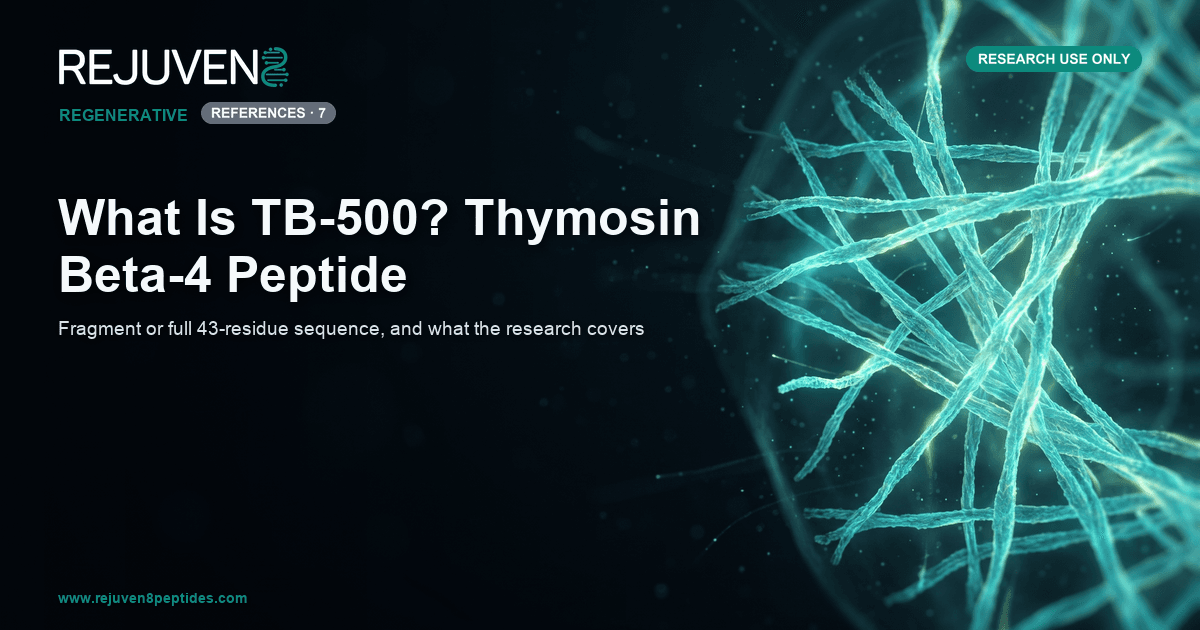
The TB500 peptide is one of the most frequently referenced compounds in tissue-repair research, and also one of the most loosely named. The designation covers a synthetic preparation related to thymosin beta-4 (Tb4), a 43-amino-acid actin-binding peptide present in nearly every mammalian cell type and first characterized from thymus tissue. Laboratories study it because Tb4 is the principal G-actin sequestering molecule in the cytoplasm, which places it upstream of cell migration, cytoskeletal remodeling, and the coordinated movement that tissue repair depends on.
This overview sets out what TB-500 actually is at the molecular level, how the fragment and full-sequence forms differ, which research domains the peptide has been examined in, and what the 2024 and 2025 literature has added. Everything described here comes from in-vitro and animal work. The compound is supplied for research use only, not for human consumption.
What Is TB-500? Fragment Versus Full Sequence
The Parent Peptide
Thymosin beta-4 is a 43-residue, highly acidic peptide of roughly 4.9 kDa, present at micromolar concentrations inside most eukaryotic cells. Its defining functional element is the central LKKTETQ motif, the short stretch responsible for binding monomeric (globular) actin. By holding G-actin in a one-to-one complex, Tb4 maintains a reserve of unpolymerized subunits that a cell can release on demand, which is why the peptide sits at the center of cytoskeletal research rather than being treated as a structural protein.
Where the Name TB-500 Comes From
The name TB-500 entered research supply as a label for a synthetic actin-binding fragment built around that LKKTETQ motif, rather than the complete 43-residue sequence. In practice, material sold under the TB-500 name ranges from short acetylated fragments built around that motif to the full synthetic thymosin beta-4 sequence, and published studies almost always use full-length Tb4. The distinction matters when comparing a supplier’s certificate of analysis against a paper: a molecular weight near 4.9 kDa indicates the full sequence, while a mass under 1 kDa indicates a short fragment. Confirming which one is in the vial is a prerequisite for interpreting any result.
The values below reflect commonly reported laboratory attributes and are provided for comparison only.
| Attribute | Full Thymosin Beta-4 | Short LKKTETQ Fragment |
|---|---|---|
| Class | Beta-thymosin family actin-binding peptide | Synthetic actin-binding fragment |
| Sequence length | 43 amino acids | 7 amino acids (acetylated) |
| Approximate molecular weight | About 4963 Da | Roughly 0.9 kDa |
| Molecular formula | C212H350N56O78S | Varies with capping chemistry |
| CAS number (parent) | 77591-33-4 | Not applicable |
| Actin-binding motif | LKKTETQ, central to the sequence | LKKTETQ, the entire molecule |
| Use in published studies | Predominant form | Occasional, motif-focused work |
What the TB500 Peptide Does in Cells
Tb4 binds G-actin in a one-to-one complex and prevents premature filament assembly. This is not passive storage. When a cell receives a migratory or wound signal, the complex dissociates and releases monomers for rapid polymerization at the leading edge, producing the lamellipodia and filopodia that characterize a moving cell. Groups led by Goldstein and Kleinman described this actin-sequestering role alongside the mobilization and migration of progenitor cells in laboratory models, and the same actin-dependent logic recurs across the keratinocyte, endothelial, corneal epithelial, and cardiac progenitor systems in which the peptide has been examined.
A second thread in the literature concerns signaling that is not obviously actin-dependent, including reported associations with vascular endothelial growth factor expression, suppression of NF-kB-linked inflammatory transcription, and, in 2025 work, receptor-level pathways discussed below. Whether these are downstream consequences of cytoskeletal change or parallel activities remains an open mechanistic question.
Where TB-500 Research Has Focused
Cardiac Repair and Fibrosis
Cardiac models are the most developed arm of this literature. Work by Smart and colleagues reported that Tb4 could activate epicardial progenitor populations and support vascular formation after experimental myocardial injury in rodents. The 2025 literature sharpened the fibrosis side of that story. A study in the International Journal of Molecular Sciences reported that Tb4 upregulated miR-139-5p, which targets ROCK1, reducing stress-fiber formation and the fibroblast-to-myofibroblast transition in adult mouse hearts after coronary ligation and in cultured adult human cardiac fibroblasts. A separate 2025 report in Cardiovascular Research described recombinant Tb4 limiting cardiac fibrosis and cardiomyocyte death in mice through an ErbB2-dependent mechanism, with the effect lost when ErbB2 was blocked.
Fibrosis Beyond the Heart
Antifibrotic questions have extended to other organs. A 2024 report in the Journal of Pharmacy and Pharmacology described inhaled Tb4 suppressing bleomycin-induced pulmonary fibrosis in mice through TGF-beta1 signaling, and earlier work examined Tb4 in carbon-tetrachloride and ethanol models of liver injury. The common readouts across these models are collagen deposition, alpha-smooth muscle actin expression, and myofibroblast counts.
Neurovascular and Brain Injury Models
Rodent traumatic brain injury and stroke models have been used to examine Tb4 for neurorestorative endpoints, including oligodendrogenesis and axonal remodeling. In 2025, a Scientific Reports study moved this work to the barrier itself, reporting that Tb4 preserved claudin-5, occludin, and ZO-1 expression in hypoxic human brain microvascular endothelial cells and restored transendothelial electrical resistance, with the effect abolished by an S1PR1 antagonist.
Cornea and Dermal Wound Models
Sosne and colleagues characterized Tb4 in corneal injury models, reporting faster epithelial closure alongside reduced neutrophil infiltration and lower inflammatory cytokine transcript levels. Dermal work by Philp and colleagues linked the peptide to angiogenesis and wound re-epithelialization in aged rodent skin. Together these lines are why Tb4 is described in reviews as multifunctional rather than tissue-specific.
TB-500 Alongside Related Research Peptides
TB-500 is rarely studied in isolation. It is the actin-regulating component of several multi-peptide research preparations, and it is the standard comparator for pentadecapeptide repair research. The values below reflect commonly reported laboratory attributes and are provided for comparison only.
| Compound | Class | Approx. molecular weight | Primary studied pathway |
|---|---|---|---|
| TB-500 | Thymosin beta-4-derived peptide | Parent Tb4 about 4963 Da (supplied mass per lot COA) | G-actin sequestration, cell migration |
| BPC-157 | Synthetic pentadecapeptide | About 1419 Da | VEGFR2 signaling, angiogenesis |
| GHK-Cu | Copper-binding tripeptide | About 340 Da (peptide) | Matrix remodeling, collagen signaling |
Combination research pairs TB-500 with BPC-157 to examine complementary migration and vascular pathways, available as a combined preparation, and both appear alongside GHK-Cu in the GLOW blend. These are studies of combined signaling in models, not regimens.
Laboratory Handling and Verification
TB-500 is supplied as a lyophilized powder and is typically held at -20 C, protected from light and moisture. As a worked example, reconstituting a 10 mg vial with 2 mL of bacteriostatic water yields a 5 mg/mL stock, while 5 mL yields 2 mg/mL. Solutions are aliquoted to avoid repeated freeze-thaw cycling, which is the most common avoidable cause of drift in a peptide stock. General solvent technique is covered in the bacteriostatic water guide, and temperature practice in the storage and handling article.
Because the TB-500 name spans two very different molecules, verification is not optional. A batch certificate reporting mass by spectrometry and purity by HPLC settles which form is present, and reading those numbers is covered in the COA and purity guide. In short, the TB500 peptide has a precise identity only once the certificate is in hand: a thymosin beta-4 preparation whose research record spans cardiac, fibrotic, neurovascular, corneal, and dermal models. TB-500 and the rest of the research peptide catalog are laboratory materials only.
Frequently Asked Questions
What is TB-500?
TB-500 is a synthetic research peptide related to thymosin beta-4, a 43-amino-acid actin-binding peptide found in most mammalian cells. It is studied for G-actin sequestration and the cell-migration processes that follow from it, strictly in in-vitro and animal models.
Is TB-500 the same as thymosin beta-4?
Not necessarily. The name originally referred to a short synthetic fragment carrying the LKKTETQ actin-binding motif, and material supplied as TB-500 by different sources ranges from that fragment to the full 43-residue thymosin beta-4 sequence. The certificate of analysis mass distinguishes them: roughly 4.9 kDa for the full sequence, under 1 kDa for the fragment.
What does the TB500 peptide do at the molecular level?
It binds monomeric G-actin in a one-to-one complex, holding a reserve of unpolymerized subunits that cells release for rapid filament assembly at the leading edge during migration. Related research has also examined associations with angiogenic and inflammatory signaling.
What is the LKKTETQ motif?
LKKTETQ is the seven-residue actin-binding sequence at the center of thymosin beta-4. It is the functional core of the molecule and the basis for the short synthetic fragments studied in motif-focused work.
What has 2025 research added on TB-500?
Reports in 2025 described thymosin beta-4 reducing fibroblast-to-myofibroblast transition through a miR-139-5p and ROCK1 axis in mouse hearts, limiting cardiac fibrosis through an ErbB2-dependent mechanism in mice, and preserving tight-junction proteins in hypoxic brain microvascular endothelial cells via S1PR1.
How is research-grade TB-500 stored?
As a lyophilized powder at -20 C, protected from light and moisture, and reconstituted with bacteriostatic water when needed. Solutions are aliquoted and repeated freeze-thaw cycling is avoided.
References and Further Reading
- Goldstein AL, Kleinman HK and colleagues have published extensively on thymosin beta-4 as a multifunctional regenerative peptide. PubMed: thymosin beta 4 regenerative peptide
- Research on actin sequestration and the LKKTET motif in beta-thymosin biology. PubMed: thymosin beta 4 actin sequestration LKKTET
- Smart N and colleagues on thymosin beta-4, epicardial progenitors, and cardiac repair in rodent models. PubMed: thymosin beta 4 cardiac repair
- 2025 work on thymosin beta-4, miR-139-5p, ROCK1, and cardiac remodeling in adult mammals. PubMed: thymosin beta 4 ROCK1 cardiac remodeling
- Antifibrotic studies including inhaled thymosin beta-4 in bleomycin-induced pulmonary fibrosis in mice. PubMed: thymosin beta 4 pulmonary fibrosis
- Rodent traumatic brain injury and stroke models examining neurorestorative endpoints, plus 2025 blood-brain barrier work on S1PR1. PubMed: thymosin beta 4 traumatic brain injury
- Sosne G and colleagues on thymosin beta-4 in corneal injury models, including inflammatory endpoints. PubMed: thymosin beta 4 corneal wound