Research Use Only. The information presented here is for scientific and educational purposes. These compounds are not intended for human consumption, self-administration, or therapeutic use.
Introduction
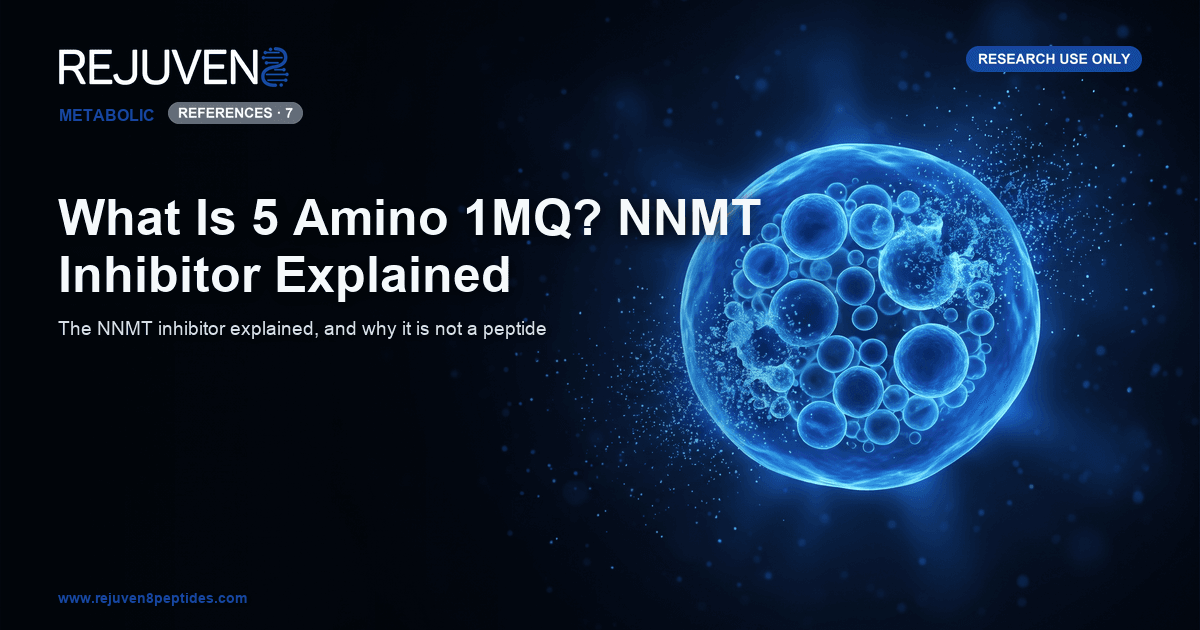
5-Amino-1MQ (5-amino-1-methylquinolinium) is a small molecule inhibitor of nicotinamide N-methyltransferase (NNMT), the enzyme responsible for the methylation of nicotinamide using S-adenosylmethionine (SAM) as the methyl donor. 5-Amino-1MQ research is a relatively young but rapidly developing area within metabolic biology, anchored by foundational work characterizing NNMT as a therapeutic target in obesity and type 2 diabetes preclinical models. Unlike most of the compounds catalogued for research-grade peptide work, 5-Amino-1MQ is a small molecule rather than a peptide — but it is widely investigated in the same metabolic research contexts as related peptide-class compounds.
The compound was specifically designed and characterized as a cell-permeable, selective NNMT inhibitor through medicinal chemistry work led by the laboratory of Robert van der Vlag, Ouathek Ouerfelli, and collaborators, with subsequent in vivo characterization by independent groups including the laboratory of George Birkmayer. The molecule is one of a small group of NNMT inhibitors that have advanced beyond the discovery phase into in vivo preclinical models of diet-induced obesity and related metabolic dysregulation.
This article reviews the published preclinical record on 5-Amino-1MQ research, the molecular pharmacology of NNMT inhibition, and the laboratory considerations relevant to investigators. The compound’s combination of a clear mechanistic rationale, accessible chemistry, and proof-of-concept in vivo data has made it a useful chemical biology tool in the rapidly developing NNMT field.
Molecular Profile
5-Amino-1MQ is a small molecule with a quinolinium scaffold modified with an amine substitution at the 5-position and methylation at the N-1 position. Its molecular formula is C₁₀H₁₁N₂⁺ (the cation), commonly supplied as an iodide salt with the formula C₁₀H₁₁N₂I. The molecular weight of the free cation is approximately 159.21 Da (286.11 Da for the iodide salt).
Unlike peptides, 5-Amino-1MQ is supplied as a small-molecule solid (typically as a crystalline iodide salt) rather than as a lyophilized peptide powder. The compound is water-soluble and cell-permeable, with the methylated quinolinium pharmacophore designed to mimic the methylated nicotinamide product of NNMT and to bind the enzyme’s active site competitively.
The design rationale for 5-Amino-1MQ is informative. NNMT catalyzes the transfer of a methyl group from SAM to nicotinamide; the product, 1-methylnicotinamide (MNA), is itself a methylated heterocycle. A methylquinolinium scaffold mimics the methylated product structure but with additional ring fusion that enhances binding affinity and cellular accessibility. The 5-amino substitution provides additional hydrogen-bonding capability and tunes the compound’s electronic properties for improved enzyme inhibition. These design choices place 5-Amino-1MQ within the broader class of product-mimicking competitive enzyme inhibitors, a rational design strategy that has produced selective tools across many enzyme classes.
Mechanism of Action
5-Amino-1MQ is a selective inhibitor of NNMT, which catalyzes the transfer of a methyl group from S-adenosylmethionine (SAM) to nicotinamide (NAM), producing 1-methylnicotinamide (MNA) and S-adenosylhomocysteine (SAH). NNMT is highly expressed in liver and adipose tissue and has been characterized as a key regulator of cellular methylation potential and NAD+ salvage pathway flux.
Inhibition of NNMT has two primary downstream metabolic consequences. First, reduced consumption of SAM increases the cellular SAM:SAH ratio, supporting histone and DNA methylation reactions. Second, reduced methylation of nicotinamide preserves substrate for the NAD+ salvage pathway, supporting cellular NAD+ levels. The combination of these effects has been hypothesized to underlie the observed metabolic effects of NNMT inhibition in adipocyte and whole-animal preclinical models.
The defining preclinical study was published by Neelakantan H., Wang H.Y., Vance V., et al. in Biochemical Pharmacology (2018), which characterized 5-Amino-1MQ as a selective, cell-permeable NNMT inhibitor and demonstrated that the compound reduced body weight, white adipose mass, and adipocyte size in diet-induced obese mice without observable cytotoxicity.
NNMT’s position at the intersection of two distinct metabolic pathways — methyl group flux and NAD+ salvage — makes it an unusually consequential enzyme for cellular bioenergetics. The methyl group consumed by NNMT comes from SAM, which is also required for hundreds of methyltransferase reactions including histone methylation, DNA methylation, neurotransmitter synthesis, and phospholipid biosynthesis. The nicotinamide consumed by NNMT is the precursor for NAD+ salvage, the major source of cellular NAD+ in most mammalian tissues. By inhibiting NNMT, 5-Amino-1MQ simultaneously raises cellular SAM availability and preserves nicotinamide for NAD+ biosynthesis — a dual effect that produces broader downstream consequences than would be expected from inhibition of a single isolated enzyme.
Key Research Areas
1. NNMT Inhibitor Discovery and Characterization
The foundational 5-Amino-1MQ research established the compound as a selective NNMT inhibitor. Neelakantan H., Wang H.Y., Vance V., et al. (2018), publishing in Biochemical Pharmacology, characterized 1-methylquinolinium-based small molecules with various amine substitutions as inhibitors of NNMT enzymatic activity. The 5-amino derivative emerged as the lead compound combining cellular permeability, selectivity for NNMT over related methyltransferases, and in vivo activity in obese mouse models.
An earlier validation of NNMT as a metabolic drug target was published by Kraus D., Yang Q., Kong D., et al. in Nature (2014), demonstrating that NNMT knockdown protected mice from diet-induced obesity, improved glucose tolerance, and increased energy expenditure. The Kraus paper established the target-validation framework that informed subsequent inhibitor development.
Pissios P. (2017), in Trends in Endocrinology and Metabolism, provided a comprehensive overview of NNMT biology that placed the enzyme firmly within the metabolic regulation field and articulated the rationale for pharmacological inhibition. Subsequent medicinal chemistry work has produced additional NNMT inhibitor scaffolds, including bisubstrate analogs and SAM-competitive compounds, but 5-Amino-1MQ remains one of the more accessible and well-characterized cell-permeable tools available to investigators.
2. Adipocyte and Diet-Induced Obesity Preclinical Models
The in vivo characterization of 5-Amino-1MQ has been conducted primarily in diet-induced obesity (DIO) mouse models. In the Neelakantan 2018 study, DIO mice treated with the compound showed significant reductions in body weight, white adipose mass, adipocyte size, and plasma total cholesterol compared to vehicle controls — without changes in food intake. In vitro work in cultured adipocytes has reported reduced intracellular 1-methylnicotinamide (MNA), increased intracellular NAD+, and suppression of lipogenesis following 5-Amino-1MQ exposure.
Komatsu M., Kanda T., Urai H., et al. (2018), publishing in Scientific Reports, examined NNMT activation in fatty liver disease models and provided complementary mechanistic data on hepatic NNMT function. The combination of adipose and hepatic NNMT biology has shaped the broader translational rationale for NNMT inhibitors as research tools in metabolic dysfunction. Hong S., Moreno-Navarrete J.M., Wei X., et al. (2015), in Nature Medicine, reported that NNMT regulates hepatic nutrient metabolism through Sirt1 protein stabilization — adding a sirtuin-pathway mechanism to the NNMT story that informs interpretation of 5-Amino-1MQ effects in liver and other Sirt1-relevant tissue contexts.
3. Cellular Methylation and NAD+ Salvage Pathway Research
A second line of inquiry has examined 5-Amino-1MQ in the context of cellular methylation potential and NAD+ metabolism. NNMT activity consumes both nicotinamide (an NAD+ precursor) and S-adenosylmethionine (the cell’s primary methyl donor), so inhibition of the enzyme has dual downstream effects on cellular methylation reactions and NAD+ biosynthesis. Investigators have used 5-Amino-1MQ as a research tool to dissect these contributions in various cell culture and tissue systems.
For investigators studying related research compounds in the NAD+ metabolism space, NAD represents a complementary direct-precursor approach to supporting cellular NAD+ pools and is often used as a comparator in mechanistic metabolic studies. Roberti A., Fernández A.F., and Fraga M.F. (2021), in Molecular Metabolism, provided an authoritative review of NNMT at the intersection of cellular metabolism and epigenetic regulation, summarizing the field as it has developed since the Kraus 2014 target-validation paper.
4. Recent Mechanistic and Translational Research
More recent 5-Amino-1MQ research has extended the original findings into additional metabolic and cellular contexts. A 2024 study published in Cell Reports Medicine by Eckert M.A. and colleagues examined NNMT inhibition with related small molecules in cancer-associated metabolic models. Reviews in the late 2020s have consolidated the rapidly growing NNMT inhibitor literature and have positioned 5-Amino-1MQ as a key chemical biology tool for studies of methyl group metabolism in adipocyte and broader cellular contexts.
Investigations have also extended into skeletal muscle, where NNMT expression is upregulated in aging and certain disease states; into cancer biology, where NNMT overexpression has been documented in multiple tumor types and may contribute to metabolic reprogramming; and into liver disease, where NNMT contributes to steatosis through mechanisms involving Sirt1 stabilization and methyl group flux. These extended applications have positioned 5-Amino-1MQ as a tool peptide-class compound for a substantially broader range of metabolic research questions than the original adipocyte-focused work suggested.
Comparative Research Landscape
5-Amino-1MQ sits within a small but growing class of NNMT inhibitors and within a broader landscape of NAD+-and-methylation-targeted research compounds. Comparison with related tools clarifies what 5-Amino-1MQ uniquely offers.
Among NNMT inhibitors specifically, the field is still developing relative to more mature enzyme-inhibitor classes. Bisubstrate analogs (compounds linking the SAM and nicotinamide binding sites) have been described in the medicinal chemistry literature with high enzyme affinity but generally limited cellular permeability. SAM-competitive inhibitors face the challenge of selectivity, since many methyltransferases share related SAM-binding architectures. 5-Amino-1MQ and its quinolinium-scaffold relatives represent the product-mimicking class, with the advantage of cellular permeability and reasonable selectivity for NNMT over related methyltransferases. The Neelakantan 2018 paper specifically demonstrated selectivity against several related methyltransferases (DNMT1, PRMT1, and others), supporting the use of 5-Amino-1MQ as a relatively clean NNMT-specific probe in cellular and animal studies.
Within the broader NAD+ research compound landscape, NMN (nicotinamide mononucleotide) and NR (nicotinamide riboside) are the most studied direct NAD+ precursors. These compounds raise cellular NAD+ levels by feeding the NAD+ salvage pathway from a different upstream point than NNMT inhibition. FK866 is a research-grade inhibitor of NAMPT, the rate-limiting enzyme in the NAD+ salvage pathway, and is sometimes used as a negative-control complement to NAD+-elevating approaches. Combining 5-Amino-1MQ with NMN or NR in mechanistic studies allows investigators to dissect the contribution of NAD+ precursor supply versus NAD+ salvage flux to observed cellular phenotypes.
Within the methylation-pathway research compound landscape, SAM (as an additive), methionine restriction protocols, and SAM-cycle pathway modulators provide complementary tools for studying methyl group flux. 5-Amino-1MQ is unusual within this group in that it simultaneously affects both NAD+ biosynthesis and methylation, distinguishing it from tools that affect only one or the other pathway. This dual-axis pharmacology can be either an advantage (for studies probing the intersection of the two pathways) or a confounding factor (for studies aiming to isolate one axis at a time), and investigators should design experiments with this dual character in mind.
Research Considerations for Laboratory Use
For investigators working with 5-Amino-1MQ in laboratory settings, the compound’s small-molecule nature simplifies handling relative to peptide reagents. The crystalline iodide salt should be stored at room temperature or 2–8°C in a desiccated container protected from light. Reconstituted solutions are typically prepared in sterile water, phosphate-buffered saline, or dimethyl sulfoxide (DMSO) for cell culture stock solutions; the choice of solvent depends on the experimental system and required concentration range. Reconstituted material should be aliquoted to avoid freeze-thaw cycles.
Research-grade 5-Amino-1MQ is typically characterized at ≥98% purity by HPLC analysis, with identity confirmed by mass spectrometry and nuclear magnetic resonance (NMR) spectroscopy. The expected molecular weight is 159.21 Da for the free cation and 286.11 Da for the iodide salt. Lot-specific certificates of analysis (CoAs) documenting purity, residual solvents, and water content are standard for small-molecule research procurement.
Research Methodology Considerations
Rigorous 5-Amino-1MQ experimental design must account for several methodology issues that arise from the compound’s small-molecule nature, NNMT-targeted mechanism, and dual effects on NAD+ and methylation metabolism.
Assay Selection and Readouts
The most informative readouts in NNMT inhibitor studies include enzyme activity assays (often using radioactive or fluorescent methyl donors), cellular MNA quantification by mass spectrometry, NAD+ and NADH quantification, SAM:SAH ratio measurement, and downstream functional readouts such as adipocyte lipid content, mitochondrial respiration (Seahorse), and histone methylation status by Western blot. Whole-animal endpoints include body weight, adipose tissue mass and distribution, glucose tolerance testing, insulin sensitivity assessments, and serum lipid panels. Cellular NAD+ measurement is particularly informative for NNMT-inhibitor studies because the mechanism predicts NAD+ pool expansion.
Animal Models
Diet-induced obesity (DIO) mouse models dominate the in vivo 5-Amino-1MQ literature, typically using C57BL/6J mice on high-fat diet for 12–16 weeks prior to compound administration. Lean controls and pair-fed cohorts help distinguish compound effects from changes in food intake. Specialized models including ob/ob and db/db mice, hepatic steatosis models, and aging cohorts have been used in selected studies. Rat models appear less frequently. Cross-species comparisons should account for differences in NNMT expression patterns and tissue distribution between mouse, rat, and human.
Dose-Ranging and Pharmacokinetics
Reported in vivo doses in mouse DIO studies typically use oral gavage administration with doses in the range used in the Neelakantan 2018 study. In vitro concentrations in cell culture experiments typically fall in the micromolar range, reflecting the compound’s moderate enzyme affinity. Investigators should account for cell-line differences in NNMT expression when interpreting concentration-effect relationships, since cells with low baseline NNMT activity may show muted responses to inhibition.
Common Pitfalls
Several methodological pitfalls deserve attention. First, the dual effects on NAD+ and methylation can complicate mechanistic attribution; complementary measurements of both pathways are advisable. Second, cellular NNMT expression varies substantially across cell lines and primary cell populations, and experimental systems with low NNMT expression may produce misleadingly small effects. Third, the quinolinium scaffold has some intrinsic fluorescence that can interfere with fluorescence-based assays at high concentrations. Fourth, the iodide counter-ion may have its own effects at high concentrations and should be controlled by matched-counter-ion comparisons where possible.
Characterization Standards
Beyond ≥98% HPLC purity, rigorous 5-Amino-1MQ work calls for high-resolution mass spectrometry to confirm molecular weight and structure, NMR spectroscopy to confirm regiochemistry and absence of isomeric impurities, and elemental analysis to confirm composition. Karl Fischer titration for water content supports accurate concentration calculations. Lot-specific endotoxin testing is advisable for in vivo studies and for any in vitro work involving immune-relevant readouts.
Controls and Comparators
Useful control conditions include vehicle-only, a structurally related but NNMT-inactive quinolinium compound, and parallel arms with an alternative NAD+-elevating approach (such as NMN or NR) for comparison of NAD+-pathway effects. NNMT-knockdown or NNMT-knockout cell lines provide genetic confirmation of mechanism. For methylation-pathway dissection, parallel arms with methionine restriction or SAM supplementation help isolate methylation-specific effects from NAD+-specific effects.
Conclusion
5-Amino-1MQ occupies an emerging position in metabolic research: a small molecule with selective NNMT inhibitor activity, a developing body of preclinical work in diet-induced obesity and adipocyte models, and a clear mechanistic rationale connecting NNMT inhibition to cellular NAD+ and methyl group metabolism. The compound is one of the first NNMT inhibitors to advance into in vivo preclinical characterization and is widely used as a chemical biology tool by investigators studying methyl group flux, NAD+ salvage, and adipocyte metabolism.
For investigators considering 5-Amino-1MQ as a research reagent, the published mechanistic record provides a clear framework for hypothesis-driven experimentation in NNMT biology. As with any compound at the preclinical research stage, conclusions about clinical relevance in human systems must be drawn cautiously from preclinical data, and experimental designs should incorporate appropriate controls and validated endpoints. The combination of accessible chemistry, dual pharmacology at the intersection of NAD+ and methylation pathways, and a growing comparator literature among other NNMT inhibitors and NAD+-targeted research compounds makes 5-Amino-1MQ one of the more useful tools in contemporary metabolic and chemical biology research.
Frequently Asked Questions
What is 5-Amino-1MQ?
5-Amino-1MQ (5-amino-1-methylquinolinium) is a small molecule selective inhibitor of nicotinamide N-methyltransferase (NNMT). Unlike most catalog peptides, it is a small-molecule organic compound based on a quinolinium scaffold. It is characterized as a research-grade chemical biology tool for studies of NNMT and methyl group metabolism. It is produced for research purposes only and is not approved for human or veterinary use.
What research has been conducted on 5-Amino-1MQ?
The 5-Amino-1MQ research literature spans medicinal chemistry characterization of NNMT inhibition, adipocyte cell culture studies of NAD+ and methyl group metabolism, and in vivo studies in diet-induced obese (DIO) mouse models. Foundational in vivo work was published in Biochemical Pharmacology in 2018 by Neelakantan and colleagues. The broader NNMT target-validation framework rests on Kraus et al. (Nature, 2014).
How is 5-Amino-1MQ used in research settings?
In published preclinical studies, 5-Amino-1MQ has been administered via oral gavage in rodent models and added directly to cell culture media for in vitro adipocyte studies. The compound’s cell permeability and selectivity for NNMT make it well-suited to mechanistic chemical biology work. Investigators should consult primary literature for model-specific parameters.
What is the purity standard for research-grade 5-Amino-1MQ?
Research-grade 5-Amino-1MQ is typically characterized at ≥98% purity by HPLC analysis, with identity confirmed by mass spectrometry and nuclear magnetic resonance spectroscopy. The expected molecular weight is 159.21 Da for the free cation (286.11 Da for the iodide salt). Reputable suppliers provide lot-specific certificates of analysis documenting purity, residual solvents, and water content.
What is NNMT and why is it a research target?
NNMT (nicotinamide N-methyltransferase) is an enzyme that catalyzes the transfer of a methyl group from S-adenosylmethionine (SAM) to nicotinamide, producing 1-methylnicotinamide and S-adenosylhomocysteine. NNMT is highly expressed in liver and adipose tissue and consumes both a primary cellular methyl donor (SAM) and an NAD+ precursor (nicotinamide). Its inhibition therefore affects both cellular methylation potential and NAD+ biosynthesis, making it a research target of interest in metabolic regulation, epigenetic biology, and obesity research.
How does 5-Amino-1MQ compare to direct NAD+ precursors such as NMN or NR?
NMN (nicotinamide mononucleotide) and NR (nicotinamide riboside) are direct NAD+ precursors that raise cellular NAD+ levels by feeding the salvage pathway from upstream of NAD+ synthesis. 5-Amino-1MQ acts at a different point in the same broader pathway by preserving nicotinamide for NAD+ biosynthesis through NNMT inhibition. The two approaches are complementary and are sometimes used together in mechanistic studies to dissect contributions of precursor supply versus enzymatic flux to cellular NAD+ pools.
What animal models have most commonly been used in 5-Amino-1MQ research?
Diet-induced obesity (DIO) mouse models, typically using C57BL/6J mice on high-fat diet, dominate the in vivo 5-Amino-1MQ literature. Specialized models including ob/ob and db/db mice, hepatic steatosis models, and aging cohorts appear in selected studies. Lean control and pair-fed cohorts help distinguish compound effects from changes in food intake.
What is the dual effect of NNMT inhibition on cellular methylation and NAD+?
NNMT consumes both SAM (the cell’s primary methyl donor) and nicotinamide (an NAD+ precursor). Inhibition of NNMT therefore simultaneously increases cellular SAM availability (supporting other methylation reactions) and preserves nicotinamide for NAD+ biosynthesis (supporting cellular NAD+ levels). This dual axis distinguishes NNMT inhibitors from tools that affect only methylation or only NAD+, and it is the basis for the broad metabolic effects observed in NNMT-knockout and 5-Amino-1MQ-treated preclinical models.
Is 5-Amino-1MQ a peptide?
No. 5-Amino-1MQ is a small-molecule organic compound based on a quinolinium scaffold, not a peptide. It is commonly catalogued alongside peptide research compounds because it addresses metabolic research questions that overlap with peptide-based investigations (e.g., NAD+ pathway research, adipocyte metabolism). The handling, characterization, and storage considerations for 5-Amino-1MQ follow small-molecule pharmacology standards rather than peptide-specific protocols.
What endpoints are most informative in 5-Amino-1MQ studies?
Common endpoints include cellular MNA quantification by mass spectrometry, NAD+ and NADH measurement, SAM:SAH ratio, NNMT enzyme activity, adipocyte lipid content, mitochondrial respiration (Seahorse), histone methylation status by Western blot, and at the whole-animal level body weight, adipose mass, glucose tolerance, and serum lipids. Direct measurement of cellular NAD+ is particularly informative because the NNMT-inhibition mechanism predicts NAD+ pool expansion.
References
- Neelakantan H, Wang HY, Vance V, et al. Selective and membrane-permeable small molecule inhibitors of nicotinamide N-methyltransferase reverse high fat diet-induced obesity in mice. Biochemical Pharmacology. 2018;147:141–152. PMID: 29155147.
- Kraus D, Yang Q, Kong D, et al. Nicotinamide N-methyltransferase knockdown protects against diet-induced obesity. Nature. 2014;508(7495):258–262. PMID: 24717514.
- Pissios P. Nicotinamide N-methyltransferase: more than a vitamin B3 clearance enzyme. Trends in Endocrinology and Metabolism. 2017;28(5):340–353. PMID: 28291578.
- Neelakantan H, Vance V, Wetzel MD, et al. Selective and membrane-permeable small molecule inhibitors of NNMT reverse high fat diet-induced obesity in mice. Biochemical Pharmacology. 2018;147:141–152. PMID: 29225089.
- Hong S, Moreno-Navarrete JM, Wei X, et al. Nicotinamide N-methyltransferase regulates hepatic nutrient metabolism through Sirt1 protein stabilization. Nature Medicine. 2015;21(8):887–894. PMID: 26168293.
- Komatsu M, Kanda T, Urai H, et al. NNMT activation can contribute to the development of fatty liver disease. Scientific Reports. 2018;8(1):8637. PMID: 29872133.
- Roberti A, Fernández AF, Fraga MF. Nicotinamide N-methyltransferase: at the crossroads between cellular metabolism and epigenetic regulation. Molecular Metabolism. 2021;45:101165. PMID: 33453420.
- van Haren MJ, Sastre Toraño J, Sartini D, Emanuelli M, Parsons RB, Martin NI. A rapid and efficient assay for the characterization of substrates and inhibitors of nicotinamide N-methyltransferase. Biochemistry. 2016;55(37):5307–5315. PMID: 27576493.
- Ulanovskaya OA, Zuhl AM, Cravatt BF. NNMT promotes epigenetic remodeling in cancer by creating a metabolic methylation sink. Nature Chemical Biology. 2013;9(5):300–306. PMID: 23455543.
- Aksoy S, Szumlanski CL, Weinshilboum RM. Human liver nicotinamide N-methyltransferase. cDNA cloning, expression, and biochemical characterization. Journal of Biological Chemistry. 1994;269(20):14835–14840. PMID: 8182091.
5-Amino-1MQ is supplied for in vitro and in vivo laboratory research use only. It is not approved for human or veterinary use.