Research Use Only. The information presented here is for scientific and educational purposes. These compounds are not intended for human consumption, self-administration, or therapeutic use.
Introduction
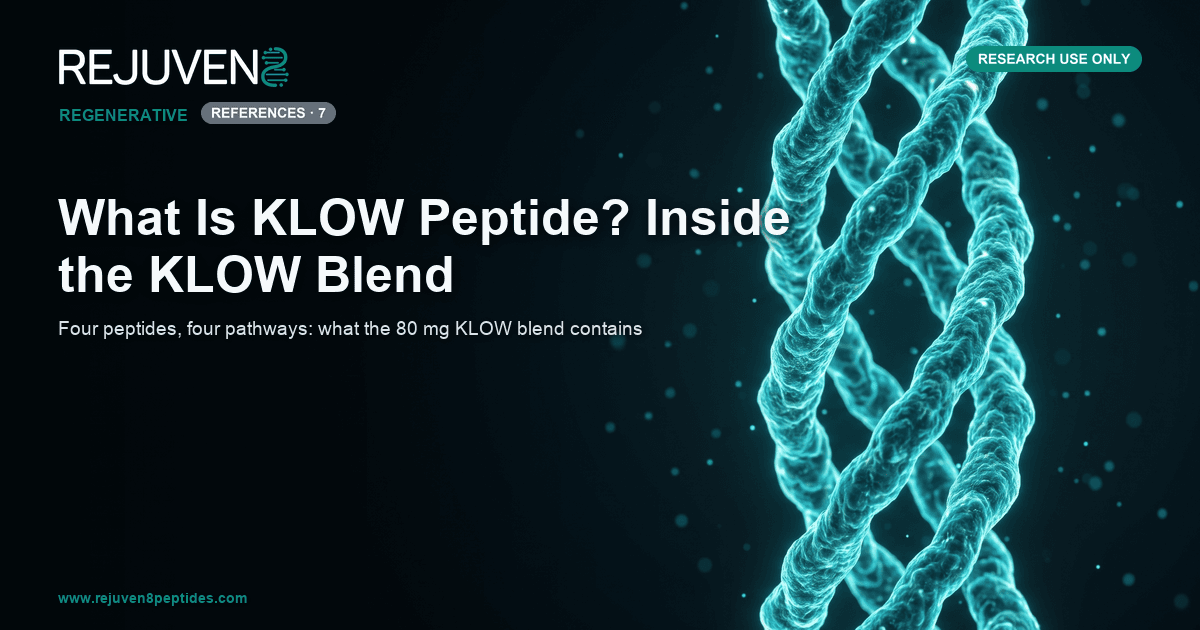
KLOW peptide is the common name for a four-component research blend that co-lyophilizes GHK-Cu, BPC-157, TB-500, and KPV in a single vial. Three of those peptides form the regenerative trio of the GLOW blend; the fourth, KPV, is a tripeptide fragment of alpha-melanocyte-stimulating hormone (alpha-MSH) investigated for anti-inflammatory signaling. The blend is often listed as KLOW80, a reference to the 80 mg of total peptide in the vial, and the “K” in the name refers to the KPV component that distinguishes it from GLOW.
Interest in the klow peptide blend has grown because it groups four separately characterized mechanisms, matrix remodeling, angiogenic signaling, actin-dependent cell migration, and inflammatory modulation, into one preparation for tissue-repair models. This article explains what KLOW is, what each component is studied for in preclinical work, how the four pathways map onto the phases of tissue repair, and how the blend is handled and verified. The material is supplied for research use only, not for human consumption.
What Is KLOW Peptide? Composition of the 80 mg Blend
The Four Components at a Glance
The KLOW Blend 80mg supplied by Rejuven8 contains 50 mg of GHK-Cu together with 10 mg each of BPC-157, TB-500, and KPV. The values below reflect commonly reported laboratory attributes and are provided for comparison only.
| Component | Class | Sequence length | Approx. molecular weight | Mass per 80 mg vial | Studied focus |
|---|---|---|---|---|---|
| GHK-Cu | Copper-binding tripeptide complex | 3 amino acids | ~340 Da peptide, ~404 Da complex | 50 mg | Matrix remodeling, collagen gene expression |
| BPC-157 | Synthetic pentadecapeptide | 15 amino acids | ~1419 Da | 10 mg | Angiogenic signaling, cytoprotection |
| TB-500 | Synthetic thymosin beta-4-derived peptide | Built around the LKKTETQ motif of the 43-residue parent (see lot COA) | Parent Tb4 ~4963 Da (supplied mass per lot COA) | 10 mg | Actin sequestration, cell migration |
| KPV | alpha-MSH C-terminal tripeptide | 3 amino acids | ~342 Da | 10 mg | Anti-inflammatory signaling |
Because the four peptides are co-lyophilized at a fixed mass ratio, the composition is a property of the lot. A lot-specific certificate of analysis should report the identity and purity of each component; the guide to reading a peptide COA explains how to check a multi-component chromatogram against the stated composition.
The Regenerative Trio: GHK-Cu, BPC-157, and TB-500
GHK-Cu and Extracellular Matrix Remodeling
GHK-Cu (glycyl-L-histidyl-L-lysine complexed with copper) was first identified in human plasma by Loren Pickart in the early 1970s. Fibroblast culture studies from the late 1980s reported that the complex stimulates collagen synthesis, and later work described increased matrix metalloproteinase-2 expression and modulation of decorin production. Gene-expression profiling has since associated GHK with changes in thousands of genes connected to tissue remodeling, antioxidant defense, and inflammatory tone. Rejuven8 supplies GHK-Cu as a standalone research peptide.
BPC-157 and Angiogenic Signaling
BPC-157 is a stable fifteen-residue peptide derived from a partial sequence of a protective protein in gastric juice. In endothelial culture and rodent injury models it has been studied for activation of the VEGFR2-Akt-eNOS pathway, interactions with the nitric oxide system, and a broad cytoprotective profile described most extensively by the Sikiric group in Zagreb. A 2025 systematic review of the orthopaedic sports-medicine literature catalogued roughly three dozen studies, mostly tendon, ligament, muscle, and mechanistic models, and characterized the peptide’s activity as pleiotropic across VEGF, FAK-paxillin, nitric oxide synthase, and MAPK signaling. Standalone BPC-157 is also available.
TB-500 and Actin-Dependent Migration
TB-500 is a synthetic fragment of thymosin beta-4 built around the LKKTETQ motif (residues 17 to 23 of the parent protein), the region that short-peptide mapping studies identified as carrying the actin-binding activity. Thymosin beta-4 sequesters monomeric G-actin and so regulates the pool of polymerization-ready actin at the leading edge of a migrating cell. Preclinical work has examined the parent peptide and its fragments in keratinocyte, fibroblast, and endothelial migration assays and in dermal wound models. TB-500 is also stocked separately.
KPV: The Component That Sets KLOW Apart from GLOW
A Fragment of alpha-MSH Without Pigmentary Signaling
KPV (lysine-proline-valine) corresponds to residues 11 to 13 of alpha-MSH. It is the minimal C-terminal sequence reported to retain the anti-inflammatory activity of the parent hormone while lacking the melanocortin-1 receptor engagement that produces pigmentary effects. That separation is why KPV, rather than full-length alpha-MSH, serves as the blend’s anti-inflammatory component: it adds an inflammation-focused arm without introducing pigmentation as a confound.
PepT1 Transport and NF-kB Modulation
The mechanistic literature on KPV centers on two observations. First, the tripeptide is a substrate for PepT1, the di- and tripeptide transporter on intestinal epithelial cells and on immune cells in inflamed tissue, which carries KPV into the cell rather than acting through a surface receptor. Second, inside the cell KPV has been reported to suppress NF-kB activation and MAP kinase signaling, reducing pro-inflammatory cytokines such as TNF-alpha and IL-1beta. The Merlin laboratory at Emory described these effects in murine colitis models in the late 2000s, and later studies delivered KPV through hyaluronic-acid nanoparticles and colon-targeted hydrogels in the same models.
Recent Tripeptide Research
A 2025 review in the International Journal of Medical Sciences surveyed tripeptides in wound and skin regeneration models and discussed both GHK-Cu and KPV. It summarized reports that KPV loaded into mucoadhesive hydrogels lowered IL-1beta and TNF-alpha while raising IL-10 in infected wound models, and that GHK-Cu suppresses NF-kB p65 and p38 MAPK signaling alongside its collagen and elastin effects. For KLOW research, the practical point is that GHK-Cu and KPV share an anti-inflammatory signaling node despite sitting in different arms.
How the Four Pathways Are Studied Together
Mapping Components onto Repair Phases
Tissue repair in animal models proceeds through overlapping inflammatory, proliferative, and remodeling phases, and each KLOW component is associated with a different one. The mapping below reflects commonly reported laboratory attributes and is provided for comparison only.
| Repair phase or process | KLOW component | Studied pathway | Present in GLOW? |
|---|---|---|---|
| Inflammatory tone | KPV | NF-kB and MAPK suppression via PepT1 uptake | No |
| Vascular supply | BPC-157 | VEGFR2-Akt-eNOS, nitric oxide | Yes |
| Cell migration | TB-500 | G-actin sequestration, integrin-linked kinase | Yes |
| Matrix remodeling | GHK-Cu | Collagen, MMP-2, decorin gene expression | Yes |
Seen this way, the GLOW blend covers the vascular, migratory, and matrix arms, and KLOW adds the inflammatory arm. A laboratory studying inflammatory tone in a repair model selects KLOW; one holding inflammation out of the variable set selects GLOW.
Designing Combination Experiments in Models
Direct controlled studies of the exact four-peptide combination remain sparse in the peer-reviewed literature, so the case for the blend rests on the complementarity of individually characterized mechanisms. Investigators studying the combination in cell culture or rodent injury models usually include a vehicle arm and single-peptide arms alongside the full blend, since a complete 16-condition factorial design is rarely practical. Because the mass ratio is fixed, per-component concentrations covary whenever the total changes.
Laboratory Handling and Verification
Storage and Reconstitution Notes
The lyophilized blend is stored cold (2 to 8 C), dry, and protected from light. Light protection matters more for KLOW than for many single peptides because the GHK-Cu copper complex is light-sensitive and can lose its blue-violet color as the coordination changes. After reconstitution in bacteriostatic water the solution is refrigerated, with a supplier-indicated working window of about 20 days and no repeated freeze-thaw. As a worked example, dissolving the full 80 mg vial in 4 mL yields 20 mg/mL of total peptide: 12.5 mg/mL GHK-Cu and 2.5 mg/mL each of BPC-157, TB-500, and KPV. The reconstitution chemistry guide covers the general chemistry.
Analytical Verification of a Four-Peptide Blend
Verifying a blend is more demanding than verifying a single peptide. Reversed-phase HPLC must resolve four components of very different hydrophobicity: KPV is small and hydrophilic and elutes early, GHK-Cu behaves as a metal complex, and the BPC-157 and TB-500 peaks fall later in the gradient. Mass spectrometry confirms each peak’s identity, so a useful KLOW certificate reports per-component purity rather than one aggregate number.
Frequently Asked Questions
What is KLOW peptide?
KLOW peptide is a four-component research blend that combines GHK-Cu, BPC-157, TB-500, and KPV in one lyophilized vial. The first three are the regenerative peptides of the GLOW blend; KPV is an alpha-MSH tripeptide fragment investigated for anti-inflammatory signaling in preclinical tissue-repair models.
What peptides are in the KLOW blend and in what amounts?
The 80 mg KLOW blend contains 50 mg of GHK-Cu and 10 mg each of BPC-157, TB-500, and KPV. The ratio is fixed during co-lyophilization and should be confirmed on the lot-specific certificate of analysis.
What does KLOW80 mean?
KLOW80 refers to the 80 mg total peptide mass in the vial; the number simply identifies the vial size of the same four-peptide blend.
How is KLOW different from GLOW?
GLOW is a three-peptide blend of GHK-Cu, BPC-157, and TB-500. KLOW contains those same three peptides plus KPV, which adds an anti-inflammatory signaling arm not present in GLOW.
What is KPV studied for?
KPV is investigated in cell culture and rodent models for suppression of NF-kB and MAP kinase signaling and reduced pro-inflammatory cytokine expression. It enters cells through the PepT1 transporter and retains the anti-inflammatory activity of alpha-MSH without its pigmentary effects.
Is the KLOW blend intended for human use?
No. KLOW is a research compound supplied for laboratory investigation only. It is not intended for human consumption, self-administration, or therapeutic use; the studies described here were performed in vitro or in animal models.
References and Further Reading
- Merlin laboratory (Emory) studies of PepT1-mediated KPV uptake in murine colitis models. PubMed: KPV PepT1 intestinal inflammation
- Catania and colleagues on the melanocortin system and alpha-MSH-derived peptides in inflammation. PubMed: melanocortin system inflammation alpha-MSH tripeptide
- Adnan and colleagues, International Journal of Medical Sciences, 2025: tripeptides in wound and skin regeneration models. PubMed: tripeptides wound healing skin regeneration review
- Pickart and Margolina on GHK-Cu gene-expression data and regenerative actions in cell models. PubMed: GHK-Cu gene expression regenerative
- Hsieh and colleagues, 2017, on BPC-157 and VEGFR2 activation. PubMed: BPC 157 VEGFR2 angiogenesis
- Vasireddi and colleagues, 2025, systematic review of BPC-157 in orthopaedic sports-medicine research. PubMed: BPC-157 orthopaedic sports medicine systematic review
- Goldstein and colleagues on thymosin beta-4 and its actin-binding LKKTETQ region. PubMed: thymosin beta 4 actin binding LKKTETQ