Research Use Only. The information presented here is for scientific and educational purposes. These compounds are not intended for human consumption, self-administration, or therapeutic use.
Introduction
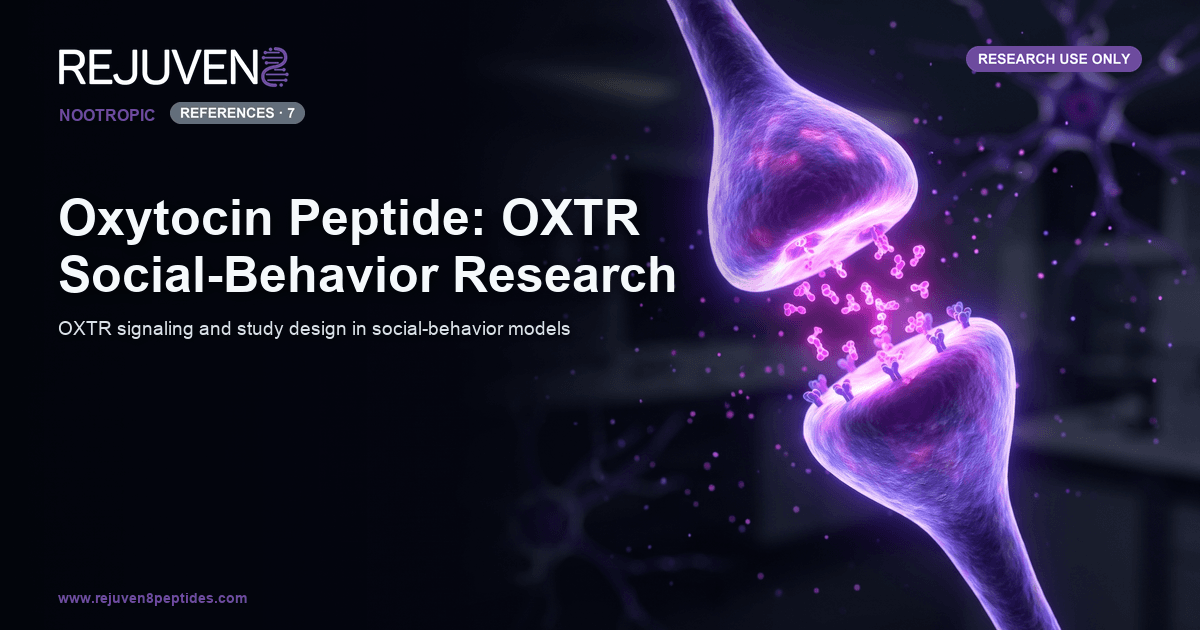
Few molecules are as closely tied to the neuroscience of social behavior as the oxytocin peptide. Across rodents, voles, and even fish, the nine-amino-acid hormone and its receptor, OXTR, are studied for their role in social recognition, affiliation, pair bonding, and parental care. That breadth makes oxytocin a workhorse of behavioral neuroscience, but it also makes experiments with it easy to misdesign: OXTR distribution varies by species, the receptor shares chemistry with the vasopressin system, and social readouts are sensitive to context. This article focuses less on rehearsing the receptor cascade and more on how social-behavior studies with oxytocin are actually built and interpreted.
It surveys the model systems in which OXTR signaling is characterized, the design decisions that separate a clean experiment from a confounded one, and the 2025 to 2026 literature that continues to refine both. Everything here concerns preclinical and in-vitro research and is provided for research use only, not for human consumption; the behavioral findings described come from laboratory animals rather than people.
The Oxytocin Peptide and Its Receptor
The oxytocin peptide is a cyclic nonapeptide synthesized in the hypothalamus and acting through a single cognate receptor. Its compact structure and its close relationship to vasopressin are the two facts that most shape experimental design, so they are worth stating precisely. These values reflect commonly reported laboratory attributes and are provided for comparison only.
| Attribute | Reported value |
|---|---|
| Peptide class | Cyclic nonapeptide (9 residues) |
| Amino-acid sequence | Cys-Tyr-Ile-Gln-Asn-Cys-Pro-Leu-Gly-NH2 |
| Approx. molecular weight | ~1007 Da |
| Key structural feature | Disulfide bridge (Cys1 to Cys6) |
| Cognate receptor | OXTR, a class A (rhodopsin-like) GPCR |
| Primary G-protein coupling | Gq/11, engaging phospholipase C and calcium signaling |
| Closest relative | Vasopressin (differs at residues 3 and 8) |
Two features carry directly into study design. First, OXTR is a Gq/11-coupled GPCR whose activation raises intracellular calcium, the basis for the cell-level assays used to confirm receptor engagement. Second, oxytocin differs from vasopressin by only two residues, so cross-reactivity at vasopressin V1a receptors is a constant consideration rather than an afterthought. The single-peptide reference material is stocked as Oxytocin for this line of work.
Core Social-Behavior Research Models
Oxytocin research is organized around a handful of well-validated behavioral paradigms, each probing a different facet of social function.
Social recognition and memory
The most established rodent model tests whether an animal remembers a previously encountered conspecific. Oxytocin and receptor knockout mice show impaired social recognition, a phenotype used to establish OXTR as necessary for normal social memory. A 2025 study by Hidema and colleagues used social recognition testing in oxytocin and receptor knockout mice to dissect these requirements further.
Pair bonding and social selectivity
The prairie vole, unusually monogamous among rodents, is the classic system for studying affiliation. Partner-preference assays measure selective bonding, and OXTR distribution in reward-related brain regions is central to the interpretation. Black and colleagues (Current Biology, 2025) reported that OXTR mediate social selectivity in prairie vole peer relationships, extending the model beyond mating pairs to peer bonds.
Parental behavior and cross-species work
Maternal and parental care is a third pillar. Zelmanoff and colleagues (Science, 2025) reported that oxytocin signaling regulates maternally directed behavior during early life, while Kareklas and colleagues (Biology Letters, 2025) described an evolutionarily conserved role for oxytocin in zebrafish social reward, illustrating how the system is now probed across vertebrate models, not rodents alone.
Designing an OXTR Social-Behavior Study
Because the readouts are behavioral and the receptor biology is species-specific, several design choices determine whether a result is interpretable.
Species and OXTR mapping
OXTR expression patterns differ markedly between species and even between strains, and the same peptide can produce different behavior depending on where the receptor is expressed. Mapping OXTR distribution in the model of interest, by autoradiography or receptor-reporter lines, is a prerequisite for interpreting a behavioral effect rather than an optional add-on.
Central versus peripheral engagement
The oxytocin peptide crosses the blood-brain barrier poorly, so whether it is applied centrally or peripherally is a variable that changes which receptor populations are engaged. Distinguishing central from peripheral contributions is a core design question, and studies increasingly use circuit-specific tools to localize the signal rather than inferring it from a whole-animal readout.
Genetic and pharmacological tools
Knockout and conditional-knockout lines establish necessity; selective agonists and antagonists probe sufficiency and receptor identity. The strongest designs pair a behavioral manipulation with a molecular confirmation of receptor engagement, so that a change in social behavior can be attributed to OXTR specifically.
Selectivity, Species, and Confounds
The recurring threat to oxytocin social-behavior work is attribution: is an observed effect really OXTR-mediated? Three confounds dominate. The first is vasopressin cross-talk: because oxytocin and vasopressin differ by two residues and their receptors overlap in pharmacology, apparent oxytocin effects can run partly through V1a receptors unless selective ligands and controls are included. The second is species and strain variation in OXTR distribution, which limits how far a finding in one model generalizes. The third is behavioral context: alertness, stress, and prior social experience all modulate social readouts, so vehicle controls and standardized testing conditions are essential. Recent work, including 2025 studies dissecting distinct oxytocin signaling pathways in mice, underscores that a single behavior can be supported by more than one circuit, which is why converging genetic and pharmacological evidence is the standard for a strong claim. Verified peptide identity is the quiet prerequisite behind all of this, since an ambiguous or impure reference material undermines any behavioral attribution.
Handling and Quality Considerations
Oxytocin is a disulfide-bridged peptide, and that bridge is the feature most relevant to handling: oxidation or disulfide scrambling changes the molecule, so cold storage, light protection, and minimal freeze-thaw matter for reproducible behavioral work. It ships as a lyophilized powder and is reconstituted with bacteriostatic water for laboratory use. For a peptide whose experiments hinge on receptor selectivity, identity confirmation by mass spectrometry and purity by HPLC is not a formality: an impurity or a truncated sequence can shift receptor pharmacology and confound a social-behavior result. Reviewing a lot-specific certificate of analysis, with the help of the COA and purity guide, confirms the ~1007 Da nonapeptide before any assay; Rejuven8 publishes its certificates of analysis lot by lot, and general cold-chain practice is covered in the storage and handling guide. Handled and documented this way, the oxytocin peptide remains a reliable tool for OXTR social-behavior research within the broader neuro-focused research catalog, strictly for laboratory investigation.
Frequently Asked Questions
What is the oxytocin peptide?
The oxytocin peptide is a cyclic nonapeptide (nine amino acids, about 1007 Da) made in the hypothalamus and acting through the oxytocin receptor OXTR, a class A GPCR. In research it is studied as a signaling molecule in the neurobiology of social behavior, and it is supplied as a laboratory reference compound only.
How is oxytocin studied in social-behavior models?
Through validated paradigms in laboratory animals: social recognition and memory tests in rodents, partner-preference assays in prairie voles, parental-behavior assays, and, increasingly, social-reward tasks in species such as zebrafish. These models link OXTR signaling to specific facets of social function under controlled conditions.
Why does vasopressin matter in oxytocin research?
Oxytocin and vasopressin differ by only two amino acids, and their receptors overlap in pharmacology. As a result, an apparent oxytocin effect can partly involve vasopressin V1a receptors. Including selective ligands and appropriate controls is how researchers attribute a behavioral effect specifically to OXTR.
What makes an OXTR social-behavior study well designed?
Mapping OXTR distribution in the chosen species, distinguishing central from peripheral engagement, pairing behavioral manipulations with molecular confirmation of receptor engagement, and controlling for context such as stress and prior social experience. Converging genetic and pharmacological evidence is the standard for a strong claim.
Why is OXTR distribution mapped before behavioral testing?
Because OXTR expression varies by species and strain, and the same peptide can produce different behavior depending on where the receptor sits. Without a distribution map, a behavioral change cannot be confidently tied to a receptor population, which is why autoradiography or reporter lines precede interpretation.
Is oxytocin intended for human use?
No. The oxytocin discussed here is a research compound for laboratory investigation only. It is used in cell-based assays and animal models of OXTR signaling and social behavior and is not intended for human consumption or self-administration.
References and Further Reading
- Zelmanoff and colleagues, Science (2025), on oxytocin signaling regulating maternally directed behavior during early life. PubMed: oxytocin maternally directed behavior 2025
- Black and colleagues, Current Biology (2025), on oxytocin receptors mediating social selectivity in prairie vole peer relationships. PubMed: oxytocin receptor prairie vole social selectivity
- Kareklas and colleagues, Biology Letters (2025), on a conserved role of oxytocin in zebrafish social reward. PubMed: oxytocin zebrafish social reward
- Hidema and colleagues (2025) on social recognition testing in oxytocin and receptor knockout mice. PubMed: oxytocin receptor knockout social recognition
- Studies dissecting distinct oxytocin signaling pathways in mouse social behavior (2025). PubMed: oxytocin signaling pathways social behavior mice
- Comparative work on oxytocin and vasopressin receptor pharmacology and cross-reactivity. PubMed: oxytocin vasopressin receptor selectivity
- Reviews of OXTR distribution and its role in the neurobiology of social behavior across species. PubMed: OXTR distribution social behavior neurobiology