Research Use Only. The information presented here is for scientific and educational purposes. These compounds are not intended for human consumption, self-administration, or therapeutic use.
Introduction
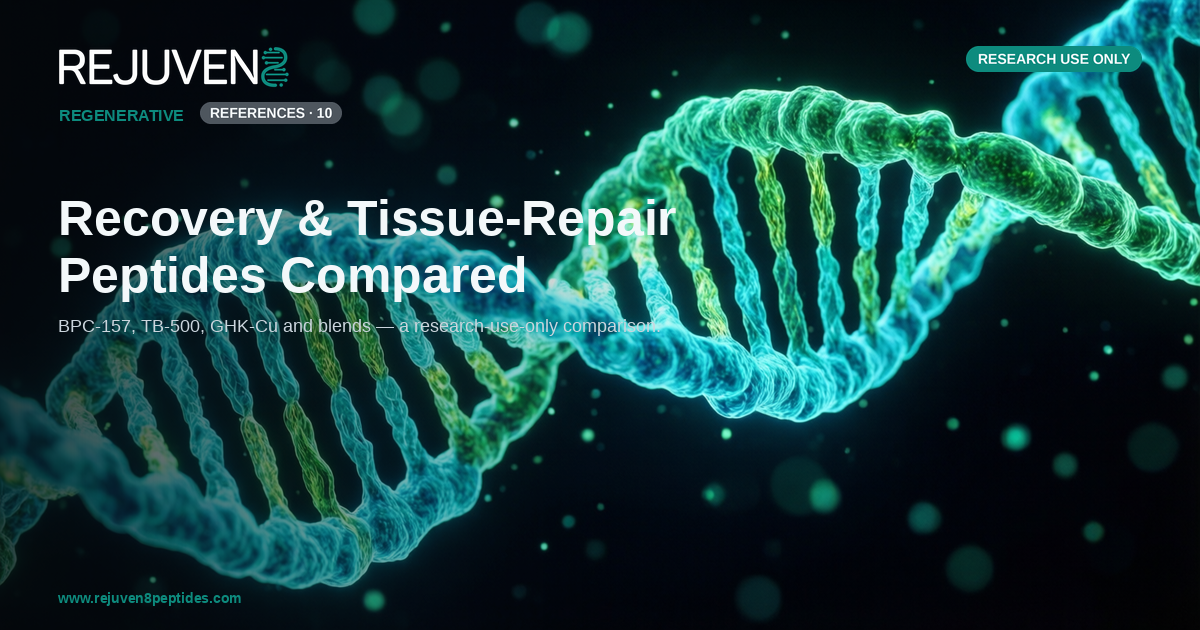
Researchers studying tissue repair, angiogenesis, and extracellular-matrix (ECM) remodeling repeatedly encounter the same small group of peptides across the preclinical literature. Three compounds — BPC-157, TB-500 (a synthetic fragment of Thymosin Beta-4), and GHK-Cu (a naturally occurring copper-binding tripeptide) — together with the blends that combine them, account for the majority of recovery-focused peptide research inquiries in 2026.
These compounds are frequently grouped together because they engage distinct but complementary nodes of the repair cascade: BPC-157 is most associated with angiogenesis and organoprotection, TB-500 with actin sequestration and cell migration, and GHK-Cu with ECM remodeling and gene expression. Understanding how they differ — by class, by studied mechanism, and by the research questions they suit — is the starting point for sound experimental design and material selection.
This overview compares the most commonly referenced recovery and tissue-repair research peptides side by side, summarizes the preclinical evidence for each, and outlines the sourcing and methodology considerations that most affect reproducibility. All material discussed is offered strictly for laboratory research use.
Compounds at a Glance
| Compound | Class | Preclinical research focus | Commonly studied models | Notes for researchers |
|---|---|---|---|---|
| BPC-157 | Synthetic pentadecapeptide | Angiogenesis (VEGFR2/NO), GI lining, connective tissue | Tendon, ligament, and GI cell/animal models | Reported stability in aqueous conditions; widely referenced |
| TB-500 | Synthetic Thymosin β4 fragment | Actin sequestration, cell migration, remodeling | Cardiac, dermal, musculoskeletal repair models | Often studied alongside BPC-157 |
| GHK-Cu | Naturally occurring Cu²⁺-binding tripeptide | Wound healing, ECM remodeling, gene expression | Skin/fibroblast and wound models | Copper complex; light- and oxidation-sensitive |
| BPC-157 + TB-500 | Two-peptide blend | Complementary angiogenic + migratory pathways | Comparative repair models | Minimal mechanistically motivated blend |
| GLOW / KLOW | Three- / four-peptide blends | Multi-pathway ECM and repair research | Dermal and fibroblast research | Add GHK-Cu (and KPV) for broader coverage |
BPC-157
BPC-157 is a synthetic 15-amino-acid peptide derived from a fragment of a gastric protein. In the preclinical literature it is most often studied in connection with angiogenesis — notably signaling through the VEGFR2–Akt–eNOS axis — alongside gastrointestinal protection and connective-tissue research in tendon and ligament models. Hsieh et al. (2017, J Mol Med) reported VEGFR2 activation and up-regulation in pro-angiogenic models, while Brcic et al. (2010, J Physiol Paris) characterized a modulatory effect on angiogenesis in muscle and tendon healing. Staresinic et al. (2003, J Orthop Res) reported accelerated healing of transected rat Achilles tendon with stimulated tendocyte growth in vitro.
In comparative work, BPC-157 typically represents the angiogenesis-associated arm of a study design, paired against a migration-associated compound such as TB-500.
Related research material: BPC-157 (research use only).
TB-500 (Thymosin Beta-4 Fragment)
TB-500 is a synthetic peptide corresponding to the actin-binding region of Thymosin Beta-4 (Tβ4), a naturally occurring protein and the major intracellular G-actin sequestering molecule in mammalian cells. By maintaining a reservoir of polymerization-ready actin, Tβ4 supports the rapid cell migration central to tissue repair. Malinda et al. (1999, J Invest Dermatol) demonstrated accelerated wound closure in full-thickness skin models, and Goldstein et al. (2012, Expert Opin Biol Ther) reviewed Tβ4’s multi-functional regenerative properties across keratinocyte, fibroblast, and endothelial migration.
Because its studied mechanisms differ from those most associated with BPC-157, the two are frequently examined in parallel.
Related research material: TB-500 (research use only).
GHK-Cu (Copper Tripeptide)
GHK-Cu (glycyl-L-histidyl-L-lysine-Cu²⁺) is a naturally occurring tripeptide that binds copper(II). It is among the most thoroughly studied peptides in skin, wound-healing, and gene-expression research. Pickart & Margolina (2018, Int J Mol Sci) reviewed its regenerative and protective actions in light of large-scale gene-expression data, and Simeon et al. (2000, Life Sci) reported that the complex stimulates matrix metalloproteinase-2 (MMP-2) expression in fibroblast cultures — a marker relevant to ECM remodeling. Because it is a copper complex, GHK-Cu is more sensitive to light and oxidation than the other compounds here, so storage and handling conditions are material to experimental reproducibility.
Related research material: GHK-Cu (research use only).
Blends: When Researchers Combine Compounds
Some protocols are designed to study complementary mechanisms simultaneously:
- BPC-157 + TB-500 pairs an angiogenesis-associated peptide with a migration/remodeling-associated peptide — the minimal mechanistically motivated recovery blend. See our BPC-157 + TB-500 blend research overview.
- GLOW (BPC-157 + TB-500 + GHK-Cu) extends engagement into ECM remodeling; KLOW (with added KPV) further extends it into inflammatory-tone research.
Blends don’t replace single-compound studies — they are used when a research question explicitly concerns interaction or combined activity. For isolating a single pathway, single-compound preparations remain the cleaner choice.
Related research material: BPC-157 + TB-500 blend · GLOW · KLOW.
What Determines Reproducible Results
Regardless of which compound a protocol uses, the variables that most affect reproducibility are consistent:
- Verified purity (HPLC) — a stated purity percentage from high-performance liquid chromatography on the specific lot.
- Confirmed identity (mass spectrometry) — confirming the molecule matches its label.
- Lot-specific COAs — the certificate must correspond to the batch received.
- Appropriate storage and reconstitution — especially for oxidation-sensitive compounds like GHK-Cu.
- U.S.-based handling and cold-chain practices — reducing variability introduced in transit.
We cover each of these in two companion guides: how to read a peptide COA and how to choose a research peptide supplier in 2026.
Frequently Asked Questions
What’s the difference between BPC-157 and TB-500 in research?
They are most associated with different mechanisms: BPC-157 appears frequently in angiogenesis- and GI-related preclinical research, while TB-500 (a Thymosin Beta-4 fragment) appears in cell-migration and tissue-remodeling research. They are often studied together for that reason.
Is GHK-Cu the same as the other recovery peptides?
No. GHK-Cu is a naturally occurring copper-binding tripeptide studied mainly in skin, wound-healing, and gene-expression contexts, and it requires more careful storage because it is a light- and oxidation-sensitive copper complex.
Why do researchers use blends like BPC-157 + TB-500?
Blends are used when a study is specifically examining complementary or combined mechanisms. For isolating a single pathway, single-compound preparations are preferred.
What should I check before sourcing research peptides?
Lot-specific HPLC purity, mass-spec identity confirmation, a matching Certificate of Analysis, and proper storage and handling. See our supplier vetting guide.
Are these peptides intended for human use?
No. These materials are sold for laboratory research use only and are not intended for human or animal use of any kind.
References
- Staresinic M, Sebecic B, Patrlj L, et al. Gastric pentadecapeptide BPC 157 accelerates healing of transected rat Achilles tendon and in vitro stimulates tendocytes growth. J Orthop Res. 2003;21(6):976–983. PMID: 14554208.
- Brcic L, Brcic I, Staresinic M, et al. Modulatory effect of gastric pentadecapeptide BPC 157 on angiogenesis in muscle and tendon healing. J Physiol Paris. 2010. PMID: 20388964.
- Hsieh MJ, Liu HT, Wang CN, et al. Therapeutic potential of pro-angiogenic BPC157 is associated with VEGFR2 activation and up-regulation. J Mol Med (Berl). 2017;95(3):323–333. PMID: 27847966.
- Chang CH, Tsai WC, Lin MS, et al. The promoting effect of pentadecapeptide BPC 157 on tendon healing involves tendon outgrowth, cell survival, and cell migration. J Appl Physiol. 2011;110(3):774–780. PMID: 21030672.
- Malinda KM, Sidhu GS, Mani H, et al. Thymosin beta4 accelerates wound healing. J Invest Dermatol. 1999;113(3):364–368. PMID: 10469335.
- Goldstein AL, Hannappel E, Sosne G, Kleinman HK. Thymosin β4: a multi-functional regenerative peptide. Expert Opin Biol Ther. 2012;12(1):37–51. PMID: 22074294.
- Bock-Marquette I, Saxena A, White MD, et al. Thymosin beta4 activates integrin-linked kinase and promotes cardiac cell migration, survival and cardiac repair. Nature. 2004;432(7016):466–472. PMID: 15565145.
- Huff T, Müller CSG, Otto AM, et al. Beta-Thymosins, small acidic peptides with multiple functions. Int J Biochem Cell Biol. 2001;33(3):205–220. PMID: 11311852.
- Pickart L, Margolina A. Regenerative and Protective Actions of the GHK-Cu Peptide in the Light of the New Gene Data. Int J Mol Sci. 2018;19(7):1987. PMID: 29986520.
- Simeon A, Wegrowski Y, Bontemps Y, Maquart FX. Expression of matrix metalloproteinases and their inhibitors by the tripeptide-copper complex glycyl-L-histidyl-L-lysine-Cu2+. Life Sci / J Invest Dermatol. 2000. PMID: 11045606.