Research Use Only. The information presented here is for scientific and educational purposes. These compounds are not intended for human consumption, self-administration, or therapeutic use.
Introduction
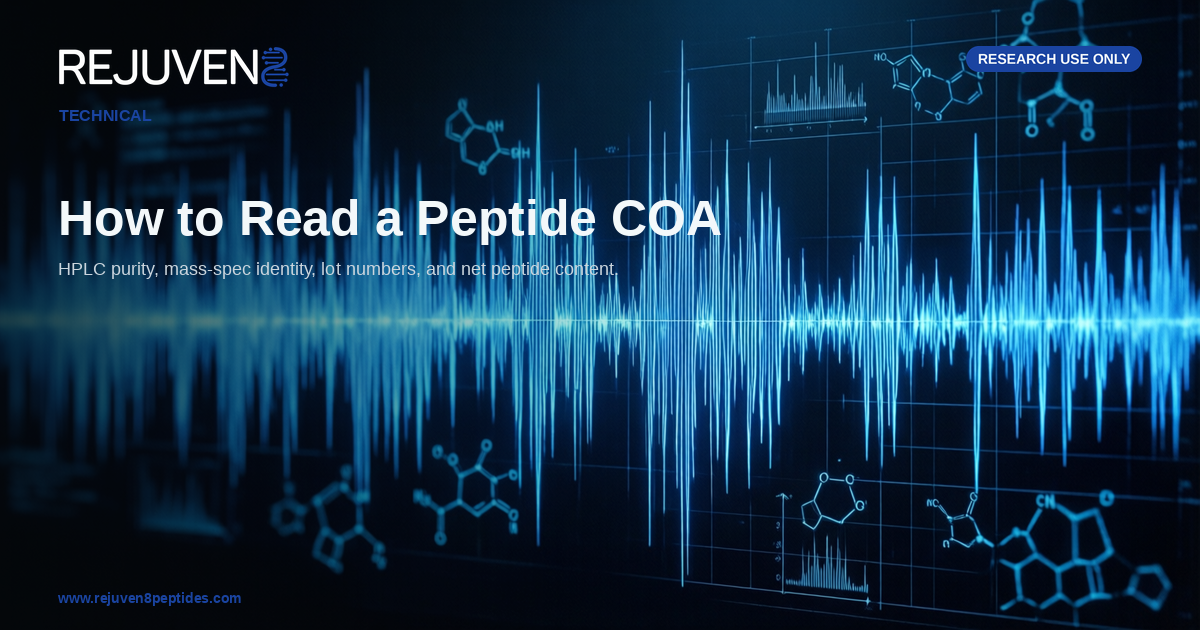
A Certificate of Analysis (COA) is the laboratory report that documents what is actually in a vial. For research peptides, it is the difference between data you can trust and data you cannot reproduce — yet most COAs go unread because the terminology looks intimidating.
It isn’t. A peptide COA comes down to six things to check, and once you know what each one means, you can verify any batch in under a minute. This guide walks through each field, explains what “good” looks like, and provides a short glossary of the terms you’ll encounter.
The Six Things to Check on Any Peptide COA
- Product name + sequence/molecular weight — does it match what you ordered?
- Lot / batch number — does it match the number on your vial?
- HPLC purity (%) — how much of the sample is the target peptide.
- Mass spectrometry (MS) — confirms the molecule’s identity by weight.
- Net peptide content — how much is actual peptide vs. salts and water.
- Test date + testing lab — recent, and ideally third-party.
If all six line up, you have material you can stand behind. Here’s each in detail.
1. Identity: Name, Sequence, Molecular Weight
The top of a COA states the peptide name and often its amino-acid sequence and theoretical molecular weight. This is your first check: the name and sequence must match the product you ordered. The theoretical molecular weight matters again when you read the mass-spec result, because the measured weight should match it closely.
2. Lot / Batch Number
A COA is a report on one specific batch. The lot number on the certificate must match the lot number printed on your vial or label. A COA with no lot number — or a single “example” certificate reused across every order — cannot verify the material you actually received. This is the most common way a weak COA creates a false sense of security.
3. HPLC Purity (the Headline Number)
High-performance liquid chromatography (HPLC) separates a sample’s components so the lab can measure what fraction is the target peptide. The result is a purity percentage — for research peptides, typically reported in the high-90s (e.g., ≥98%).
On an HPLC chromatogram, you’re looking for:
- One dominant peak representing the target peptide.
- Small or minimal additional peaks, representing related impurities.
- A stated purity % derived from the relative peak areas.
A high number from a disclosed HPLC method on the correct lot is what makes purity meaningful — not a percentage printed without a method.
4. Mass Spectrometry: Confirming Identity
Purity tells you how much of the target is present; mass spectrometry tells you it’s the right molecule at all. MS measures the peptide’s mass, and the observed mass should match the theoretical molecular weight from the identity section, within the method’s expected tolerance. Together, HPLC + MS answer the two essential questions: is it the right peptide, and how pure is it?
5. Net Peptide Content
A lyophilized vial also contains residual salts (from synthesis) and bound water. Net peptide content states how much of the powder’s mass is actually peptide. This matters when a protocol depends on precise quantities, because two vials of identical labeled amount can differ in true peptide mass if their net content differs. Not every COA reports it, but its presence signals a thorough supplier.
6. Test Date and Testing Laboratory
Finally, check when and by whom the testing was done:
- A recent test date relative to manufacture indicates current data.
- A named, third-party laboratory is more credible than unattributed in-house testing, because an independent lab has no stake in the result.
Quick Glossary
- COA (Certificate of Analysis): lab report documenting a lot’s identity and purity.
- HPLC: separation method used to measure purity as a percentage.
- Mass spectrometry (MS): method that confirms identity by measuring molecular mass.
- Lot / batch number: identifier tying a COA to a specific production run.
- Net peptide content: fraction of the powder mass that is actual peptide.
- Lyophilized: freeze-dried; the typical form research peptides ship in.
Putting It Together
A trustworthy COA shows the right peptide (name/sequence), confirmed by mass spectrometry, at a high HPLC purity, on a lot number that matches your vial, tested recently by a third-party lab. When you can confirm those, you remove one of the biggest sources of variability in peptide research. For choosing vendors who consistently provide this, see how to choose a research peptide supplier in 2026; to see these principles applied across compounds, see our recovery peptide comparison.
Frequently Asked Questions
What is a peptide COA?
A Certificate of Analysis is the laboratory report documenting a specific lot’s identity (by mass spec) and purity (by HPLC), so researchers can verify material before use.
What purity should a research peptide COA show?
Most are reported in the high-90s by HPLC. More important than the exact number is that it’s lot-specific, third-party verified, and tied to a disclosed method.
What’s the difference between HPLC and mass spectrometry on a COA?
HPLC measures how pure the sample is (a percentage); mass spectrometry confirms the molecule’s identity by its mass. A complete COA includes both.
Why does the lot number matter?
A COA only describes the batch it was run on. If the lot number doesn’t match your vial, the certificate doesn’t actually verify your material.
What is net peptide content?
It’s the share of the freeze-dried powder that is actual peptide (versus salts and water), which matters when a protocol depends on precise quantities.