Research Use Only. The information presented here is for scientific and educational purposes. These compounds are not intended for human consumption, self-administration, or therapeutic use.
Introduction
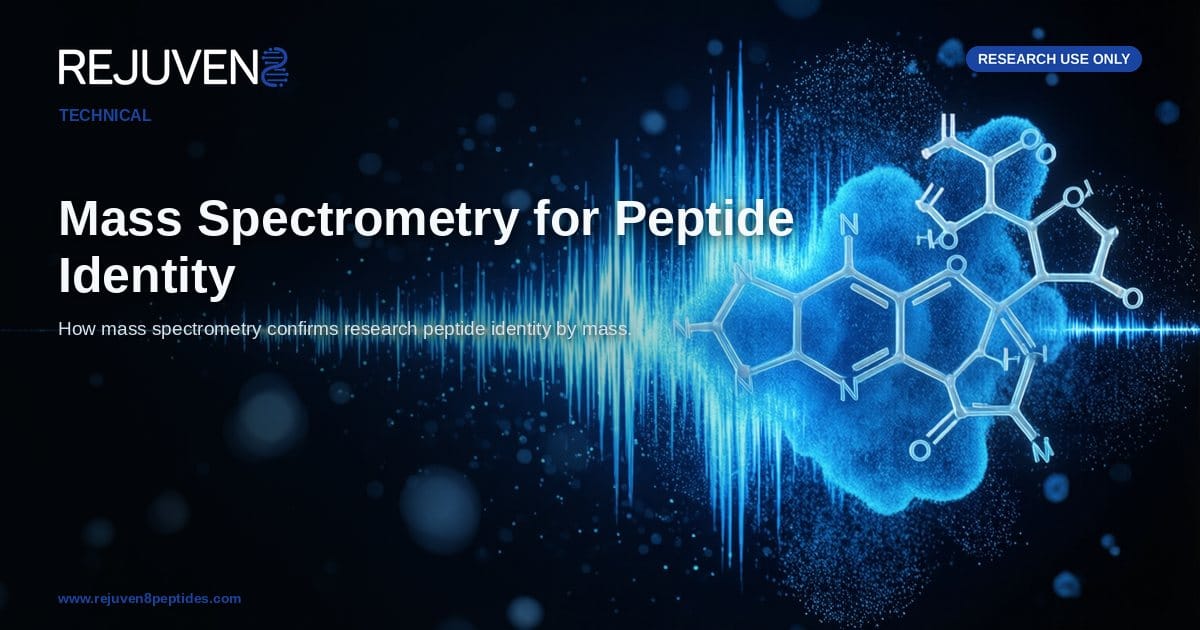
Mass spectrometry (MS) is a core analytical technique used in peptide research to confirm that a synthesized molecule matches its intended sequence. By measuring the mass-to-charge ratio (m/z) of ionized molecules, mass spectrometry allows researchers to compare an observed mass against the theoretical mass calculated from a peptide’s amino acid sequence. That single comparison is the primary evidence of molecular identity reported on a peptide certificate of analysis (COA), and it is what separates a correctly assembled sequence from a truncated, deletion, or side-product species.
Unlike chromatographic methods that estimate purity by separation, mass spectrometry directly interrogates molecular mass, which makes it the definitive identity check within a quality-control workflow. This article explains how electrospray ionization (ESI) and matrix-assisted laser desorption ionization (MALDI) generate that data, how theoretical mass is derived from a sequence, and how to interpret observed versus theoretical mass on supporting documentation. All material here concerns laboratory characterization only: these are research use only compounds, not for human consumption.
How Mass Spectrometry Identifies a Peptide
Every mass spectrometry experiment follows three stages: the peptide is converted into gas-phase ions, those ions are separated according to their mass-to-charge ratio, and a detector records their relative abundance. For peptides, two soft ionization methods dominate because they transfer molecules into the gas phase without shattering the peptide backbone.
Electrospray Ionization (ESI)
In ESI, a peptide dissolved in a volatile solvent is pushed through a charged capillary, producing a fine spray of charged droplets. As the solvent evaporates, the droplets shrink until bare, multiply charged peptide ions remain. A key feature is that ESI generates a charge-state envelope: the same molecule appears at several m/z values as [M+H]+, [M+2H]2+, [M+3H]3+, and so on. Because ESI runs directly from liquid, it couples naturally to liquid chromatography (LC-MS), letting researchers separate a mixture and record an accurate mass for each eluting component.
Matrix-Assisted Laser Desorption Ionization (MALDI)
In MALDI, the peptide is co-crystallized with a light-absorbing matrix on a target plate. A pulsed laser strikes the spot, the matrix absorbs the energy, and the peptide is desorbed and ionized, usually as a single [M+H]+ ion. MALDI tolerates buffer salts better than ESI and pairs efficiently with a time-of-flight (TOF) analyzer, which gives it particular strength for larger peptides and small proteins. The characteristics summarized below reflect commonly reported laboratory attributes and are provided for comparison only.
| Attribute | ESI | MALDI |
|---|---|---|
| Ionization source | Electrospray from a flowing liquid | Laser desorption from a crystalline matrix |
| Typical charge states | Multiple ([M+nH]n+) | Predominantly single ([M+H]+) |
| Sample form | Liquid, chromatography compatible | Dried spot mixed with matrix |
| Salt and buffer tolerance | Lower | Higher |
| Relative strength | Small to mid-size peptides | Mid-size peptides to larger proteins |
| Common analyzer pairing | Quadrupole, Orbitrap | Time-of-flight (TOF) |
Observed Versus Theoretical Mass
Identity confirmation rests on a comparison between two numbers. The theoretical mass is calculated on paper from the peptide’s declared sequence by summing the residue masses and adding water for the terminal groups, along with any modifications such as an amide C-terminus, an acetyl N-terminus, or a bound metal ion. The observed mass is what the instrument actually measures after ionization. When the two agree within the instrument’s expected tolerance, the sequence is considered confirmed.
Monoisotopic Mass Versus Average Mass
Two forms of theoretical mass appear in peptide work, and confusing them is a common source of apparent mismatches. Monoisotopic mass sums the masses of the most abundant isotope of each element (carbon-12, hydrogen-1, nitrogen-14, oxygen-16), and it is the value used with high-resolution instruments that resolve individual isotope peaks. Average mass weights each element by its natural isotopic abundance and is the appropriate reference for lower-resolution or larger-molecule measurements. For a peptide near 1400 Da the two values can differ by roughly 0.8 Da, so a COA should be read against the matching mass type.
Charge States and Deconvolution
Because ESI spreads one molecule across several charge states, the raw spectrum is not read directly as molecular weight. Software performs deconvolution, mathematically collapsing the charge-state envelope back to a single neutral mass. A consistent, well-formed envelope that deconvolutes to the expected value is strong evidence of a pure, correctly assembled peptide, whereas extra series or unexplained peaks can flag deletion sequences, incomplete deprotection, or adducts that warrant follow-up.
Worked Examples and Acceptance Windows
In practice, a research peptide is judged confirmed when its observed mass falls inside a defined window around the theoretical value. On a TOF instrument reading average mass, agreement within about 1 Da is typical, while a high-resolution instrument may specify tolerance in parts per million against the monoisotopic mass. The table pairs several representative research peptides with their commonly cited sequence length and mass. The values listed below reflect commonly reported laboratory attributes and are provided for comparison only.
| Peptide | Sequence length (aa) | Approx. average mass (Da) | Class |
|---|---|---|---|
| BPC-157 | 15 | 1419.5 | Pentadecapeptide |
| Ipamorelin | 5 | 711.9 | Pentapeptide (GH secretagogue class) |
| Semax | 7 | 813.9 | Heptapeptide (ACTH fragment analog) |
| GHK-Cu | 3 | 403.9 | Tripeptide copper complex |
| Thymosin beta-4 (parent of TB-500) | 43 | 4963.4 | Actin-binding peptide |
The spread illustrates why method choice matters: a 403 Da tripeptide and a copper adduct are easily resolved on a high-resolution ESI system, while a 4963 Da species is often characterized comfortably by MALDI-TOF. A mass that lands well outside the acceptance window (for example, short by the residue mass of a single amino acid) points to a deletion product rather than the target sequence, which is exactly the kind of discrepancy identity testing is designed to catch.
Where Mass Spectrometry Fits in Peptide Quality Control
Mass spectrometry answers the question of identity: is this the molecule the label claims? It does not, on its own, quantify how much unrelated material is present. That question of purity is usually answered by reversed-phase HPLC, which separates a sample and reports the percentage area of the main peak. A complete characterization therefore pairs the two: HPLC establishes purity, and mass spectrometry confirms that the dominant peak is the intended sequence. Learning to read both together is the single most useful skill when reviewing a peptide COA and purity documentation.
Reading the Data on a Certificate
A well-prepared certificate states the ionization method, lists the theoretical and observed masses, and notes whether the value is monoisotopic or average. It may include the deconvoluted spectrum or a labeled charge-state series. When those elements are present and internally consistent, the identity claim is verifiable rather than asserted. Suppliers that stand behind their testing typically make batch-specific published certificates available for review, which is one practical marker to weigh when choosing a research peptide supplier. For laboratories building an inventory of characterized material, the full research peptide catalog is organized so identity and purity records can be checked before a compound enters a study, strictly for research use only, not for human consumption.
Frequently Asked Questions
What does mass spectrometry confirm about a research peptide?
It confirms molecular identity by measuring the peptide’s mass and comparing it to the theoretical mass calculated from the declared amino acid sequence. When the observed and theoretical masses agree within the instrument’s tolerance, the sequence is considered confirmed for research documentation.
What is the difference between observed and theoretical mass?
Theoretical mass is calculated on paper from the sequence and any modifications, while observed mass is what the mass spectrometer actually measures. Agreement between the two within a defined acceptance window is the basis for confirming identity, and a large discrepancy can indicate a truncated or side-product species.
Is ESI or MALDI better for analyzing peptides?
Both are soft ionization methods suited to peptides. ESI produces multiply charged ions and couples well with liquid chromatography for small to mid-size peptides, while MALDI usually produces singly charged ions, tolerates salts better, and pairs with time-of-flight analyzers for larger species. Many laboratories use them as complementary tools.
What is monoisotopic mass versus average mass?
Monoisotopic mass sums the most abundant isotope of each element and is used with high-resolution instruments, whereas average mass weights each element by natural isotopic abundance and suits lower-resolution or larger-molecule measurements. A COA should be read against the mass type it reports so the numbers can be compared correctly.
Can mass spectrometry detect impurities in a peptide sample?
Mass spectrometry can reveal mass-distinct impurities such as deletion sequences or adducts that appear as extra peaks, but it is not primarily a purity assay. Percentage purity is normally quantified by HPLC, so the two techniques are reported together for a complete picture.
Where do I find mass spectrometry data on a peptide COA?
A thorough certificate of analysis lists the ionization method, the theoretical and observed masses, and whether the value is monoisotopic or average, often alongside the deconvoluted or labeled spectrum. Reviewing that section next to the HPLC purity result is the recommended way to verify a research peptide before use in a study.