Research Use Only. The information presented here is for scientific and educational purposes. These compounds are not intended for human consumption, self-administration, or therapeutic use.
Introduction
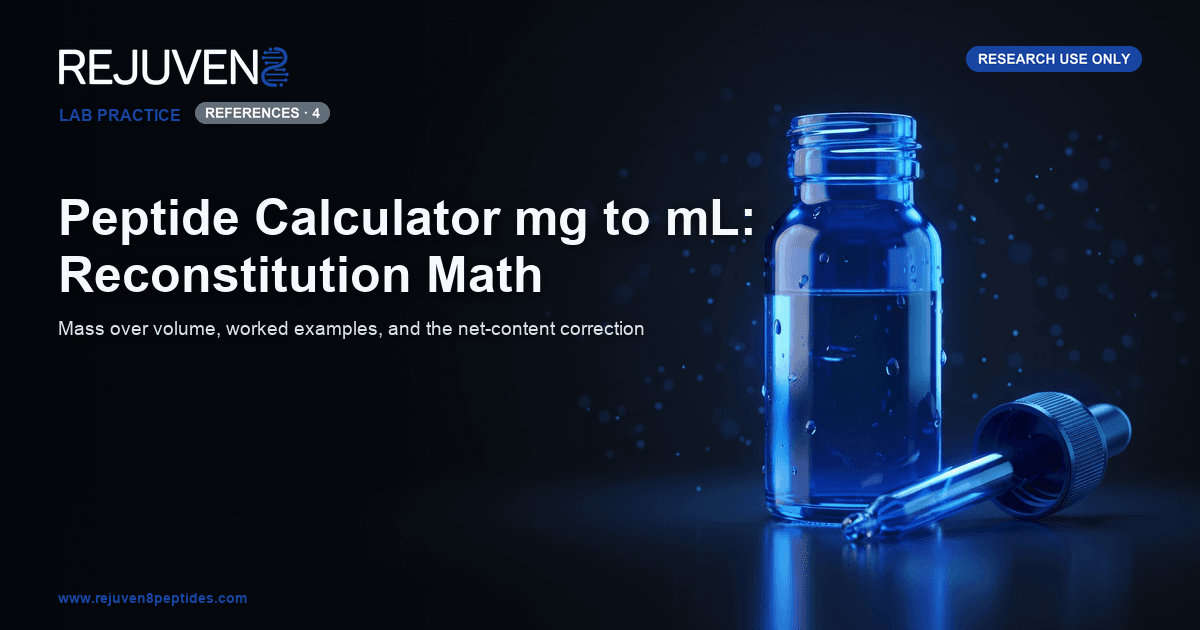
Every quantitative experiment with a lyophilized peptide begins with the same arithmetic: a known mass of powder is dissolved in a known volume of solvent, producing a stock solution with a defined concentration in mg/mL. A search for a “peptide calculator mg” tool usually reflects a wish to skip that arithmetic, but the relationship is a single division, and a researcher who understands it can check any calculator and convert between mass, volume, and molar units without software. The solvent in most of these preparations is bacteriostatic water, sterile water containing 0.9 percent benzyl alcohol as a preservative, which is why the question is so often phrased as how much bac water to reconstitute peptides with.
This article works through the reconstitution math step by step: the core equation, a reference grid of common vial masses and solvent volumes, one worked example carried through to molar concentration, and the corrections for net peptide content and purity that separate a nominal concentration from an accurate one. All material concerns laboratory work with compounds supplied for research use only, not for human consumption; the scope is the chemistry and arithmetic of preparing a solution, not its use.
The Core Equation: Mass, Volume, and Concentration
Concentration is mass divided by volume. For a peptide vial the mass is the peptide quantity in milligrams and the volume is the solvent added in milliliters:
Concentration (mg/mL) = peptide mass (mg) / solvent volume (mL)
Rearranging gives the two other forms a laboratory needs: multiply concentration by aliquot volume to find the mass in an aliquot, or divide vial mass by a target concentration to find the solvent volume required. A “reconstitution calculator” performs exactly these three operations and nothing more.
Why the Powder Volume Is Ignored
A lyophilized cake of 5 or 10 mg occupies only a few microliters once dissolved, so the final solution volume is treated as equal to the solvent volume added. The approximation breaks down only for large masses in very small volumes.
Unit Conversions
One milligram equals 1000 micrograms (mcg), so a 5 mg/mL solution is also 5000 mcg/mL. Molar concentration requires the peptide’s molecular weight: dividing mg/mL by the molecular weight in g/mol and multiplying by 1000 gives millimolar (mM). The reconstitution chemistry guide covers the solubility limits that determine whether a chosen concentration is achievable at all.
Peptide Calculator mg/mL Reference Table
The grid below applies the core equation to the vial masses and solvent volumes most often encountered with research peptides. Each cell is the vial mass divided by the solvent volume. The values reflect commonly reported laboratory attributes and are provided for comparison only.
| Vial mass | 1 mL solvent | 2 mL solvent | 3 mL solvent | 5 mL solvent |
|---|---|---|---|---|
| 2 mg | 2.00 mg/mL | 1.00 mg/mL | 0.67 mg/mL | 0.40 mg/mL |
| 5 mg | 5.00 mg/mL | 2.50 mg/mL | 1.67 mg/mL | 1.00 mg/mL |
| 10 mg | 10.00 mg/mL | 5.00 mg/mL | 3.33 mg/mL | 2.00 mg/mL |
| 20 mg | 20.00 mg/mL | 10.00 mg/mL | 6.67 mg/mL | 4.00 mg/mL |
How Much Bac Water to Reconstitute Peptides: Choosing a Volume
There is no single correct volume; the choice depends on the concentration an experiment calls for and on three practical constraints. First, small lyophilized vials may not accept several milliliters without transfer to a larger sterile vessel. Second, pipetting error is proportionally larger at small volumes, so a highly concentrated stock sub-sampled in tiny aliquots amplifies uncertainty, while a more dilute stock allows larger, more reproducible aliquots. Third, some peptides approach their solubility limit at high concentrations and form haze or aggregates; a larger volume keeps the solution below that threshold. The 10 mL format of Bacteriostatic Water 10mL covers several vials at these volumes, and the 30 mL eBac format suits laboratories preparing many stocks at once. Because the 0.9 percent benzyl alcohol is a fixed fraction of the water itself, the preservative ratio does not change with the volume chosen.
A Worked Example Carried Through to Molarity
Step 1: Nominal Concentration
Consider a vial labeled 10 mg of BPC-157, a pentadecapeptide with an approximate molecular weight of 1419.5 g/mol. Adding 2.0 mL of bacteriostatic water gives 10 mg / 2.0 mL = 5.0 mg/mL, or 5000 mcg/mL, so a 0.1 mL aliquot of this stock contains 0.5 mg (500 mcg) of peptide.
Step 2: Molar Concentration
Cell-culture and binding experiments are usually designed in molar terms. Converting the same stock: 5.0 mg/mL is 5.0 g/L, and 5.0 / 1419.5 = 0.00352 mol/L, which is 3.52 mM. Because molarity depends on molecular weight, peptides prepared at identical mg/mL differ widely in molar terms, as the comparison at 5.0 mg/mL below shows. These values reflect commonly reported laboratory attributes and are provided for comparison only.
| Peptide | Class | Approx. molecular weight | Molar concentration at 5.0 mg/mL |
|---|---|---|---|
| GHK-Cu (free tripeptide) | Copper-binding tripeptide | ~340 g/mol | ~14.7 mM |
| Ipamorelin | Pentapeptide GH secretagogue | ~712 g/mol | ~7.0 mM |
| BPC-157 | Pentadecapeptide | ~1420 g/mol | ~3.5 mM |
| Thymosin beta-4 (parent of TB-500) | 43-residue actin-binding peptide | ~4963 g/mol | ~1.0 mM |
| Tesamorelin | 44-residue GHRH analog | ~5136 g/mol | ~0.97 mM |
Step 3: Dilution to a Working Concentration
The dilution equation C1 x V1 = C2 x V2 converts a stock into a working solution: to prepare 1.0 mL at 1.0 mg/mL from the 5.0 mg/mL stock, V1 = (1.0 x 1.0) / 5.0 = 0.2 mL of stock, brought to 1.0 mL with 0.8 mL of diluent. Serial dilutions repeat this step, and each stage should be recorded so the final assay concentration traces back to the original vial mass.
Net Peptide Content, Purity, and Other Sources of Error
Gross Weight Versus Actual Peptide
The largest hidden error in reconstitution math is the assumption that the label mass equals the mass of peptide in the vial. Lyophilized peptides are salts, most often trifluoroacetate or acetate, and the powder retains bound water. The net peptide content, the fraction of gross weight that is actually peptide, is typically determined by amino acid analysis and is often well below 100 percent. If a 10 mg vial carries a net peptide content of 85 percent, it contains 8.5 mg of peptide, and 2.0 mL of solvent yields 4.25 mg/mL rather than 5.0 mg/mL. The COA and purity guide explains where to find that figure and how it differs from HPLC purity.
Purity Is a Separate Correction
HPLC purity describes what fraction of the peptide material is the target sequence rather than related impurities such as truncated sequences. It is applied after the net content correction, not instead of it: actual target peptide = gross mass x net peptide content x purity. Lot-specific reporting of both figures is one reason to review a supplier’s published certificates.
Solvent and Stability Considerations
Bacteriostatic water is preferred for multi-draw stock vials because the benzyl alcohol suppresses microbial growth over repeated access; it does not stabilize the peptide itself. A 2025 nuclear magnetic resonance study in Molecular Pharmaceutics characterized how formulation preservatives, benzyl alcohol among them, associate with peptides in solution and found the interactions largely reversible. Once reconstituted, stocks are typically held at 2 to 8 degrees Celsius for short-term work or aliquoted and frozen to limit freeze-thaw cycles; the storage and handling guide and the bacteriostatic water guide cover those conditions. No peptide calculator mg tool substitutes for a written record of vial mass, solvent volume, net content, and purity; those four numbers define the concentration of every solution in the freezer, for every compound in the research peptide catalog.
Frequently Asked Questions
How do you calculate peptide concentration in mg/mL?
Divide the mass of peptide in the vial, in milligrams, by the volume of solvent added, in milliliters. A 10 mg vial reconstituted with 2 mL of bacteriostatic water gives 5 mg/mL, and a 0.1 mL aliquot of that stock contains 0.5 mg.
How much bac water do you add to reconstitute a peptide vial?
The volume is set by the concentration the experiment requires, the capacity of the receiving vial, and the peptide’s solubility. Common laboratory choices range from 1 to 5 mL for vials of 2 to 20 mg; larger volumes give dilute stocks that are easier to pipette accurately, smaller volumes give concentrated stocks that occupy less storage space.
What does a reconstitution calculator actually compute?
It applies the equation concentration = mass / volume and its two rearrangements. Given any two of vial mass, solvent volume, and target concentration, it returns the third, and it may convert mg/mL into mcg/mL or, with a molecular weight, into millimolar units.
Why is the actual concentration lower than the label suggests?
Lyophilized peptide powder includes counterions such as trifluoroacetate or acetate and residual water, so net peptide content is typically less than the gross weight on the label. Multiplying the labeled mass by net peptide content, then by HPLC purity, gives the true mass of target peptide before dividing by solvent volume.
How do you convert mg/mL to molar concentration?
Treat mg/mL as g/L, divide by the peptide’s molecular weight in g/mol, and multiply by 1000 for millimolar. A 5 mg/mL solution of a 1419.5 g/mol peptide is 5 / 1419.5 x 1000 = 3.52 mM. Peptides of different molecular weight prepared at the same mg/mL have different molarities.
Does the amount of bacteriostatic water change the preservative concentration?
No. Benzyl alcohol is present at 0.9 percent of the water itself, so any volume drawn from the vial carries the same preservative fraction. Adding more or less water changes the peptide concentration but not the benzyl alcohol percentage.
References and Further Reading
- Interaction between peptides and formulation preservatives such as benzyl alcohol, including a 2025 NMR characterization in Molecular Pharmaceutics. PubMed: peptide preservative interaction benzyl alcohol NMR
- Studies of peptide solubility, aggregation, and concentration-dependent behavior in aqueous solution. PubMed: peptide solubility aggregation aqueous concentration
- Stability of lyophilized and reconstituted peptides, including freeze-thaw and storage temperature effects. PubMed: lyophilized peptide reconstitution stability storage
- Methods for determining net peptide content and counterion contribution by amino acid analysis. PubMed: peptide content amino acid analysis counterion trifluoroacetate