Research Use Only. The information presented here is for scientific and educational purposes. These compounds are not intended for human consumption, self-administration, or therapeutic use.
Introduction
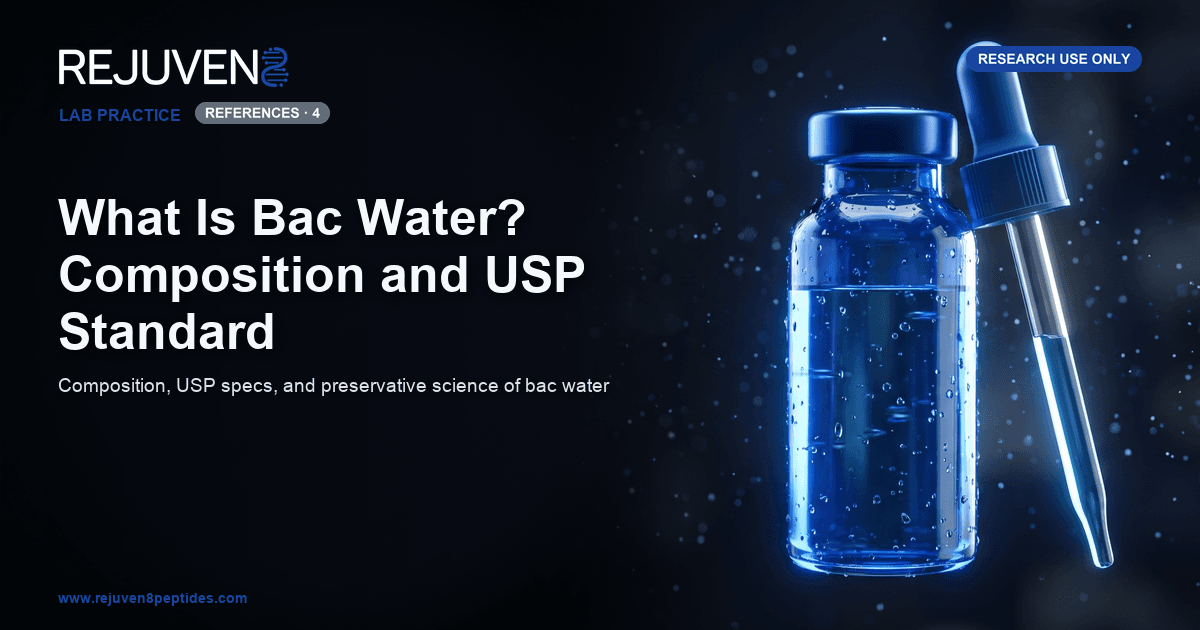
Nearly every lyophilized peptide arrives in a laboratory as a dry powder that must be dissolved before it can be aliquoted or assayed. The solvent most laboratories reach for is bacteriostatic water, and the search phrase “what is bac water” shows how often new researchers meet the term before anyone defines it. The short answer: bac water is sterile, nonpyrogenic water to which 0.9% benzyl alcohol has been added as a preservative, so that one vial can be entered repeatedly over several weeks while resisting microbial growth.
This article gives that answer in full: what the United States Pharmacopeia (USP) monograph specifies, how the benzyl alcohol preservative acts on microbial membranes, how bacteriostatic water compares with sterile water and 0.9% sodium chloride, and what the formulation literature reports about preservative-peptide interactions. Everything described concerns laboratory materials supplied for research use only, not for human consumption.
What Is Bac Water? Composition and the USP Standard
Two components, one function
Bacteriostatic water contains exactly two ingredients. The first is water meeting compendial requirements for sterility and low endotoxin content, purified, filtered, and terminally sterilized so that it carries no viable microorganisms and only trace pyrogen. The second is benzyl alcohol at 0.9% weight per volume, or 9 mg per milliliter (roughly 83 mM). Benzyl alcohol (C7H8O, approximate molecular weight 108.1 g/mol) is an aromatic alcohol that stays fully dissolved at this concentration, giving a clear, colorless liquid. No buffers, salts, or tonicity agents are present, so the solution is hypotonic and mildly acidic.
What the monograph specifies
The USP monograph defines the attributes every lot must meet. The values below reflect commonly reported laboratory attributes and are provided for comparison only.
| Attribute | Typical specification |
|---|---|
| Preservative | Benzyl alcohol 0.9% w/v (9 mg/mL, about 83 mM) |
| Base | Sterile, nonpyrogenic purified water |
| pH | Approximately 5.7 (acceptable range 4.5 to 7.0) |
| Tonicity | Hypotonic (no dissolved solute other than the preservative) |
| Container | Multi-entry glass or polyolefin vial with elastomeric septum |
| Common fill volumes | 10 mL and 30 mL |
| Unopened storage | Controlled room temperature, 20 to 25 C |
The word “bacteriostatic” is the operative one: the preparation inhibits bacterial growth rather than killing organisms outright. It is not a sterilant and cannot rescue a contaminated peptide; it slows the multiplication of organisms that enter each time the septum is punctured. Rejuven8 stocks Bacteriostatic Water 10mL and the larger eBac 30 mL vial for laboratory reconstitution work.
How Benzyl Alcohol Preserves a Multi-Entry Vial
Membrane-level mechanism
Benzyl alcohol belongs to the aromatic alcohol family of preservatives, alongside phenol and m-cresol. Its antimicrobial action is attributed mainly to partitioning into the lipid bilayer of microbial membranes, where it increases membrane fluidity, dissipates the proton gradient that drives energy metabolism, and disturbs membrane-bound enzymes. At 0.9% this activity holds bacterial populations in check without reaching concentrations that would denature most peptides. The figure is not arbitrary: preservative systems are validated under USP General Chapter 51 (antimicrobial effectiveness testing), which inoculates a preparation with defined bacterial and fungal strains and follows viable counts over 28 days.
Limits of the preservative
Benzyl alcohol is more active against bacteria than against molds and yeasts, so fungal contamination remains possible in a poorly handled vial, and its slight volatility means preservative content falls over many septum entries. These limits underlie the laboratory convention of discarding an opened vial 28 days after first entry, however much liquid remains. The preservative buys time between entries; it does not replace aseptic technique, and it offers no protection against chemical degradation of a dissolved peptide, such as oxidation or deamidation.
Bacteriostatic Water vs Sterile Water vs Sodium Chloride
The choice among reconstitution solvents depends on whether a vial will be entered once or many times, and whether preservative-free or isotonic conditions matter downstream. The values below reflect commonly reported laboratory attributes and are provided for comparison only.
| Solvent | Preservative | pH range | Tonicity | Multi-entry use | Typical laboratory role |
|---|---|---|---|---|---|
| Bacteriostatic water | Benzyl alcohol 0.9% | 4.5 to 7.0 | Hypotonic | Yes, up to 28 days refrigerated | Default for peptide stocks sampled on multiple occasions |
| Sterile water | None | 5.0 to 7.0 | Hypotonic | No, single entry | Preservative-free preparations used at once; cell-based assays |
| 0.9% sodium chloride | None | 4.5 to 7.0 | Isotonic | No, single entry | Preparations where ionic strength matters |
Sterile water is the appropriate solvent when a peptide solution will be added to cultured cells, because benzyl alcohol at 83 mM is cytotoxic to many cell lines. Why some hydrophobic or near-neutral sequences dissolve less readily in saline than in water is covered in the reconstitution chemistry guide.
Benzyl Alcohol and Peptide Stability in the Formulation Literature
Whether benzyl alcohol interacts with a dissolved peptide is a fair question, and the formulation literature has examined it. A 2021 study by D’Addio and colleagues in the Journal of Pharmaceutical Sciences compared m-cresol, phenol, and benzyl alcohol with a palmitoylated 31-residue peptide. Phenol and m-cresol bound near a tryptophan residue, raised local hydrophobicity, and induced a reversible self-association of the peptide. Benzyl alcohol produced no detectable binding enthalpy or conformational change with that sequence and improved its physical stability under salt stress, though the authors stressed that the effects were sequence-dependent.
More recent work has turned to NMR spectroscopy. A 2025 report in Molecular Pharmaceutics characterized peptide-preservative interactions and their reversibility residue by residue, and a companion study combined AlphaFold, molecular dynamics simulation, and NMR to map where aromatic preservatives contact peptide side chains. The consistent picture is that preservative binding is weak, localized to aromatic and hydrophobic residues, and generally reversible, with a magnitude that depends on the sequence. Benzyl alcohol at 0.9% is therefore compatible with most research peptides, yet any assay in which aggregation or conformation is the measured variable should include a preservative-free control. Verified identity and purity remain the starting point for either solvent: a lot-specific certificate of analysis, read with the COA and purity guide, establishes what is in the vial before any water is added, and Rejuven8 publishes its certificates of analysis lot by lot.
Research Use: Reconstitution Math and Storage
One worked concentration example
Reconstitution turns a known peptide mass into a known concentration, and the arithmetic is a single division: concentration (mg/mL) = peptide mass (mg) / solvent volume (mL). A 5 mg vial reconstituted with 2.5 mL of bacteriostatic water yields 2 mg/mL, so a 0.1 mL aliquot contains 200 micrograms (mcg) of peptide and a 0.05 mL aliquot contains 100 mcg. Choosing a volume so that convenient aliquot sizes match the quantities an assay requires reduces pipetting error, and labeling the vial with concentration and date keeps later calculations traceable.
Handling the solvent and the solution
Unopened bacteriostatic water is held at controlled room temperature; once the septum has been entered, refrigeration at 2 to 8 C slows both microbial and chemical change. Solvent should run down the inner wall of the peptide vial, and the contents should be swirled rather than shaken. Many peptides retain acceptable purity in refrigerated bacteriostatic water for several weeks, but stability is sequence-specific; for longer holding, single-use aliquots frozen at -20 C limit freeze-thaw cycles, as described in the peptide storage and handling guide.
The complete answer to “what is bac water,” then, is a two-component compendial solvent whose preservative makes multi-entry stock solutions practical, whose chemistry suits most peptides, and whose limits (bacteriostatic rather than sterilizing, with a 28-day window after first entry) define good practice around it. It sits beside the peptides in the research peptide catalog and, like them, is intended strictly for laboratory investigation.
Frequently Asked Questions
What is bac water?
Bac water is the short name for bacteriostatic water: sterile, nonpyrogenic water containing 0.9% benzyl alcohol as a preservative. The preservative inhibits bacterial growth so that one vial can be entered repeatedly over several weeks, which is why it is the default solvent for reconstituting lyophilized research peptides.
What is bacteriostatic water made of?
Two components only: purified water meeting compendial standards for sterility and low endotoxin content, and benzyl alcohol at 0.9% weight per volume (9 mg/mL). It contains no salts, buffers, or tonicity agents, so it is hypotonic with a pH between 4.5 and 7.0.
What is the difference between bacteriostatic water and sterile water?
The preservative. Sterile water contains no antimicrobial agent, so an opened container is intended for a single use. Bacteriostatic water contains 0.9% benzyl alcohol, which inhibits bacterial growth between entries and supports multi-entry use of one vial for up to 28 days under refrigeration.
How long does bacteriostatic water last after opening?
The laboratory convention is 28 days after the septum is first punctured, with the opened vial refrigerated at 2 to 8 C. Unopened vials are kept at controlled room temperature until their labeled expiry. The window reflects the preservative’s weaker activity against fungi and its gradual loss over repeated entries.
Does benzyl alcohol affect peptides in solution?
For most research peptides, no meaningful effect is reported at 0.9%. Formulation studies found that phenol and m-cresol can induce reversible peptide self-association, while benzyl alcohol showed no detectable binding or conformational change with the peptides examined. Because the effect is sequence-dependent, assays measuring aggregation or conformation should include a preservative-free control.
Is bacteriostatic water intended for human use?
No. The bacteriostatic water described here is a laboratory solvent supplied for research use only. It reconstitutes research peptides for in-vitro and preclinical study and is not intended for human consumption or self-administration.
References and Further Reading
- USP monograph for bacteriostatic water and General Chapter 51 on antimicrobial effectiveness testing of the 0.9% benzyl alcohol preservative system. PubMed: benzyl alcohol preservative antimicrobial effectiveness
- D’Addio SM and colleagues, Journal of Pharmaceutical Sciences (2021), on reversible peptide association induced by antimicrobial excipients. PubMed: antimicrobial excipient reversible association peptide
- NMR studies (Molecular Pharmaceutics, 2025) of peptide-preservative interaction and its reversibility. PubMed: peptide preservative interaction NMR
- Microbial contamination and preservative performance in multi-entry vials, the evidence base for the 28-day convention. PubMed: vial preservative microbial contamination benzyl alcohol