Research Use Only. The information presented here is for scientific and educational purposes. These compounds are not intended for human consumption, self-administration, or therapeutic use.
Introduction
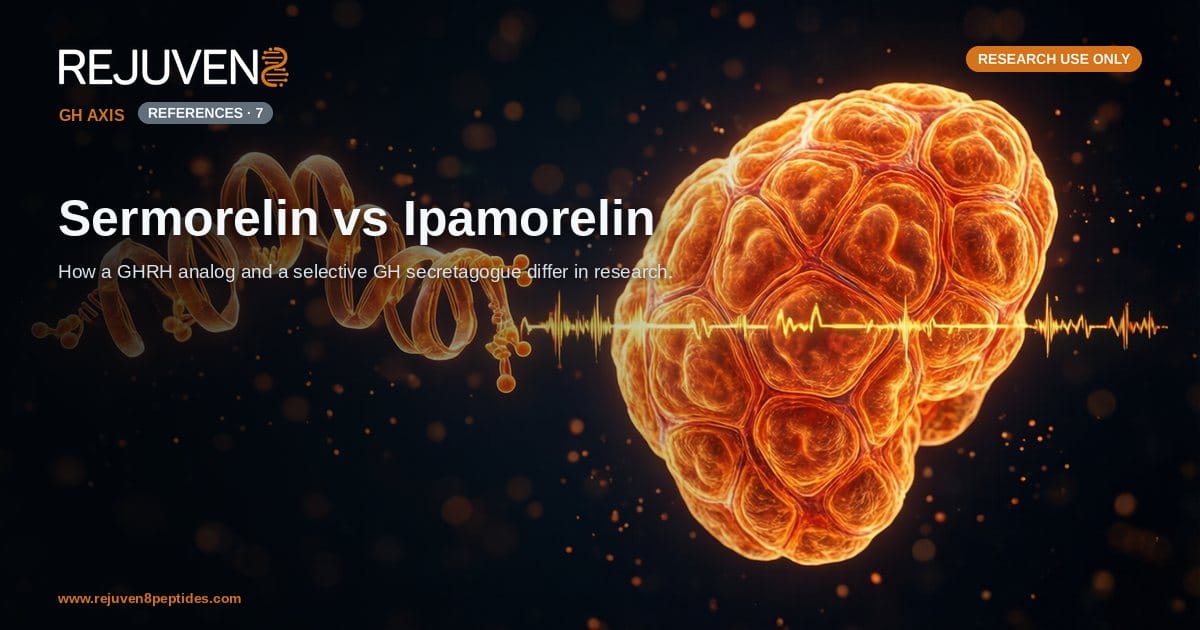
Sermorelin and ipamorelin are frequently compared in growth hormone (GH) research because both are studied for their capacity to stimulate GH release from pituitary somatotrophs. Despite this shared readout, they belong to different pharmacological classes and engage separate receptors on the GH axis. Sermorelin is a growth hormone-releasing hormone (GHRH) analog, whereas ipamorelin is a selective growth hormone secretagogue that behaves as a ghrelin receptor agonist. Understanding this distinction is central to interpreting how each compound performs in preclinical and in-vitro models.
This comparison examines the two peptides across their molecular identity, receptor pharmacology, signaling cascades, and selectivity profiles. It also explains why laboratory protocols frequently pair a GHRH analog with a secretagogue. The discussion is presented for research use only, not for human consumption, and describes only what these compounds are investigated for in controlled scientific settings, not any clinical, therapeutic, or veterinary application.
Two Receptors on One Axis
Although sermorelin and ipamorelin converge on the same target cell, they reach it through two molecularly separate receptor systems that the GH axis uses to control secretion.
Sermorelin and the GHRH receptor
Sermorelin corresponds to the first 29 amino acids of endogenous human GHRH, the N-terminal fragment often written as GRF(1-29). This segment retains the receptor-binding activity of the full 44-residue hormone. Sermorelin binds the GHRH receptor (GHRHR), a class B G-protein-coupled receptor expressed on somatotrophs. Receptor activation raises intracellular cyclic AMP (cAMP), which in preclinical studies promotes GH gene transcription and the release of stored hormone. Because it mimics the body’s own releasing hormone, sermorelin’s activity remains subject to normal negative feedback from somatostatin.
Ipamorelin and the ghrelin receptor
Ipamorelin is a synthetic pentapeptide that mimics the hormone ghrelin at the growth hormone secretagogue receptor (GHS-R1a). Rather than raising cAMP, ghrelin receptor activation signals primarily through the phospholipase C, inositol trisphosphate, and intracellular calcium cascade. In animal research this pathway both triggers GH release and transiently reduces somatostatin tone, effectively easing the brake on the somatotroph. Because the GHRH receptor and the ghrelin receptor use different second messengers within the same cell, investigators describe their signaling as complementary rather than redundant.
Molecular Identity and Structural Class
The two peptides differ sharply in size and chemical class. The values below reflect commonly reported laboratory attributes and are provided for comparison only, summarizing the structural identity investigators reference when characterizing each compound.
| Attribute | Sermorelin | Ipamorelin |
|---|---|---|
| Structural class | GHRH analog (releasing-hormone fragment) | GH secretagogue (ghrelin receptor agonist) |
| Molecular target | GHRH receptor (GHRHR) | Ghrelin receptor (GHS-R1a) |
| Sequence length | 29 amino acids | 5 amino acids (pentapeptide) |
| Approx. molecular weight | ~3358 Da | ~712 Da |
| Structural basis | N-terminal fragment of human GHRH, GRF(1-29) | Aib-His-D-2-Nal-D-Phe-Lys-NH2 |
| Reported plasma half-life | Short (roughly 10 to 20 minutes) | Longer (reported near 2 hours in animal models) |
| Selectivity note | Constrained by GHRH receptor and feedback | Minimal reported cortisol or prolactin release |
The nearly fivefold difference in molecular weight reflects two different design philosophies. Sermorelin reproduces a substantial portion of a native hormone, whereas ipamorelin is a compact, engineered mimetic built around a minimal active motif. This distinction, along with the different receptors, accounts for much of what researchers observe in stability and signaling duration when the two are studied side by side. Verifying these identity attributes against a supplier’s documentation is straightforward with a certificate of analysis.
Selectivity and Signaling Profiles
Selectivity is one of the most cited distinctions between the two compounds. In preclinical characterization, ipamorelin was noted for releasing GH with minimal stimulation of cortisol, prolactin, or adrenocorticotropic hormone (ACTH), a profile that separated it from earlier growth hormone releasing peptides such as GHRP-2 and GHRP-6. This relative specificity is why ipamorelin is often described as a selective secretagogue in the literature. Sermorelin, acting through the GHRH receptor, produces GH release that mirrors the body’s endogenous rhythm and remains fully responsive to somatostatin, so its output stays pulsatile rather than continuous in animal models. Neither profile implies any human outcome; both are documented only as observations in research systems.
Why Research Models Pair the Two
Because a GHRH analog and a secretagogue raise GH through separate second-messenger systems, combining them in research can produce a larger, often synergistic release than either alone. One arm of the pair elevates cAMP through the GHRH receptor while the other mobilizes calcium and eases somatostatin inhibition through the ghrelin receptor. This mechanistic logic underlies widely studied pairings of a long-acting GHRH analog such as CJC-1295 with ipamorelin, a combination represented in dedicated CJC-1295 and ipamorelin research blends. Related molecules, including the secretagogue GHRP-2 and the GHRH analog tesamorelin, are examined within the same framework. Any such combination remains an investigational research question, and results in cell or animal systems do not translate to human or veterinary use. A broader set of comparably studied compounds is catalogued in the research peptide collection.
Frequently Asked Questions
What is the main difference between sermorelin and ipamorelin?
Sermorelin is a GHRH analog that binds the GHRH receptor, while ipamorelin is a growth hormone secretagogue that activates the ghrelin receptor (GHS-R1a). Both are studied for stimulating GH release from somatotrophs, but they use different receptors and different second-messenger pathways to do so.
Is ipamorelin a GHRH or a secretagogue?
Ipamorelin is a secretagogue, specifically a selective ghrelin receptor agonist. It is not a GHRH analog. Sermorelin and tesamorelin are the GHRH analogs in this category, whereas ipamorelin belongs to the growth hormone secretagogue class alongside compounds such as GHRP-2.
Why are sermorelin and ipamorelin studied together?
Researchers pair them because a GHRH analog and a secretagogue act on complementary pathways. One raises cAMP while the other mobilizes calcium and lowers somatostatin tone, which in preclinical models can produce an additive or synergistic increase in GH release compared with either compound on its own.
How do the molecular sizes of sermorelin and ipamorelin compare?
Sermorelin is a 29-amino-acid peptide with a molecular weight of roughly 3358 Da, corresponding to the active N-terminal fragment of human GHRH. Ipamorelin is a pentapeptide of only 5 amino acids at approximately 712 Da, making it far smaller and structurally simpler.
Does ipamorelin affect cortisol and prolactin in research?
In its original preclinical characterization, ipamorelin released growth hormone with minimal effect on cortisol, prolactin, or ACTH. This selectivity distinguished it from earlier growth hormone releasing peptides, which is why it is frequently described as a selective secretagogue in the research literature.
Are sermorelin and ipamorelin the same as CJC-1295?
No. CJC-1295 is a separate, longer-acting GHRH analog, placing it in the same mechanistic class as sermorelin rather than ipamorelin. In study designs, CJC-1295 is often combined with ipamorelin so that a GHRH-receptor agonist and a ghrelin-receptor agonist are represented together.
References and Further Reading
- Raun and colleagues, original characterization of ipamorelin as a selective growth hormone secretagogue (European Journal of Endocrinology, 1998). PubMed: ipamorelin growth hormone secretagogue
- Sermorelin and GRF(1-29) as an N-terminal GHRH analog. PubMed: sermorelin GHRH analog
- Guillemin and Schally, characterization of growth hormone-releasing hormone and hypothalamic control of the somatotroph. PubMed: growth hormone releasing hormone somatotroph
- The growth hormone secretagogue receptor (GHS-R1a) and ghrelin signaling. PubMed: ghrelin receptor GHS-R1a growth hormone
- Bowers and the discovery of the growth hormone releasing peptides. PubMed: growth hormone releasing peptide Bowers
- Synergy between GHRH and growth hormone secretagogues on GH release. PubMed: GHRH growth hormone secretagogue synergy
- Somatostatin and the regulation of pulsatile growth hormone secretion. PubMed: somatostatin pulsatile growth hormone secretion