Research Use Only. The information presented here is for scientific and educational purposes. These compounds are not intended for human consumption, self-administration, or therapeutic use.
Introduction
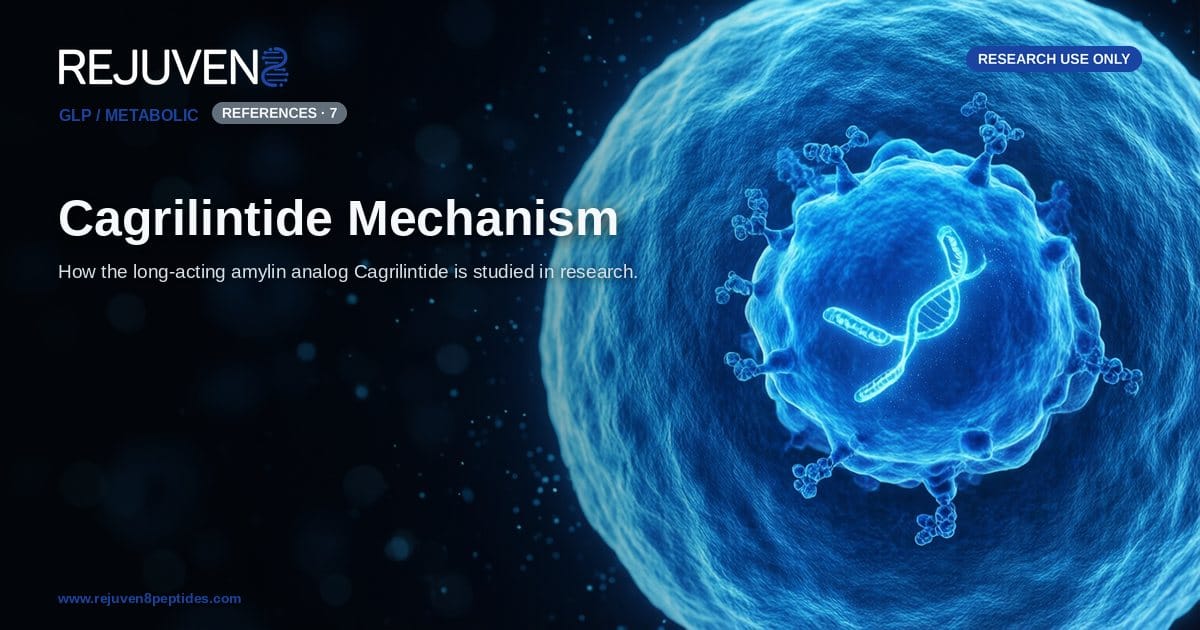
Cagrilintide is a long-acting amylin analog that has become a frequently referenced tool compound in preclinical metabolic pharmacology. Laboratory interest in the molecule centers on how a structurally modified, extended-half-life amylin peptide engages the amylin receptor family, a set of cell-surface complexes assembled from the calcitonin receptor and its accessory proteins. In research settings, Cagrilintide is examined as a probe for understanding amylin signaling, receptor selectivity, and the downstream neural and endocrine pathways that amylin is known to influence in animal models.
This overview summarizes, from a strictly research-oriented perspective, what the published literature describes about the amylin system, the molecular design of Cagrilintide, and the receptor mechanisms investigated using in-vitro assays and animal studies. Nothing here concerns human use. The material is provided for research use only, not for human consumption, and is intended to support scientists comparing amylin-directed compounds and their reported laboratory characteristics. For sourcing and documentation practices, the Rejuven8 research peptide catalog and its associated certificates of analysis are referenced throughout.
The Amylin System and Its Signaling Targets
Amylin as an islet peptide
Amylin, also called islet amyloid polypeptide (IAPP), is a 37-amino-acid peptide hormone co-secreted with insulin from pancreatic beta cells. Since its identification in the late 1980s, amylin has been characterized in research as a satiation-associated signal that works in parallel with insulin during nutrient handling. In animal and in-vitro studies, native amylin is reported to slow gastric emptying, modulate glucagon secretion, and act on hindbrain circuits linked to meal termination. Because native amylin has a short circulating half-life and a well-documented tendency to aggregate into insoluble fibrils, engineered analogs such as Cagrilintide were designed to provide greater solubility and a longer window of receptor exposure for experimental work.
Amylin receptor complexes
The amylin receptor is not a single gene product. It is formed when the calcitonin receptor (CTR), a class B G-protein-coupled receptor, associates with one of three receptor activity-modifying proteins (RAMP1, RAMP2, RAMP3). These pairings generate the AMY1, AMY2, and AMY3 receptor phenotypes, which differ in their affinity for amylin and related peptides. Structural biology work using cryo-electron microscopy has mapped how amylin-class peptides dock into this complex, and that framework guides how researchers interpret the binding behavior of engineered analogs. Determining which receptor subtype a compound favors, and how strongly it recruits downstream signaling, is a central question when characterizing any amylinomimetic in the laboratory.
Cagrilintide: Structure and Molecular Design
Cagrilintide retains the general amylin backbone while incorporating substitutions that improve stability, along with a lipid side chain that supports reversible binding to albumin. This acylation strategy, shared by several long-acting research peptides, is what gives the molecule its extended profile relative to native amylin. Material catalogued as the Cagrilintide research peptide is typically supplied as a lyophilized powder for reconstitution in laboratory settings. The values below reflect commonly reported laboratory attributes and are provided for comparison only.
| Attribute | Reported Value |
|---|---|
| Compound class | Long-acting amylin analog (acylated amylinomimetic peptide) |
| Backbone length | Approximately 37 amino acid residues |
| Approximate molecular weight | Approximately 3,750 Da |
| Key structural feature | Fatty-acid side chain enabling albumin association |
| Receptor targets studied | Amylin receptors AMY1, AMY2, AMY3 and the calcitonin receptor |
| Research status | Preclinical and in-vitro investigational use only |
Acylation and the long-acting profile
The defining design feature of Cagrilintide is its fatty-acid moiety, which associates with circulating albumin and slows clearance in animal models. This reversible albumin binding acts as a molecular reservoir, releasing peptide gradually and lengthening the interval over which the receptor complex is exposed to an active ligand. In pharmacology workflows, researchers examine how this modification changes measured half-life, solubility, and resistance to enzymatic degradation compared with unmodified amylin. Analytical documentation, such as a certificate of analysis and purity report, is used to confirm peptide identity and mass before any comparative assay is run.
Mechanisms Investigated in Research
Receptor binding and activation
Published research describes Cagrilintide as a non-selective amylin analog that also engages the calcitonin receptor, giving it measurable activity across the AMY receptor phenotypes. In cell-based assays, agonist binding to these class B receptors is commonly tracked through second-messenger readouts such as cyclic AMP accumulation and downstream signaling markers. Studying a broad-acting analog helps researchers separate the contributions of individual RAMP-defined subtypes and compare how backbone modifications shift potency at each receptor variant.
Hindbrain and satiety-associated circuits
A large body of preclinical literature places amylin action in the area postrema, a hindbrain region that lies outside the blood-brain barrier and expresses amylin receptor components. In rodent studies, amylin and its analogs are reported to activate neurons in this region and connected nuclei that participate in satiation signaling. Cagrilintide is used experimentally to probe these circuits because its extended profile allows researchers to observe receptor-linked responses over longer intervals than native amylin permits.
Gastric emptying and glucagon signaling
Amylin biology also intersects with the digestive and endocrine control of glucose. In animal and in-vitro models, amylin signaling is associated with slowed gastric emptying and modulation of glucagon release from pancreatic alpha cells. Investigators use amylin analogs to dissect how these outputs depend on receptor subtype and ligand duration. It should be emphasized that these observations belong to controlled preclinical research and do not represent any claim about outcomes in humans.
Comparative Research Context
Researchers frequently profile Cagrilintide alongside endogenous amylin and, in metabolic study designs, alongside incretin-pathway analogs such as the coded research compound GLP-1 SM. Pairing an amylin analog with an incretin analog is a common way to study complementary signaling mechanisms in preclinical models. The comparison below reflects commonly reported laboratory attributes and is provided for comparison only.
| Attribute | Endogenous Amylin (IAPP) | Cagrilintide (research analog) |
|---|---|---|
| Class | Native islet peptide hormone | Engineered long-acting analog |
| Approximate residues | 37 | 37 (modified backbone) |
| Approximate molecular weight | Approximately 3,900 Da | Approximately 3,750 Da |
| Circulating stability | Short-lived, aggregation-prone | Extended via albumin binding |
| Primary receptors studied | AMY1, AMY2, AMY3 complexes | AMY1, AMY2, AMY3 and calcitonin receptor |
| Typical role | Physiological reference peptide | Laboratory probe compound |
When selecting reference material for this kind of comparative work, provenance matters as much as sequence. Consistent lot identity, verified mass, and documented purity allow one experiment to be compared against the next. Guidance on evaluating a source is outlined in the Rejuven8 note on choosing a research peptide supplier, which pairs well with careful review of each batch record.
Frequently Asked Questions
What is the mechanism of Cagrilintide in research models?
In laboratory research, Cagrilintide is studied as a long-acting amylin analog that binds amylin receptor complexes formed from the calcitonin receptor and RAMP proteins, and this engagement is used to probe amylin signaling in cell assays and animal models.
What receptors does Cagrilintide act on?
Published research describes Cagrilintide as engaging the amylin receptor phenotypes AMY1, AMY2, and AMY3, along with the calcitonin receptor, which is why it is often classed as a non-selective amylin analog.
Why is Cagrilintide considered long-acting?
Cagrilintide carries a fatty-acid side chain that associates with albumin, and in animal studies this reversible binding slows clearance and extends the duration of receptor exposure compared with native amylin.
How does Cagrilintide differ from natural amylin?
Native amylin is a short-lived, aggregation-prone islet peptide, whereas Cagrilintide is an engineered analog with a modified backbone and a lipid moiety that improve stability for laboratory study.
Is Cagrilintide studied alongside GLP-1 SM?
In metabolic research designs, amylin analogs such as Cagrilintide are sometimes profiled together with incretin-pathway compounds like the coded research peptide GLP-1 SM to compare complementary signaling mechanisms in preclinical models.
What is the approximate molecular weight of Cagrilintide?
Commonly reported laboratory figures place the molecular weight of Cagrilintide near 3,750 daltons, with a backbone of roughly 37 amino acid residues.
References and Further Reading
- Foundational isolation and characterization of amylin (islet amyloid polypeptide). PubMed: amylin islet amyloid polypeptide
- Assembly of amylin receptors from the calcitonin receptor and RAMP proteins. PubMed: amylin receptor RAMP calcitonin
- Preclinical pharmacology of Cagrilintide as a long-acting amylin analog. PubMed: cagrilintide amylin analog
- Amylin signaling in the area postrema and satiation in animal models. PubMed: amylin area postrema satiation
- Structural studies of the calcitonin and amylin receptor complexes. PubMed: calcitonin receptor RAMP structure
- Research on amylin regulation of gastric emptying and glucagon secretion. PubMed: amylin gastric emptying glucagon
- Comparative pharmacology of amylin and calcitonin receptor agonists. PubMed: amylin calcitonin receptor agonist