Research Use Only. The information presented here is for scientific and educational purposes. These compounds are not intended for human consumption, self-administration, or therapeutic use.
Introduction
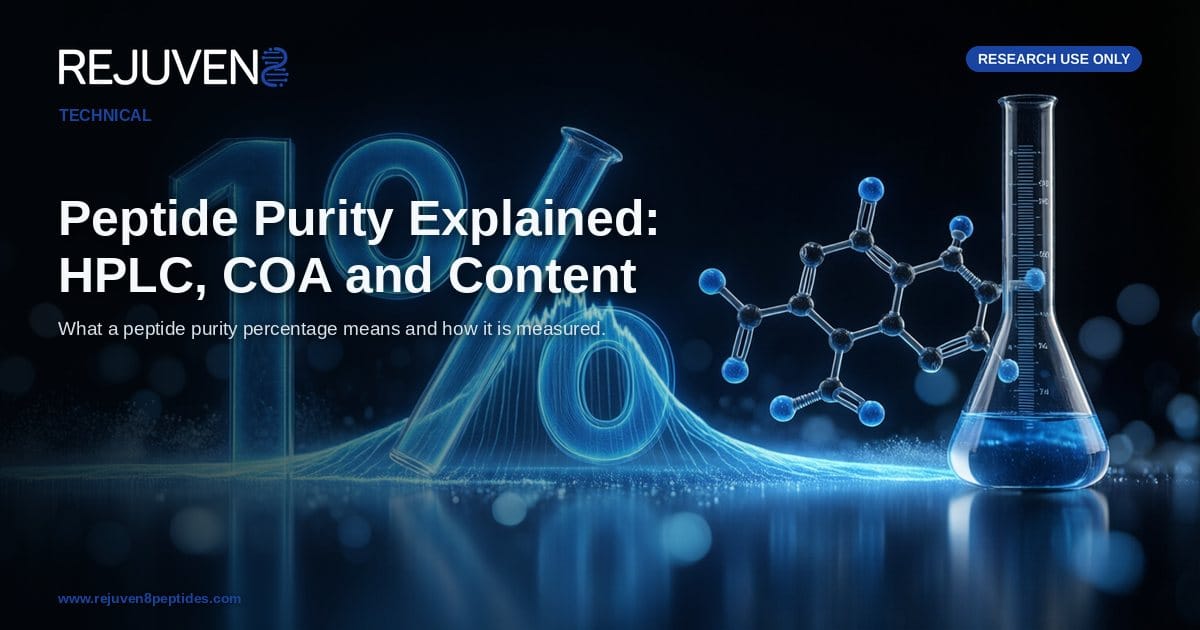
On a certificate of analysis, the peptide purity percentage is often the first figure a researcher checks and one of the most frequently misread. A value such as 98 percent or 99 percent is treated as a single grade of quality, yet it describes a specific chromatographic measurement with defined boundaries. Understanding what that number counts, and what it deliberately ignores, is central to reproducible bench work, accurate molar calculations, and any meaningful comparison between suppliers or lots.
This overview explains what a peptide purity percentage represents, how reversed-phase high-performance liquid chromatography (HPLC) generates the value, and why chromatographic purity is not the same quantity as net peptide content. The framing throughout is analytical: it describes how research-grade material is characterized in the laboratory, not how it might be used. The goal is to help laboratory personnel interpret a purity figure in context rather than in isolation.
What a Peptide Purity Percentage Represents
A peptide purity percentage is a relative chromatographic ratio, not an absolute statement of what fills the vial. When an analyst injects a dissolved sample into an HPLC system, the instrument separates the target peptide from structurally related species and reports the area of each resulting peak. Purity is calculated as the area of the main peak divided by the total integrated area of all peaks, expressed as a percentage. A figure of 98 percent therefore means that the target peptide accounts for 98 percent of the total detectable peak area at the chosen detection wavelength.
Related impurities that reduce the number
The impurities that erode a purity figure are usually peptide-related byproducts of solid-phase synthesis rather than foreign contaminants. Common examples include deletion sequences (chains missing one or more residues), truncated sequences, incompletely deprotected chains, and oxidation products, particularly at methionine or cysteine residues. Because these species share much of the target structure, they absorb ultraviolet light similarly and appear as distinct peaks near the main peak. The purity percentage quantifies how much of the peptide material is the intended sequence relative to these close relatives.
How HPLC Measures Purity
Reversed-phase HPLC (RP-HPLC) is the standard method for assessing peptide purity. It combines a physical separation step with ultraviolet detection and peak integration to produce the reported percentage.
Reversed-phase separation
The dissolved sample passes through a column packed with a hydrophobic stationary phase, most often C18-bonded silica. A mobile phase gradient, typically water and acetonitrile with a small amount of an acidic modifier such as trifluoroacetic acid, flows through the column. Peptides elute in order of hydrophobicity, so the target sequence and its related impurities separate into distinct bands as they travel through the column. A difference as small as a single missing residue is often enough to shift an impurity to a different retention time.
Detection and integration
As each band leaves the column it passes a UV detector set near 214 nanometers or 220 nanometers, wavelengths at which the peptide bond absorbs strongly. The detector records absorbance over time, producing a chromatogram of peaks. Software integrates the area under each peak, and the main peak area divided by the summed area of all peaks gives the purity percentage. Because detection depends on UV absorbance, the method captures species that absorb at the chosen wavelength and is anchored to the peptide bond rather than to total sample mass.
What HPLC purity does not tell you
A purity chromatogram is informative but bounded. It does not confirm identity or molecular weight, which require mass spectrometry, and it does not measure how much of the vial mass is actually peptide, which requires separate content analysis. Impurities that absorb poorly at the detection wavelength, or that co-elute with the main peak, may be under-represented. For this reason a purity figure is best read alongside a mass spectrometry result and a net content value rather than on its own.
Purity Versus Net Peptide Content
The most consequential misunderstanding around peptide specifications is treating chromatographic purity and net peptide content as the same quantity. They answer different questions. Purity asks what fraction of the peptide material is the target sequence. Net peptide content (also called peptide content) asks what fraction of the total dry mass in the vial is peptide at all.
A lyophilized peptide is rarely pure peptide by weight. The balance of the mass is made up of bound water, counterions left from purification (commonly trifluoroacetate or acetate), and residual salts. Peptides are hygroscopic, so they retain moisture even after freeze-drying. As a result, a sample can be 99 percent pure by HPLC yet contain only 80 percent peptide by mass, because purity and content describe different denominators. This distinction is why net content, not purity, should drive the molar calculations used to prepare research stock solutions, and it is one more reason such material is handled as research use only, not for human consumption.
The values below reflect commonly reported laboratory attributes and are provided for comparison only.
| Vial component | Typical share of dry mass | What it is |
|---|---|---|
| Target peptide | 70 to 90 percent | The intended sequence, reported as net peptide content |
| Bound water | 5 to 15 percent | Moisture retained by the hygroscopic solid |
| Counterions | 5 to 15 percent | Trifluoroacetate or acetate carried over from purification |
| Residual salts | 1 to 5 percent | Buffer or process salts remaining after lyophilization |
Why the distinction matters for molar calculations
Consider a 10 milligram vial labeled at 99 percent purity. If the net peptide content is 80 percent, the actual peptide mass is roughly 8 milligrams, not 10. A researcher who calculates concentration from the gross label mass would overstate the amount of peptide by about 25 percent, introducing a systematic error into every downstream measurement. Purity confirms that the peptide present is the correct sequence, while net content tells you how much of that sequence is actually there. Both numbers are needed to work accurately, and neither substitutes for the other.
Putting Purity in Context: Reading a Certificate of Analysis
Because no single measurement captures everything, a complete certificate of analysis (COA) reports purity alongside complementary data. Reading these values together, rather than fixating on the purity headline, is what allows meaningful comparison between lots and vendors.
The following summary reflects commonly reported laboratory attributes and is provided for comparison only.
| Measurement | What it answers | Typical method |
|---|---|---|
| HPLC purity | What fraction of the peptide material is the target sequence | RP-HPLC with UV detection |
| Identity and molecular weight | Is this the correct sequence and mass | Mass spectrometry (ESI or MALDI) |
| Net peptide content | How much of the dry mass is peptide | Amino acid analysis or nitrogen analysis |
| Water content | How much moisture is present | Karl Fischer titration |
| Counterion content | Which counterion is present and in what amount | Ion chromatography |
For a step-by-step walkthrough of these fields, the guide on how to read a peptide COA breaks down each specification line by line. Purity and content figures are only as trustworthy as the laboratory that produced them, so the framework for choosing a research peptide supplier is a useful companion when comparing documentation across vendors. Independent third-party certificates, where available, add a further layer of verification beyond an in-house number, and every batch in the research peptide catalog is documented so these values can be checked before use.
Frequently Asked Questions
What does a peptide purity percentage mean?
A peptide purity percentage is the area of the main peak in an HPLC chromatogram divided by the total area of all detected peaks, expressed as a percentage. A value of 98 percent means the target peptide accounts for 98 percent of the detectable peak area, with the remainder consisting of peptide-related impurities such as deletion or truncated sequences. It is a relative chromatographic ratio rather than a measure of how much of the vial is peptide.
How is peptide purity measured by HPLC?
Purity is measured by reversed-phase HPLC, in which a dissolved sample passes through a hydrophobic C18 column and separates into peaks based on hydrophobicity. A UV detector near 214 or 220 nanometers records each peak, and software integrates the peak areas. Dividing the main peak area by the total area of all peaks gives the purity percentage.
What is the difference between peptide purity and net peptide content?
Purity describes what fraction of the peptide material is the target sequence, while net peptide content describes what fraction of the total dry mass is peptide at all. A sample can be highly pure by HPLC yet contain a lower percentage of peptide by weight because water, counterions, and salts make up part of the mass. Net content, not purity, should drive molar calculations for stock solutions.
Is 99 percent purity always better than 98 percent for research?
Not necessarily. The additional one percent may or may not be relevant depending on which impurities are present and how sensitive the experiment is. A well-characterized 98 percent lot with mass spectrometry confirmation and a stated net content can be more useful than a 99 percent figure reported without supporting data. Complete documentation matters more than a single decimal place.
What wavelength is used for peptide HPLC purity testing?
Peptide HPLC is typically run with UV detection near 214 or 220 nanometers, where the peptide bond absorbs strongly. Some methods also monitor 254 or 280 nanometers to detect aromatic residues such as tryptophan or tyrosine. The lower wavelengths are preferred for general purity assessment because nearly all peptides absorb there regardless of sequence.
Why does a peptide vial weigh more than its labeled peptide mass?
A lyophilized peptide retains bound water and carries counterions such as trifluoroacetate or acetate left over from purification, along with residual salts. These add to the gross weight without being peptide. This is why net peptide content is often below 100 percent and why the actual peptide mass in a vial can be meaningfully less than the gross label weight.