Research Use Only. The information presented here is for scientific and educational purposes. These compounds are not intended for human consumption, self-administration, or therapeutic use.
Introduction
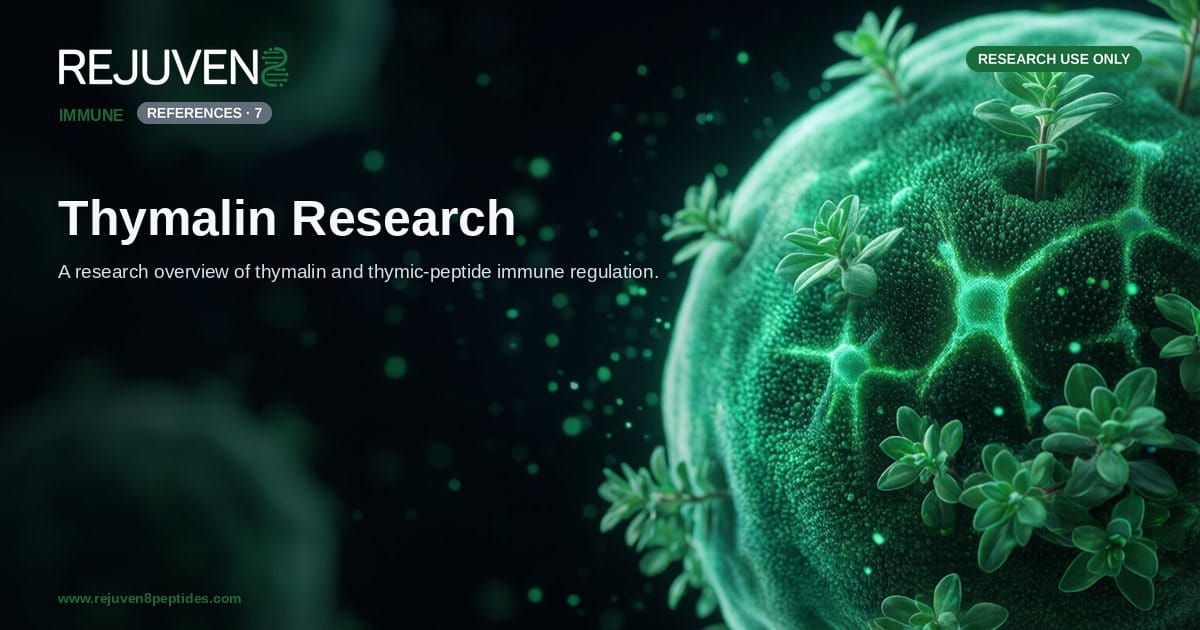
Thymalin is a thymic polypeptide preparation that has been studied primarily within Russian and international peptide bioregulator research programs. It is not a single synthetic molecule but a complex of low-molecular-weight polypeptide fractions historically isolated from thymus tissue. Laboratory interest in thymalin centers on the thymus, the organ in which T-lymphocytes mature, and on the broader question of how small peptides derived from thymic tissue may function as signaling factors in models of immune regulation. Every statement in this overview describes investigational, laboratory-scale work and is provided for educational purposes only.
The thymus produces a family of peptide factors that have been examined for their possible role in thymopoiesis (the development and maturation of T-cells) and in the coordination of immune signaling. Thymalin sits alongside more precisely defined thymic peptides such as thymosin alpha-1 and thymulin within this investigational landscape. The material below summarizes what these compounds are studied for in preclinical, in-vitro, and animal research settings. It does not describe human use, and anyone evaluating a lyophilized research material should also review independent purity documentation, for example through a certificate of analysis guide.
What Is Thymalin?
Thymalin is best understood as a polypeptide fraction rather than a purified single-sequence peptide. Preparations described in the literature are obtained from thymus tissue and contain several polypeptide components of differing size. Because it is a mixture, thymalin does not carry one exact molecular weight or one defined amino-acid sequence in the way that a chemically synthesized peptide does. That distinction shapes how it is characterized, compared, and discussed in the research record.
Origin and the Peptide Bioregulator Concept
Much of the foundational work associated with thymalin comes from researchers including V. G. Morozov and V. Kh. Khavinson, who described a class of short peptide bioregulators extracted from animal tissues. Within that framework, thymic peptides were investigated as tissue-specific signaling candidates that might influence the maturation of immune cells in experimental systems. This body of work is mechanistic and preclinical: it explores biological plausibility in models, and it does not establish outcomes in people.
Identity at a Glance
The following values reflect commonly reported laboratory attributes and are provided for comparison only.
| Attribute | Commonly Reported Description |
|---|---|
| Research name | Thymalin |
| Compound class | Thymic polypeptide complex (peptide bioregulator) |
| Typical source material | Thymus tissue (calf or bovine origin) |
| Molecular character | Mixture of low-molecular-weight polypeptide fractions (components commonly cited below approximately 10 kDa) |
| Defined single sequence | No (complex fraction, not one peptide) |
| Physical form | Lyophilized powder |
| Primary research context | Thymic peptide signaling and immune regulation (preclinical) |
The Thymus and Immune Regulation Pathways
The scientific rationale for studying thymalin rests on the biology of the thymus, a lymphoid organ that serves as the principal site of T-lymphocyte education. Understanding why thymic peptides attract research attention requires a brief look at what the thymus does and how its local signaling environment is thought to operate.
Thymopoiesis and T-cell Maturation
Within the thymus, progenitor cells undergo thymopoiesis, a staged process of proliferation, selection, and maturation that produces functional T-cells. Positive and negative selection help shape a repertoire of cells that can respond to foreign targets while limiting reactivity to self. Because this process declines with age in a pattern often described as thymic involution, researchers have long asked whether thymus-derived peptides participate in regulating it. That question is the backdrop against which thymalin and related fractions are examined in animal and cell-based models.
Thymic Peptides as Signaling Candidates
Thymic peptides are studied as possible signaling molecules that could influence immune-cell differentiation and cytokine-related activity in controlled experiments. In this context, thymalin is investigated for effects reported in laboratory systems on markers of lymphocyte maturation. It is important to frame these observations correctly: they are preclinical findings in models, not evidence of clinical immune therapy. No claim of human immune benefit is made or implied here, and mechanistic interest does not translate into demonstrated efficacy.
Thymalin Within the Family of Thymic Peptides
Thymalin is frequently discussed alongside several better-characterized thymic peptides. Placing it next to those molecules clarifies what makes thymalin distinctive: it is a fraction complex, whereas the comparators are single, sequence-defined peptides with known molecular weights. The comparison also illustrates the range of sizes within this research class, from a pentapeptide fragment to a mixture of larger polypeptides.
The following values reflect commonly reported laboratory attributes and are provided for comparison only.
| Peptide | Class / Character | Approximate Size | Studied Research Focus |
|---|---|---|---|
| Thymalin | Thymic polypeptide complex | Multiple fractions (low kDa, components commonly cited below ~10 kDa) | Thymic peptide immunoregulation in animal and in-vitro models |
| Thymosin alpha-1 | Single defined peptide | 28 amino acids (~3.1 kDa) | T-cell differentiation signaling |
| Thymulin | Zinc-dependent nonapeptide | 9 amino acids (~0.9 kDa) | Thymic hormone signaling |
| Thymopentin | Pentapeptide fragment of thymopoietin | 5 amino acids (~0.7 kDa) | Active-site modeling of thymopoietin |
The practical takeaway is that thymalin cannot be reduced to a single formula. Where thymosin alpha-1, thymulin, and thymopentin each map to one molecular structure, thymalin represents a set of co-isolated polypeptides, which is why purity characterization for such preparations is handled differently from that of a defined synthetic peptide.
Laboratory Handling and Verification
Like many research peptides, thymalin is typically supplied as a lyophilized powder that must be handled with attention to reconstitution, storage, and documentation. These are laboratory considerations, not usage instructions.
Reconstitution and Storage
Lyophilized peptide fractions are generally reconstituted with a suitable diluent and kept cold, with repeated freeze-thaw cycles minimized to protect peptide integrity. General technique for preparing and diluting such materials is covered in a dedicated bacteriostatic water reconstitution guide, so it is not restated at length here. Because thymalin is a fraction complex rather than a single peptide, any concentration figure describes total reconstituted solids in the vial rather than a precise molar amount of one molecule.
Purity and Supplier Verification
Verification matters more, not less, for a mixture. Independent analytical documentation helps a laboratory understand what a preparation actually contains. Reviewing a certificate of analysis, checking published testing certificates, and applying a structured approach to supplier vetting are all standard parts of responsible sourcing. Researchers comparing options can also browse verified materials in the Rejuven8 research peptide catalog. All such materials are supplied for research use only, not for human consumption, and thymalin itself is discussed here strictly as an investigational compound.
Frequently Asked Questions
What is thymalin?
Thymalin is a thymic polypeptide preparation, a complex of low-molecular-weight peptide fractions historically isolated from thymus tissue. It is studied as a peptide bioregulator in preclinical immune-signaling research and is handled strictly as a research material.
Is thymalin a single peptide or a peptide mixture?
Thymalin is a mixture. Unlike a synthetic single-sequence peptide, it consists of several polypeptide fractions, so it does not have one defined amino-acid sequence or a single exact molecular weight.
What is thymalin studied for in research?
Laboratory research examines thymalin in the context of thymic peptide signaling and immune regulation, including thymopoiesis and T-cell maturation, using in-vitro and animal models. These are mechanistic investigations and not demonstrations of human benefit.
How does thymalin differ from thymosin alpha-1?
Thymosin alpha-1 is a single, well-defined peptide of 28 amino acids, while thymalin is a complex of polypeptide fractions. Both are studied within thymic peptide research, but thymosin alpha-1 has a precise sequence and molecular weight whereas thymalin does not.
What is the molecular weight of thymalin?
Because thymalin is a fraction mixture, no single molecular weight applies. Reported polypeptide components are commonly cited below approximately 10 kDa, and any such figure should be treated as a comparative laboratory attribute only.
Is thymalin approved for human use?
No. Thymalin discussed here is a research-use-only material, not for human consumption. The information provided is for scientific and educational purposes and does not describe any human therapeutic application.
References and Further Reading
- PubMed: thymalin – Primary search for peer-reviewed studies on the thymalin polypeptide preparation.
- PubMed: Khavinson peptide bioregulators – Foundational work on tissue-derived peptide bioregulators, including thymic fractions.
- PubMed: thymic peptides immune regulation – Reviews of thymic peptides in preclinical immune-signaling research.
- PubMed: thymosin alpha-1 – Literature on the defined 28 amino-acid thymic peptide often compared with thymalin.
- PubMed: thymulin – Studies on the zinc-dependent nonapeptide thymic factor.
- PubMed: thymopentin – Research on the pentapeptide fragment modeled on thymopoietin.
- PubMed: thymus T lymphocyte maturation – Background on thymopoiesis and T-cell development in the thymus.