Research Use Only. The information presented here is for scientific and educational purposes. These compounds are not intended for human consumption, self-administration, or therapeutic use.
Introduction
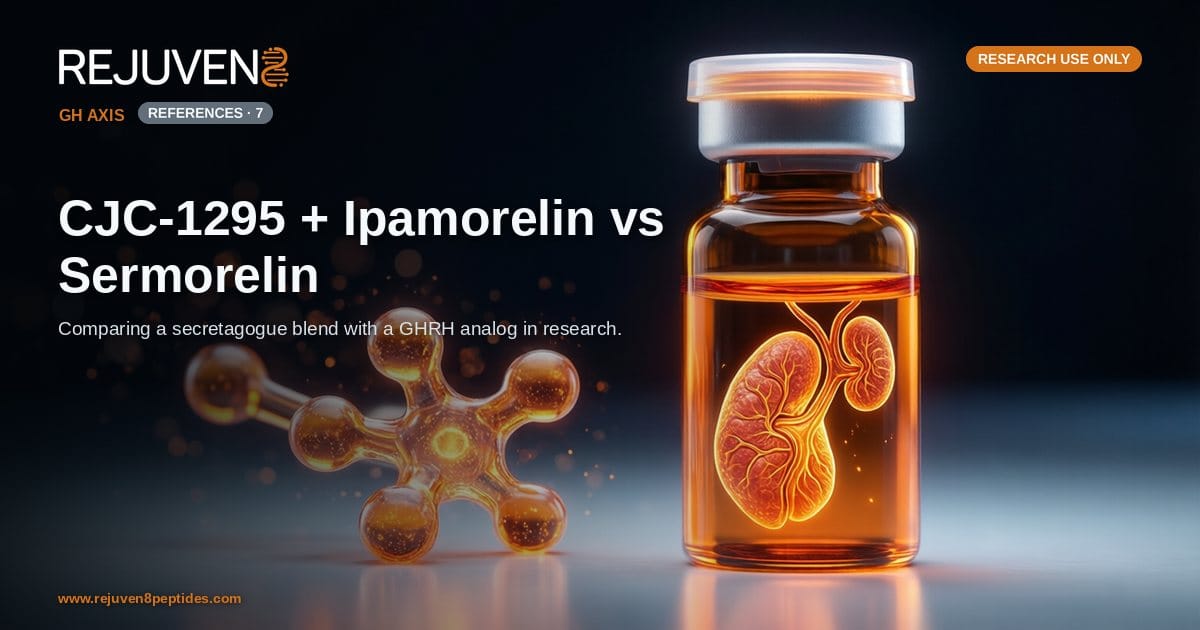
Growth hormone secretagogues are among the most studied peptide classes in endocrine research, and two research models are frequently placed side by side: the CJC-1295 + Ipamorelin blend and Sermorelin. Each is investigated for how it interacts with the somatotropic axis, the signaling network that governs pulsatile release of growth hormone (GH) from the anterior pituitary. Although all three peptides converge on the same downstream readout, namely GH secretion, they engage the axis through distinct receptor systems, which is exactly what makes them useful comparison points in laboratory study.
Sermorelin is a truncated analog of growth hormone-releasing hormone (GHRH), while the blend pairs a modified GHRH analog (CJC-1295) with a selective ghrelin-receptor agonist (Ipamorelin). This article compares the two as GH-secretagogue research models, examining their molecular identities, receptor targets, and the reasons investigators reach for a single-pathway analog versus a dual-pathway combination. All material here is provided for research use only, not for human consumption.
Two Models of GH-Secretagogue Research
The somatotropic axis responds to two complementary inputs: GHRH, which stimulates GH synthesis and release, and ghrelin, which acts on the growth hormone secretagogue receptor (GHS-R1a) to amplify and sustain that release. The peptides compared here map neatly onto these two inputs, which is the conceptual foundation of the comparison.
The Single-Pathway GHRH Analog: Sermorelin
Sermorelin corresponds to the first 29 amino acids of native GHRH, the shortest fragment that retains full receptor activity. In research settings it is studied as a GHRH-receptor agonist that promotes GH release while preserving endogenous feedback, since somatostatin can still restrain the response. Its short plasma half-life, reported in the literature at roughly 10 to 20 minutes, makes it a model for transient, physiologically patterned GHRH signaling. Sermorelin remains available as an individual Sermorelin research compound for laboratories studying the GHRH arm in isolation.
The Dual-Pathway Blend: CJC-1295 + Ipamorelin
The CJC-1295 + Ipamorelin blend combines two mechanisms in a single preparation. CJC-1295 is a modified GHRH(1-29) analog engineered with amino acid substitutions (and, in its DAC form, an albumin-binding group) that extend its resistance to enzymatic breakdown. Ipamorelin is a selective pentapeptide agonist of GHS-R1a, the ghrelin receptor, and is frequently described as the first growth hormone secretagogue with high selectivity for GH over cortisol and prolactin. Pairing a GHRH analog with a ghrelin mimetic is studied because the two pathways are reported to act synergistically: the GHRH analog raises the pool of GH available for release, while the ghrelin-receptor agonist increases the amplitude of each secretory pulse. The combined preparation is offered as the CJC-1295 + Ipamorelin blend for comparative axis research.
Molecular Identity of the Three Peptides
Comparing the peptides at the molecular level clarifies why they behave differently at the pituitary. The following values reflect commonly reported laboratory attributes and are provided for comparison only.
| Attribute | Sermorelin | CJC-1295 | Ipamorelin |
|---|---|---|---|
| Class | GHRH analog | Long-acting GHRH analog | Selective GH secretagogue (ghrelin mimetic) |
| Sequence length | 29 amino acids | ~30 amino acids (modified GHRH 1-29) | 5 amino acids (pentapeptide) |
| Approx. molecular weight | ~3358 g/mol | ~3647 g/mol (DAC form) | ~712 g/mol |
| Primary receptor target | GHRH receptor | GHRH receptor | GHS-R1a (ghrelin receptor) |
| Structural basis | Native GHRH(1-29) | GHRH(1-29) with stabilizing substitutions | Aib-His-D-2-Nal-D-Phe-Lys-NH2 |
Two observations stand out. First, Sermorelin and CJC-1295 are both large GHRH-based peptides that dock at the same receptor, so their differences are primarily kinetic rather than mechanistic. Second, Ipamorelin is a much smaller molecule that targets an entirely separate receptor, which is why it contributes a distinct pathway rather than reinforcing the GHRH signal.
Side-by-Side Research Comparison
Beyond structure, investigators weigh how each model behaves within the axis. The attributes below reflect commonly reported laboratory attributes and are provided for comparison only.
| Research attribute | Sermorelin | CJC-1295 + Ipamorelin blend |
|---|---|---|
| Pathways engaged | GHRH receptor only (single pathway) | GHRH receptor plus GHS-R1a (dual pathway) |
| Active peptides | One | Two |
| Reported duration character | Short, on the order of minutes | Extended GHRH tone (CJC-1295 DAC reported in days) with pulse amplification (Ipamorelin, hours) |
| Selectivity note | GHRH-receptor specific | Ipamorelin reported as selective for GH with minimal cortisol and prolactin effect in animal studies |
| Feedback context | Retains somatostatin restraint | Both components studied within intact feedback loops |
| Typical research framing | Isolating the GHRH arm | Studying GHRH and ghrelin synergy |
In short, Sermorelin is often chosen when a study needs a clean, short-acting GHRH stimulus, whereas the blend is selected when the research question centers on how sustained GHRH tone and ghrelin-receptor activation combine. Neither is inherently superior; they answer different questions. Related single-agent models such as CJC-1295, Ipamorelin, and Tesamorelin are frequently referenced alongside these two for broader axis mapping.
Research Handling and Sourcing Considerations
Whichever model a protocol calls for, handling practices are broadly similar across GHRH analogs and secretagogue blends. These peptides are typically supplied as lyophilized powder and reconstituted with bacteriostatic water before use. As a worked example, reconstituting a 5 mg vial with 2 mL of bacteriostatic water yields a nominal 2.5 mg/mL stock for laboratory calculations. Reconstituted material is generally kept cold with freeze-thaw cycling minimized to protect peptide integrity.
Because a blend contains two active peptides, lot-to-lot verification matters even more than it does for a single-compound vial. Reviewing a certificate of analysis confirms identity and purity for each component, and third-party certificates document independent testing. Investigators comparing suppliers can consult a supplier vetting guide to standardize sourcing criteria, and the full catalog of lab-tested research peptides lists available GH-axis models for comparative work.
Frequently Asked Questions
What is the difference between CJC-1295 + Ipamorelin and Sermorelin?
Sermorelin is a single GHRH(1-29) analog that engages only the GHRH receptor, while the CJC-1295 + Ipamorelin blend combines a longer-acting GHRH analog with a selective ghrelin-receptor agonist. As a result, the blend is studied as a dual-pathway model rather than a single-pathway one.
Why do researchers combine CJC-1295 with Ipamorelin?
The two peptides act on different receptors, the GHRH receptor and the ghrelin receptor GHS-R1a. Laboratory reports describe these pathways as complementary, with the GHRH analog raising the pool of available growth hormone and the ghrelin mimetic amplifying the size of each secretory pulse.
Is Ipamorelin a GHRH analog?
No. Ipamorelin is a selective pentapeptide agonist of the growth hormone secretagogue receptor (GHS-R1a), the ghrelin receptor. It is structurally unrelated to GHRH and is often cited as the first secretagogue with high selectivity for GH over cortisol and prolactin.
How does Sermorelin compare with CJC-1295 in duration?
Sermorelin has a short reported plasma half-life of roughly 10 to 20 minutes, whereas CJC-1295 (particularly the DAC form) is engineered for extended stability, with half-life reported in days. This kinetic gap is a central reason the two are studied as distinct GHRH models.
Are these peptides interchangeable in research?
They are not interchangeable. Because Sermorelin isolates the GHRH arm while the blend probes GHRH and ghrelin synergy, each model addresses different research questions about the somatotropic axis.
How should these peptides be stored and verified?
Research peptides are typically supplied as lyophilized powder, reconstituted with bacteriostatic water, and kept cold with minimal freeze-thaw cycling. Purity should be confirmed against a certificate of analysis before any laboratory work begins.
References and Further Reading
- Guillemin R and colleagues, characterization of growth hormone-releasing hormone. PubMed: growth hormone releasing hormone GHRH
- Sermorelin as the biologically active GHRH(1-29) fragment. PubMed: sermorelin GHRH 1-29
- Teichman SL and colleagues (2006), prolonged GH and IGF-I stimulation by CJC-1295. PubMed: CJC-1295 growth hormone
- Raun K and colleagues (1998), Ipamorelin as a selective growth hormone secretagogue. PubMed: ipamorelin growth hormone secretagogue
- Kojima M and colleagues (1999), ghrelin and the GHS-R1a receptor. PubMed: ghrelin GHS-R receptor
- Bowers CY, synergy between GHRH and growth hormone-releasing peptides. PubMed: GHRH GHRP synergy growth hormone
- Pulsatile growth hormone secretion and the somatotropic axis. PubMed: pulsatile growth hormone secretion somatotropic axis