Research Use Only. The information presented here is for scientific and educational purposes. These compounds are not intended for human consumption, self-administration, or therapeutic use.
Introduction
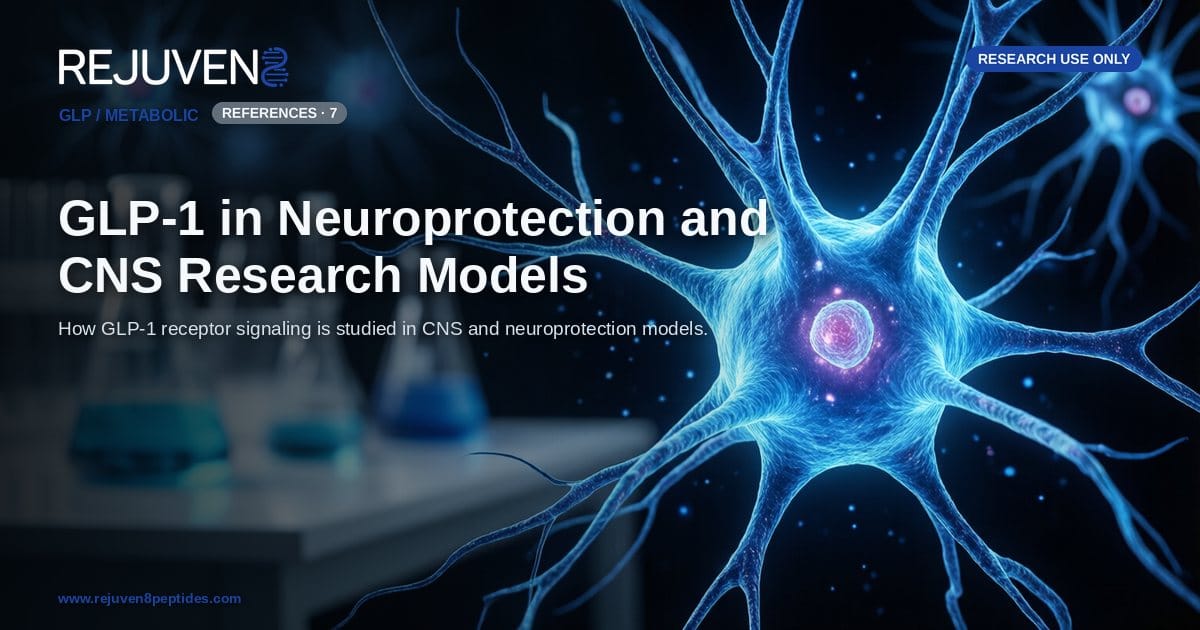
Glucagon-like peptide-1 (GLP-1) is an incretin peptide best known for its role in glucose-dependent insulin secretion, but its receptor is not confined to the pancreas and gut. The GLP-1 receptor (GLP-1R), a class B G-protein-coupled receptor, is expressed across several regions of the central nervous system, including the hippocampus, cortex, hypothalamus, and brainstem. This distribution has made GLP-1R signaling a recurring subject in preclinical neuroprotection research, where investigators examine how receptor activation influences neuronal survival, inflammation, and synaptic function in laboratory models.
This overview summarizes how GLP-1R signaling is studied in cell-culture and animal models of central nervous system stress, the intracellular pathways that are most often measured, and the categories of disease-oriented models used to probe neuronal resilience. It also describes where the research analog GLP-1 SM fits within a laboratory workflow. Every mechanism discussed below reflects in-vitro or animal research; none of it describes human use, dosing, or clinical outcomes. These materials are for research use only, not for human consumption.
The GLP-1 System in the Central Nervous System
Endogenous GLP-1 within the brain is produced largely by preproglucagon neurons in the nucleus tractus solitarius of the brainstem, which project widely to forebrain and hypothalamic targets. Peripheral GLP-1 and GLP-1R agonists are also studied for their ability to reach central sites, and several research analogs have been reported to cross the blood-brain barrier to varying degrees in animal studies. Because receptor expression overlaps with regions tied to learning and motor control in rodents, these areas are frequent focal points in neuroprotection experiments.
Receptor class and signaling
GLP-1R is a class B (secretin-family) GPCR. In neurons and glia, receptor activation is most commonly linked to increased cyclic AMP (cAMP) and downstream protein kinase A (PKA) activity, along with engagement of the PI3K/Akt and MAPK/ERK cascades. These pathways converge on transcription factors such as CREB, which is frequently used as a readout in studies of neuronal gene expression and plasticity.
Molecular identity
The values below reflect commonly reported laboratory attributes and are provided for comparison only.
| Attribute | Reported value |
|---|---|
| Peptide reference form | GLP-1(7-36) amide |
| Sequence length | Approximately 30 amino acids |
| Approximate molecular weight | About 3298 Da |
| Class | Incretin, glucagon-superfamily peptide |
| Primary receptor | GLP-1R (class B GPCR) |
| Principal signaling | cAMP/PKA, PI3K/Akt, MAPK/ERK |
Mechanisms Studied in Neuroprotection Models
Across preclinical reports, several overlapping mechanisms are examined when GLP-1R activation is applied to stressed neurons. The endpoints below are among the most frequently quantified.
Anti-apoptotic signaling
Activation of PI3K/Akt is associated in cell models with reduced pro-apoptotic signaling, including shifts in the Bax/Bcl-2 ratio and lower caspase-3 activity. These endpoints are commonly used to quantify neuronal survival after a toxic insult.
Neuroinflammation
In glial cultures and animal models, GLP-1R signaling is studied for its effect on microglial activation and the release of inflammatory mediators such as TNF-alpha and IL-1beta. Reduced markers of reactive astrogliosis are another frequently reported readout in these systems.
Oxidative stress and mitochondria
Investigators also measure markers of oxidative stress and mitochondrial function, including reactive oxygen species accumulation and mitochondrial membrane potential, to assess whether receptor activation preserves bioenergetic capacity under toxic conditions.
Neurogenesis and plasticity
Some studies examine hippocampal neurogenesis, dendritic morphology, and long-term potentiation as measures of synaptic plasticity in models where GLP-1R agonists are applied. These outcomes are typically reported alongside behavioral tasks in rodents.
Preclinical CNS Models
GLP-1R signaling has been investigated in a range of disease-oriented laboratory systems. The choice of model depends on the type of neuronal stress under study, and results are interpreted strictly within that experimental context.
Cell-culture systems
In-vitro work often uses SH-SY5Y neuroblastoma cells or primary hippocampal and cortical neurons, exposed to toxins such as 6-hydroxydopamine, amyloid-beta fragments, or glutamate to model excitotoxicity. These systems allow tight control over concentration and timing when signaling pathways are dissected.
Animal models
Rodent studies commonly include the MPTP and 6-OHDA models associated with Parkinsonian pathology, transgenic APP/PS1 and streptozotocin-induced models associated with Alzheimer-type pathology, and middle cerebral artery occlusion (MCAO) models of cerebral ischemia. Each pairs a defined insult with quantitative structural and functional readouts.
The values below reflect commonly reported laboratory attributes and are provided for comparison only.
| Model | System | Typical insult | Common readouts |
|---|---|---|---|
| SH-SY5Y culture | In vitro | 6-OHDA, amyloid-beta, glutamate | Viability, caspase-3, ROS |
| MPTP mouse | In vivo | Dopaminergic toxin | Tyrosine hydroxylase, motor tests |
| APP/PS1 mouse | In vivo | Amyloid overexpression | Plaque load, memory tasks |
| MCAO rat | In vivo | Transient ischemia | Infarct volume, neuroscore |
GLP-1 SM in a Research Setting
GLP-1 SM is a GLP-1 receptor agonist analog offered strictly as a research compound. In neuroprotection studies it functions as a tool for probing GLP-1R-dependent signaling in the cell and animal systems described above, rather than as any form of treatment. Investigators typically characterize the peptide by identity and purity before use, which is why current analytical documentation matters when planning reproducible experiments.
Handling and verification
Like other lyophilized research peptides, GLP-1 SM is generally stored cold and protected from repeated freeze-thaw cycles, then reconstituted for a given experiment. Reviewing the certificate of analysis and purity documentation helps confirm that a vial matches its stated identity, and comparing sources against a clear supplier vetting checklist supports consistent results across batches.
Research groups comparing GLP receptor tools may also review related analogs such as GLP-2 TZ and GLP-3 RT, or browse the full research peptide catalog. Product specifications for this compound are listed on the GLP-1 SM page. In all cases, these materials remain laboratory reagents intended only for controlled preclinical study.
Frequently Asked Questions
What is GLP-1 and where is its receptor found in the brain?
GLP-1 is an incretin peptide, and its receptor (GLP-1R) is expressed in several central nervous system regions studied in research, including the hippocampus, cortex, hypothalamus, and brainstem. This distribution is why GLP-1R signaling is examined in neuroprotection models.
How is GLP-1 receptor signaling studied for neuroprotection?
In preclinical work, researchers apply GLP-1R agonists to stressed neurons or model animals and measure endpoints such as cell viability, apoptotic markers, inflammatory mediators, and oxidative stress. The cAMP/PKA, PI3K/Akt, and MAPK/ERK pathways are commonly monitored.
Which preclinical models are used to study GLP-1 in the CNS?
Common systems include SH-SY5Y cultures and primary neurons in vitro, along with MPTP and 6-OHDA Parkinsonian models, APP/PS1 and streptozotocin Alzheimer-type models, and MCAO ischemia models in rodents.
Does GLP-1 cross the blood-brain barrier in research models?
Animal studies report that GLP-1 and certain receptor agonists can reach central sites to varying degrees. Endogenous central GLP-1 is also produced by preproglucagon neurons in the brainstem, which project broadly within the brain.
What is GLP-1 SM used for in research?
GLP-1 SM is a GLP-1 receptor agonist analog supplied as a research compound. It is used as a laboratory tool to probe GLP-1R-dependent signaling in cell and animal models. It is not intended for human use, and it is for research use only.
How is GLP-1 SM handled in the laboratory?
As a lyophilized peptide, it is generally stored cold, protected from repeated freeze-thaw cycles, and reconstituted before an experiment. Reviewing the certificate of analysis helps confirm identity and purity for reproducible work.
References and Further Reading
- Holst JJ and colleagues, foundational work on GLP-1 physiology and receptor biology. PubMed: GLP-1 physiology receptor
- Holscher C and colleagues, reviews of GLP-1 receptor agonists in neurodegeneration models. PubMed: GLP-1 neuroprotection
- Greig NH and colleagues, GLP-1 based approaches in preclinical neurodegeneration research. PubMed: GLP-1 receptor agonist neurodegeneration
- Preclinical studies of GLP-1R signaling in MPTP and 6-OHDA Parkinsonian models. PubMed: GLP-1 MPTP Parkinson model
- Reports on GLP-1 receptor expression and distribution in the central nervous system. PubMed: GLP-1 receptor brain expression
- Studies of GLP-1R activation in cerebral ischemia and MCAO models. PubMed: GLP-1 cerebral ischemia
- Investigations of GLP-1R signaling with amyloid-beta in hippocampal models. PubMed: GLP-1 amyloid beta hippocampus