Research Use Only. The information presented here is for scientific and educational purposes. These compounds are not intended for human consumption, self-administration, or therapeutic use.
Introduction
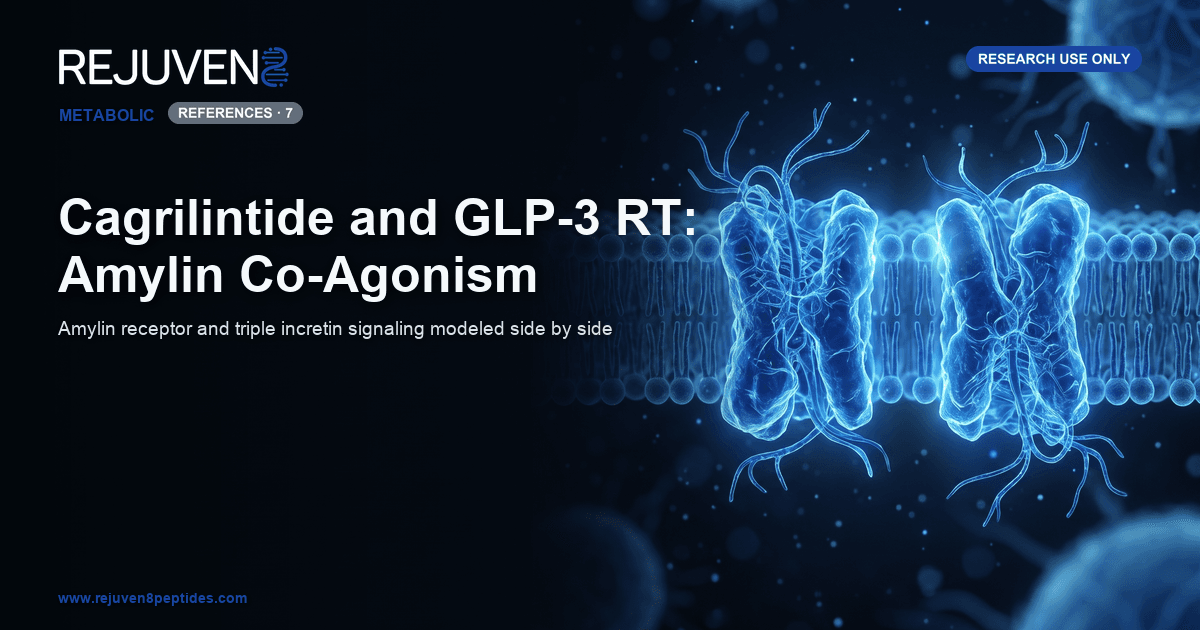
Cagrilintide and GLP-3 RT sit on two different branches of the peptide hormone family tree. Cagrilintide is a long-acting analog of amylin, the 37-residue hormone co-secreted with insulin from pancreatic beta cells, and it signals through the calcitonin receptor and its amylin-receptor heteromers. GLP-3 RT is a multi-receptor incretin peptide built on a GIP-like scaffold that engages the GLP-1, GIP, and glucagon receptors at once. Because the two peptides address non-overlapping receptor systems that converge on the same physiological questions (food intake, energy balance, and nutrient handling), laboratories increasingly study them side by side or in combination models.
This article explains the receptor biology behind each compound, why the amylin and incretin arms are modeled together in preclinical research, and the molecular attributes that distinguish the two peptides. The material summarizes in-vitro pharmacology and rodent studies only. Both compounds are supplied for research use only, not for human consumption, and nothing here describes an outcome in people.
Cagrilintide: A Long-Acting Amylin Analog
Structure and Design
Native amylin aggregates readily into amyloid fibrils, which limits its usefulness as a research tool in solution. Cagrilintide retains the proline substitutions first introduced in pramlintide, an earlier amylin analog, to suppress fibril formation, and adds further substitutions that improve solubility and physical stability. A C20 fatty diacid attached through a short linker lets the peptide bind albumin and persist in circulation far longer than the native hormone in rodent models. The 2021 medicinal chemistry description of the compound (Kruse and colleagues) documents this stepwise design; the resulting 37-residue peptide has an approximate mass of 4,409 Da.
Receptor Pharmacology
Amylin receptors are not single proteins. Each is a heteromer of the calcitonin receptor (CTR) with one of three receptor activity-modifying proteins: CTR plus RAMP1 forms AMY1, CTR plus RAMP2 forms AMY2, and CTR plus RAMP3 forms AMY3. Pharmacological characterization from the Sexton and Wootten laboratories at Monash University (published 2021 under the research code AM833) showed that cagrilintide is a non-selective agonist, activating CTR alone as well as the AMY heteromers, placing it in the dual amylin and calcitonin receptor agonist category. A 2025 study in receptor-deficient mice attributed the peptide’s effect on food intake and body weight to AMY1 and AMY3 receptors in the brain, with the hindbrain area postrema identified as a primary site of action. Hydrogen-deuterium exchange mass spectrometry work published in 2026 has since shown that each RAMP reshapes CTR conformational dynamics differently, a structural clue to why the AMY subtypes respond differently to one ligand. Further background appears in the Cagrilintide research profile.
GLP-3 RT: The GLP-3 Peptide and Triple Incretin Agonism
What Is the GLP-3 Peptide?
“GLP-3 peptide” is the shorthand under which researchers search for third-generation incretin research peptides: single molecules that activate three receptors. GLP-3 RT is a 39-amino-acid peptide built on a modified GIP backbone, with residues borrowed from GLP-1 and glucagon so that one sequence docks productively at the GLP-1 receptor (GLP-1R), the GIP receptor (GIPR), and the glucagon receptor (GCGR). Like cagrilintide it carries a C20 fatty diacid for albumin binding, and it includes non-natural residues that resist the enzyme DPP-4. Its approximate mass is 4,731 Da, and it is profiled in detail in the GLP-3 RT listing.
Three Receptors, Three Contributions
The rationale for triple agonism emerged from unimolecular multi-agonist research led by DiMarchi, Tschoep, Mueller, and Finan in the 2010s. In rodent models, GLP-1R activation reduces food intake and slows gastric emptying; GIPR activation adds to the reduction in intake and, in hindbrain studies, appears to dampen the aversive responses that pure GLP-1R agonists can provoke; and GCGR activation raises energy expenditure and hepatic lipid turnover. A 2022 Cell Metabolism discovery report of a GIP-based triple agonist, together with 2022 to 2025 mouse studies of next-generation triple agonists, describes greater reductions in body weight and liver fat in high-fat-diet mice than single- or dual-receptor comparators achieve. Single-receptor comparisons are discussed in the GLP-1 SM profile.
Why Amylin and Incretin Pathways Are Modeled Together
Distinct Neural Populations
The strongest argument for studying the two arms together is anatomical. Work from Thomas Lutz’s group at the University of Zurich showed that amylin and GLP-1 receptor agonists activate largely separate populations of area postrema neurons in rats, both modulated by nutrient signals. Amylin is characterized as a meal-terminating satiation signal acting first through the hindbrain (area postrema and nucleus of the solitary tract) and relaying onward to the lateral parabrachial nucleus and hypothalamus, whereas GLP-1R agonists reach hypothalamic feeding circuits and hindbrain sites through partly independent routes. Two signals arriving through different neurons provide a mechanistic basis for the additive effects seen when both pathways are engaged.
Complementary Peripheral Actions
The two families also diverge peripherally. Amylin suppresses post-meal glucagon secretion and slows gastric emptying; GIPR and GCGR signaling act on adipose and hepatic lipid metabolism and on energy expenditure. Rodent studies pairing long-acting amylin analogs with GLP-1R agonists, and more recently with multi-receptor incretin agonists, report additive or greater-than-additive reductions in food intake, body weight, and fat mass, and a 2025 report on a unimolecular GLP-1 and amylin receptor co-agonist in mice and rats reached the same conclusion from a single-molecule design. The receptor systems involved are summarized below; these values reflect commonly reported laboratory attributes and are provided for comparison only.
| Receptor System | Engaged By | Principal Sites Studied | Preclinical Readouts |
|---|---|---|---|
| Calcitonin receptor (CTR) | Cagrilintide | Hindbrain, bone, kidney | cAMP signaling, food intake |
| AMY1 (CTR + RAMP1) | Cagrilintide | Area postrema, hypothalamus | Food intake, body weight in mice |
| AMY3 (CTR + RAMP3) | Cagrilintide | Area postrema, hypothalamus | Food intake, body weight in mice |
| GLP-1R | GLP-3 RT | Hypothalamus, hindbrain, pancreas | Food intake, gastric emptying, insulin release |
| GIPR | GLP-3 RT | Hindbrain, adipose, pancreas | Food intake, reduced aversion, lipid handling |
| GCGR | GLP-3 RT | Liver, adipose | Energy expenditure, hepatic lipid turnover |
Cagrilintide and GLP-3 RT Compared
The two peptides are similar in size and albumin-binding strategy but differ in scaffold, receptor family, and the physiology they probe. The values below reflect commonly reported laboratory attributes and are provided for comparison only.
| Attribute | Cagrilintide | GLP-3 RT |
|---|---|---|
| Class | Long-acting amylin analog (dual amylin and calcitonin receptor agonist) | Triple incretin agonist |
| Scaffold | Amylin, via pramlintide-type substitutions | Modified GIP |
| Sequence length | 37 amino acids | 39 amino acids |
| Approx. molecular weight | ~4,409 Da | ~4,731 Da |
| Lipidation | C20 fatty diacid via linker | C20 fatty diacid via linker |
| Receptor targets | CTR, AMY1, AMY2, AMY3 | GLP-1R, GIPR, GCGR |
| Primary CNS site studied | Area postrema (hindbrain) | Hypothalamus and hindbrain |
| Distinctive peripheral arm | Glucagon suppression, gastric emptying | Energy expenditure via GCGR |
In practice the two compounds are variables in different experimental arms rather than substitutes for one another. Both are lipidated lyophilized peptides of roughly 4.4 to 4.7 kDa, so both call for cold-chain shipping, storage at -20 C before reconstitution, and lot-specific identity and purity verification; the guide to reading a peptide COA explains what HPLC and mass spectrometry reports should show for peptides in this mass range. Laboratories investigating cagrilintide alongside the incretin family can find both compounds in the research peptide catalog.
Frequently Asked Questions
What is cagrilintide and what is it studied for?
Cagrilintide is a 37-amino-acid, lipidated analog of the pancreatic hormone amylin. In preclinical research it is studied as a non-selective agonist of the calcitonin receptor and the AMY1, AMY2, and AMY3 amylin receptors, with rodent work focused on food intake, body weight, gastric emptying, and glucagon suppression.
What is the GLP-3 peptide?
GLP-3 peptide is the search term researchers use for third-generation incretin peptides that activate three receptors at once. GLP-3 RT is a 39-amino-acid, GIP-based research peptide engineered to act at the GLP-1, GIP, and glucagon receptors, and it is studied in rodent models for effects on food intake, energy expenditure, and hepatic lipid metabolism.
How does cagrilintide differ from GLP-3 RT?
Cagrilintide signals through the calcitonin receptor family (CTR plus RAMP heteromers) and acts primarily in the hindbrain area postrema, whereas GLP-3 RT signals through three incretin-family receptors (GLP-1R, GIPR, GCGR) across the hypothalamus, hindbrain, pancreas, liver, and adipose tissue.
Why are amylin and GLP-1 pathways combined in research models?
Studies from the University of Zurich showed that amylin and GLP-1 receptor agonists activate largely separate populations of area postrema neurons in rats, and rodent combination studies report additive or greater-than-additive reductions in food intake and body weight when both pathways are engaged.
Which receptors does cagrilintide activate?
Monash University pharmacology characterized cagrilintide (research code AM833) as a non-selective agonist of the calcitonin receptor and of AMY1, AMY2, and AMY3, the heteromers of CTR with RAMP1, RAMP2, and RAMP3. A 2025 mouse study attributed its central effect on food intake mainly to AMY1 and AMY3.
Are cagrilintide and GLP-3 RT intended for human use?
No. Both are supplied strictly for laboratory research and are not intended for human consumption, self-administration, or therapeutic use. The findings summarized here come from in-vitro pharmacology and rodent models only.
References and Further Reading
- Kruse and colleagues, development of cagrilintide as a long-acting amylin analog, medicinal chemistry description, 2021. PubMed: cagrilintide long-acting amylin analogue development
- Fletcher, Sexton, Wootten and colleagues (Monash University), pharmacological comparison of AM833 with selective and non-selective calcitonin-family receptor agonists, 2021. PubMed: AM833 calcitonin family receptors agonist pharmacological comparison
- 2025 study in receptor-deficient mice attributing cagrilintide’s effect on food intake and body weight to brain amylin receptors 1 and 3. PubMed: cagrilintide amylin receptors 1 and 3 brain
- Lutz and colleagues (University of Zurich) on amylin and GLP-1 targeting different populations of area postrema neurons in rats. PubMed: amylin GLP-1 area postrema neurons different populations
- Hydrogen-deuterium exchange mass spectrometry studies of calcitonin receptor and RAMP conformational dynamics, 2026. PubMed: amylin receptor conformational dynamics hydrogen-deuterium exchange
- Discovery and rodent characterization of GIP-based GLP-1, GIP, and glucagon receptor triple agonists, 2022 to 2025. PubMed: GLP-1 GIP glucagon triple agonist mice
- Preclinical studies combining long-acting amylin analogs with GLP-1 receptor agonists, and unimolecular GLP-1 and amylin receptor co-agonists in mice and rats, 2019 to 2025. PubMed: amylin analogue GLP-1 receptor agonist combination rodent