Research Use Only. The information presented here is for scientific and educational purposes. These compounds are not intended for human consumption, self-administration, or therapeutic use.
Introduction
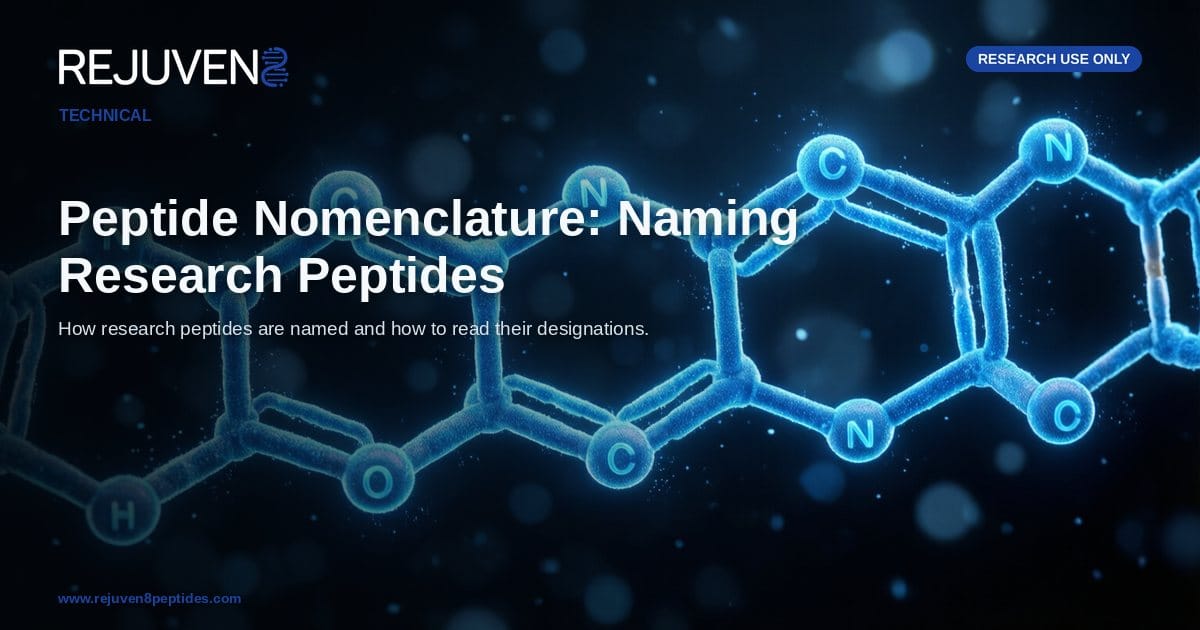
Every research peptide arrives with a name, and that name is rarely arbitrary. Peptide nomenclature is the collection of conventions that biochemists and preclinical laboratories use to compress an amino acid sequence, its structural modifications, and its molecular lineage into a short, readable designation. A label such as CJC-1295 with DAC or IGF-1 LR3 is effectively a condensed data string: it can signal the parent molecule, the residues that were kept or removed, the chemical groups that were added, and sometimes the laboratory or patent series in which the compound was first described.
Reading these designations accurately matters for anyone interpreting the primary literature, comparing certificates of analysis, or cataloging compounds studied in vitro and in animal models. This article maps the main systems used to name research peptides: the one- and three-letter amino acid codes, position numbering and sequence fragments such as 1-29, analogs and substitutions, chemical modifications including DAC and LR3, and the acronym conventions behind combination blends. All compounds referenced here are supplied for research use only, not for human consumption, and the discussion stays strictly within how these molecules are named and studied.
The Amino Acid Alphabet: One- and Three-Letter Codes
Because peptides are chains of amino acids linked by peptide bonds, their most fundamental naming layer is the amino acid code itself. The International Union of Pure and Applied Chemistry and the International Union of Biochemistry and Molecular Biology (IUPAC-IUBMB) define two standardized shorthand systems that appear throughout sequence data, certificates, and structural notation.
Three-Letter Codes
The three-letter system uses abbreviations such as Gly for glycine, Arg for arginine, and Lys for lysine. These codes are favored when readability matters, for example when writing out a short sequence or highlighting a single substituted residue. The copper tripeptide GHK-Cu, for instance, is written as Gly-His-Lys, which spells out glycine, histidine, and lysine in order from the N-terminus.
One-Letter Codes
The one-letter system compresses each residue to a single character (G for glycine, R for arginine, K for lysine) and is preferred for long sequences, database entries, and alignment work where space is limited. The two systems are interchangeable and describe the same residues; the choice is a matter of context and convention rather than chemistry. The table below lists common residues that appear frequently in the peptides catalogued in the research peptide library.
| Amino Acid | Three-Letter Code | One-Letter Code |
|---|---|---|
| Glycine | Gly | G |
| Alanine | Ala | A |
| Arginine | Arg | R |
| Lysine | Lys | K |
| Glutamic acid | Glu | E |
| Aspartic acid | Asp | D |
| Serine | Ser | S |
| Tyrosine | Tyr | Y |
| Tryptophan | Trp | W |
| Proline | Pro | P |
Sequence Positions, Fragments, and Truncations in Peptide Nomenclature
Once residues are named, they are numbered. By convention, position 1 is the N-terminus (the end bearing a free amino group) and numbering increases toward the C-terminus (the end bearing a free carboxyl group). This positional map is what allows a name to reference specific residues or a defined stretch of the parent molecule.
What “1-29” and Similar Ranges Mean
A range such as 1-29 denotes residues 1 through 29 of a larger parent sequence, a construct known as a fragment or truncation. Sermorelin corresponds to the 1-29 fragment of growth hormone releasing hormone (GHRH), the shortest segment that retains the parent molecule’s receptor-binding region in laboratory assays. Tesamorelin is built on the same 1-29 backbone with an added stabilizing group, illustrating how a fragment and a modified fragment can share a numeric lineage.
Fragment Codes
Some names encode the fragment position directly. AOD-9604 is derived from the C-terminal region of human growth hormone (approximately residues 176-191) and is sometimes written in the literature as hGH 176-191, making the parent origin and the residue window explicit. Recognizing this pattern helps distinguish a true fragment from a full-length analog.
Analogs, Substitutions, and Chemical Modifications
Beyond fragments, most research peptides are analogs: molecules deliberately altered from a natural template to change stability, binding, or half-life in study models. The peptide nomenclature conventions for these changes are among the most information-dense in the field.
Substitutions and D-Amino Acids
A substitution is usually written as the position followed by the replacement residue. Swapping the natural L-form of an amino acid for its mirror-image D-form (for example D-Ala) is a common modification studied for its resistance to enzymatic breakdown, and it is noted with a D prefix. Growth hormone secretagogue analogs frequently carry several such substitutions at defined positions to slow degradation in vitro.
Terminal and Side-Chain Modifications
Names may also flag chemical groups added to the ends or side chains of a peptide. Common notations include Ac- for an acetylated N-terminus, a trailing -NH2 for C-terminal amidation, and references to PEGylation or lipidation where a polyethylene glycol chain or fatty acid is attached to extend circulation time in research settings.
DAC and LR3: Two Common Suffixes
DAC stands for Drug Affinity Complex, a maleimidopropionic acid group that binds serum albumin. In CJC-1295 with DAC, this modification is studied for markedly extending the peptide’s half-life compared with the non-DAC version, which is often labelled modified GRF(1-29). LR3 means Long R3, as seen in IGF-1 LR3: the name signals a 13-residue extension on the N-terminus plus an arginine substituted at position 3 (Arg3), a pair of changes investigated for altering how the analog interacts with binding proteins. Once decoded, both suffixes tell a researcher exactly what was done to the parent molecule.
Discovery Codes, Supplier Designations, and Blends
Not every name describes sequence or chemistry. Many designations in peptide nomenclature are historical or organizational, tracing back to the discovery laboratory, a patent series, or a supplier catalog. The exact designation is also what ties a vial to its third-party certificate of analysis and its published test data.
Numeric and Discovery Codes
Codes like BPC-157 (Body Protection Compound, isolate 157), TB-500 (a synthetic version related to thymosin beta-4), SS-31 (from the Szeto-Schiller research series), and MOTS-c (a mitochondrial-derived peptide) reflect origin rather than structure. In melanocortin-receptor research, PT-141 and Melanotan-2 follow the same pattern, using project-style codes for compounds studied at the MC1R, MC3R, and MC4R receptors. These labels must be memorized rather than parsed, because the number carries no sequence meaning.
Coded Supplier Designations
Some incretin-class research peptides are catalogued under coded supplier designations such as GLP-1 SM, GLP-2 TZ, and GLP-3 RT. Here the GLP prefix indicates the studied receptor family, while the two-letter suffix is an internal identifier that distinguishes each research compound within the catalog. Cagrilintide is another example of a named research peptide in this space.
Blends and Combination Acronyms
Combination products are typically named as acronyms of their components. The GLOW blend takes its letters from GHK-Cu, BPC-157, and TB-500, while KLOW adds a further component to the same family. A straightforward plus-sign format is also common, as in BPC-157+TB-500, where the name simply lists the peptides combined. The table below summarizes how several of these naming systems map onto real designations. The values below reflect commonly reported laboratory attributes and are provided for comparison only.
| Designation | What the Name Encodes | Class | Approx. Length / Molecular Weight |
|---|---|---|---|
| BPC-157 | Body Protection Compound, isolate 157 | Synthetic peptide | 15 aa, ~1419 Da |
| Sermorelin | GHRH fragment, residues 1-29 | GHRH analog | 29 aa, ~3358 Da |
| CJC-1295 with DAC | Analog plus Drug Affinity Complex | GHRH analog | ~30 aa core, ~3647 Da |
| IGF-1 LR3 | Long R3 analog (Arg3 plus N-terminal extension) | IGF-1 analog | 83 aa, ~9100 Da |
| GLOW | Acronym blend (GHK-Cu, BPC-157, TB-500) | Combination blend | Multiple components |
Frequently Asked Questions
What does “1-29” mean in a peptide name?
It refers to residues 1 through 29 of a larger parent sequence, counted from the N-terminus. The construct is a fragment, meaning only that defined stretch of the original molecule is present. Sermorelin, for example, is the 1-29 fragment of growth hormone releasing hormone.
What is the difference between a peptide fragment and an analog?
A fragment is an unmodified subsection of a parent sequence, such as residues 176-191 of a larger protein. An analog is a molecule that has been deliberately changed from its template through substitutions, extensions, or chemical modifications. A single compound can be both, as when a fragment is further modified.
What does DAC stand for in CJC-1295 with DAC?
DAC stands for Drug Affinity Complex, a chemical group (maleimidopropionic acid) that binds to serum albumin. In research models it is studied for substantially lengthening the circulating half-life of the peptide relative to the version without DAC.
What does LR3 mean in IGF-1 LR3?
LR3 is shorthand for Long R3. The name signals two structural changes to the parent molecule: a 13-residue extension added to the N-terminus and an arginine substituted at position 3. These changes are investigated for how they alter the analog’s interaction with binding proteins in vitro.
Why do some peptides use one-letter codes and others three-letter codes?
Both are standardized IUPAC-IUBMB systems that describe the same amino acids. Three-letter codes (Gly, Arg, Lys) are easier to read in short sequences, while one-letter codes (G, R, K) save space in long sequences and databases. The choice is a matter of convention, not chemistry.
How are blends like GLOW and KLOW named?
These names are acronyms built from the first letters of their component peptides. GLOW draws its letters from GHK-Cu, BPC-157, and TB-500, and KLOW extends the same idea with an additional component. Reading the acronym reveals what the blend contains.