Research Use Only. The information presented here is for scientific and educational purposes. These compounds are not intended for human consumption, self-administration, or therapeutic use.
Introduction
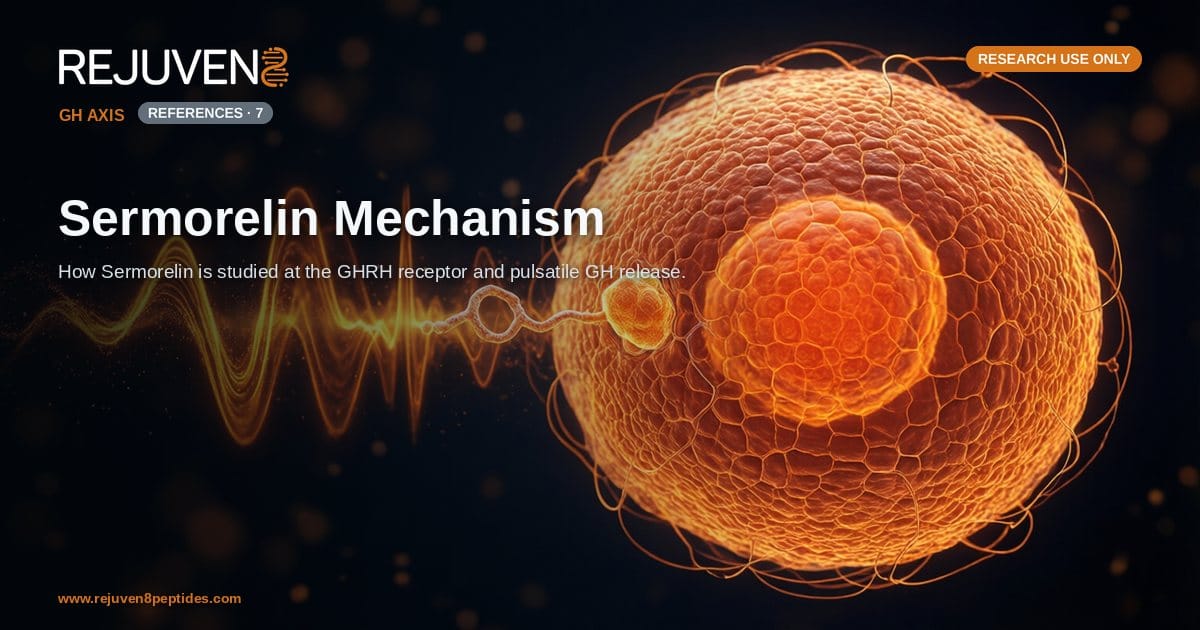
Sermorelin is a synthetic 29 amino acid peptide that reproduces the biologically active N-terminal fragment of human growth hormone-releasing hormone (GHRH), the hypothalamic signal that drives the somatotropic axis. In laboratory settings it is studied as a model GHRH analog, a tool for probing how the GHRH receptor (GHRHR) on pituitary somatotroph cells translates an extracellular peptide signal into the synthesis and release of growth hormone (GH). Because it corresponds to the shortest sequence that retains full receptor activity, sermorelin is used widely in mechanistic work on the GH axis.
This overview summarizes what preclinical and in-vitro research describes about the sermorelin mechanism: how the peptide engages its receptor, the intracellular cascade that follows, and why the resulting pulsatile pattern of GH output is a central theme in the literature. All discussion here is framed around cell-based and animal research; sermorelin is offered for research use only, not for human consumption. Readers comparing related compounds can also review the Sermorelin research listing and the broader research peptide catalog.
What Sermorelin Is: The GHRH(1-29) Fragment
Native GHRH is a 44 amino acid peptide first characterized from pancreatic tumor tissue in the early 1980s. Structure-activity studies established that the first 29 residues, designated GHRH(1-29), carry essentially all of the receptor-binding and activating capacity of the full-length hormone. Sermorelin is the acetate salt of this fragment, typically prepared with a C-terminal amide to improve stability in laboratory preparations.
Molecular identity
As a secretin-family peptide, sermorelin carries the amphipathic helical motif that class B receptor ligands use to dock into their target. The values below reflect commonly reported laboratory attributes and are provided for comparison only.
| Attribute | Reported value |
|---|---|
| Compound class | Synthetic GHRH analog (GH secretagogue) |
| Sequence length | 29 amino acids |
| Parent hormone | GHRH (1-44) |
| Molecular formula | C149H246N44O42S |
| Approximate molecular weight | 3358 g/mol |
| Primary target | GHRH receptor (GHRHR) |
| Reported plasma half-life (in-vivo models) | Roughly 10 to 12 minutes |
The short reported half-life is itself a mechanistic feature: rapid clearance means the signal is transient, a property that researchers link to the preservation of natural release rhythms discussed below. Purity and identity of any research batch are documented on its certificate of analysis, and the COA reading guide explains how those figures are reported.
The GHRH Receptor: Signaling at the Somatotroph
The GHRH receptor is a class B G-protein-coupled receptor (GPCR), part of the same structural family as the secretin and glucagon receptors. It is expressed most densely on somatotrophs, the GH-producing cells of the anterior pituitary. Sermorelin research uses this receptor as the entry point for the entire cascade.
From receptor binding to cAMP
When sermorelin occupies the GHRHR, the receptor couples to a stimulatory Gs protein and activates adenylyl cyclase. This raises intracellular cyclic AMP (cAMP), the second messenger that activates protein kinase A (PKA). PKA in turn phosphorylates the transcription factor CREB and supports the activity of Pit-1, a pituitary-specific factor that governs transcription of the GH gene. In parallel, receptor activation promotes calcium influx that triggers the release of GH stored in secretory granules.
Receptor specificity
A recurring point in the literature is that the GHRH receptor is distinct from the ghrelin receptor (GHS-R1a) targeted by growth hormone-releasing peptides such as ipamorelin and GHRP-2. Because the two receptor systems converge on GH output through different pathways, they are frequently studied together to examine additive or synergistic signaling in cell and animal models.
Pulsatile GH Release: Why the Rhythm Matters
Growth hormone is not secreted at a steady level. It is released in discrete pulses, and the shape of that pulsatile profile is governed by the interplay between stimulatory GHRH and inhibitory somatostatin arriving from the hypothalamus. Much of the research interest in sermorelin stems from where it acts within this system.
Acting upstream of the pituitary output
Because sermorelin drives GH release by activating the pituitary’s own somatotrophs rather than supplying GH directly, the resulting output remains subject to the body’s regulatory checkpoints. In animal models, somatostatin tone and negative feedback from GH and insulin-like growth factor 1 (IGF-1) continue to shape the response, so the released GH tends to follow a pulsatile rather than a flat, continuous pattern. This contrast with direct exogenous GH, which bypasses pituitary control, is one reason GHRH analogs are studied as tools for probing physiological release dynamics.
Feedback as a built-in constraint
Investigators note that this feedback dependence gives the model a self-limiting quality: when circulating GH and IGF-1 rise, somatostatin restrains further release. Research on the sermorelin mechanism therefore often focuses on how pulse frequency and amplitude change under different experimental conditions rather than on any single peak value.
Sermorelin Among GH-Axis Research Peptides
Sermorelin is one of several peptides used to interrogate the GH axis, and it is often positioned against longer-acting GHRH analogs and the ghrelin-receptor secretagogues. The comparison below reflects commonly reported laboratory attributes and is provided for comparison only.
| Compound | Class | Primary receptor target | Noted research feature |
|---|---|---|---|
| Sermorelin | GHRH(1-29) analog | GHRH receptor | Short-acting parent-fragment model |
| Tesamorelin | Stabilized GHRH analog | GHRH receptor | Modified for extended stability |
| CJC-1295 | GHRH analog | GHRH receptor | Studied for prolonged receptor engagement |
| Ipamorelin | GHRP (secretagogue) | Ghrelin receptor (GHS-R1a) | Selective GH-release profile in models |
Because GHRH analogs and GHRPs act at separate receptors, combinations such as CJC-1295 with ipamorelin are a common experimental pairing for studying convergent signaling on the somatotroph. Sermorelin, as the closest analog to the native GHRH fragment, serves as a reference point in many of these comparisons.
Frequently Asked Questions
What is the mechanism of sermorelin?
In research models, sermorelin binds the GHRH receptor on pituitary somatotroph cells and activates a Gs protein, raising intracellular cAMP and activating protein kinase A. This cascade promotes both transcription of the growth hormone gene and the release of stored GH, reproducing the action of native GHRH.
What receptor does sermorelin target?
Sermorelin targets the GHRH receptor (GHRHR), a class B G-protein-coupled receptor expressed on anterior pituitary somatotrophs. It is a different receptor from the ghrelin receptor engaged by growth hormone-releasing peptides such as ipamorelin.
How does sermorelin differ from growth hormone itself?
Sermorelin does not supply growth hormone. Instead it prompts the pituitary to release its own GH, so the output in laboratory models remains subject to somatostatin and negative feedback, and tends to preserve a pulsatile release pattern rather than a continuous one.
What does pulsatile GH release mean?
Pulsatile release refers to the secretion of growth hormone in discrete bursts rather than at a constant level. Because sermorelin acts upstream at the pituitary, research describes it as working within the natural rhythm set by GHRH and somatostatin.
How does sermorelin compare with CJC-1295 and ipamorelin?
Sermorelin and CJC-1295 are both GHRH analogs that act at the GHRH receptor, with CJC-1295 modified for longer receptor engagement. Ipamorelin acts at the separate ghrelin receptor. The two receptor classes are often studied in combination for their convergent effects on GH output.
Is sermorelin available for human use?
No. Sermorelin offered here is a research compound intended for research use only, not for human consumption. The material described in this article is for laboratory and educational study of the GH axis.
References and Further Reading
- Guillemin and colleagues (1982), isolation and characterization of growth hormone-releasing hormone from pancreatic tumor tissue. PubMed: growth hormone releasing hormone Guillemin
- Structure-activity research on the GHRH(1-29) fragment and sermorelin. PubMed: sermorelin GHRH 1-29
- Mayo and colleagues, molecular cloning and characterization of the GHRH receptor. PubMed: GHRH receptor cloning
- GHRH receptor signaling through cAMP and protein kinase A in somatotrophs. PubMed: GHRH receptor cAMP somatotroph
- Analyses of pulsatile growth hormone secretion and its hypothalamic control. PubMed: pulsatile growth hormone secretion
- Growth hormone secretagogues and the ghrelin receptor as a parallel pathway. PubMed: growth hormone secretagogue ghrelin receptor
- Comparative research on GHRH analogs including tesamorelin. PubMed: tesamorelin GHRH analog