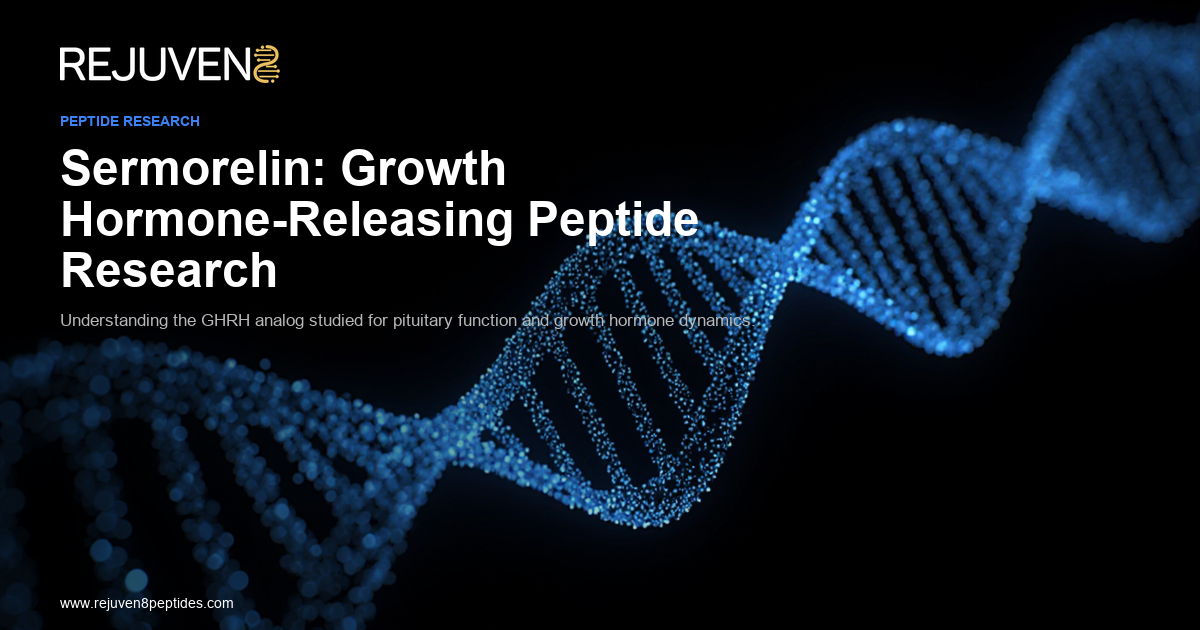
Sermorelin — chemically designated as growth hormone-releasing hormone (GHRH) fragment 1–29 amide — represents the shortest fully bioactive analog of endogenous human GHRH known to retain the complete GH-stimulatory profile of the native 44-amino acid hormone. Since its characterization in the 1980s, sermorelin has been an important research and clinical tool for investigating the hypothalamic-pituitary-somatotropic axis, studying age-related changes in GH secretion dynamics, and probing the downstream physiological consequences of pulsatile GH release.
This article provides an overview of the scientific literature on sermorelin, with attention to its pharmacological profile, the neuroendocrine mechanisms it engages, and the contexts in which it has been studied in preclinical and clinical research settings.
This article is intended for research purposes only. Sermorelin is a research compound and is not approved for general therapeutic use in adults outside of specific regulatory frameworks. Nothing herein constitutes medical advice.
Molecular Profile: GHRH Fragment 1–29
Endogenous GHRH is a 44-amino acid peptide secreted by arcuate nucleus neurons of the hypothalamus in a pulsatile pattern that drives corresponding pulsatile GH release from anterior pituitary somatotrophs. The first 29 amino acids of GHRH are sufficient to bind the GHRH receptor (GHRH-R) and activate adenylyl cyclase-mediated signaling, leading to GH gene transcription and secretion.
Sermorelin (sequence: Tyr-Ala-Asp-Ala-Ile-Phe-Thr-Asn-Ser-Tyr-Arg-Lys-Val-Leu-Gly-Gln-Leu-Ser-Ala-Arg-Lys-Leu-Leu-Gln-Asp-Ile-Met-Ser-Arg-NH₂) has a molecular weight of approximately 3,358 Da. The C-terminal amidation (-NH₂) is important for receptor affinity and metabolic stability; without it, biological potency is substantially reduced.
Sermorelin binds GHRH-R with high affinity, triggering a Gs protein-coupled cascade that elevates intracellular cAMP, activates protein kinase A, and ultimately stimulates both GH gene expression and exocytosis of stored GH granules from pituitary somatotrophs (PMID: 18031173). This mechanism preserves the pulsatile, physiological pattern of GH secretion rather than producing the sustained, supraphysiological elevations associated with exogenous GH administration.
Mechanism of Action: Pituitary Engagement and GH Secretion Dynamics
The defining pharmacological feature of sermorelin is its action upstream of pituitary GH stores, relying on the subject’s own somatotroph reserve to generate GH output. Unlike exogenous recombinant human GH, sermorelin does not bypass the hypothalamic-pituitary feedback axis. The resulting GH release remains subject to somatostatin inhibition and IGF-1-mediated negative feedback — the same regulatory constraints that govern endogenous GH pulses.
Research in both healthy volunteers and patient populations has consistently demonstrated that sermorelin — administered intravenously or subcutaneously — elicits a prompt, dose-dependent rise in serum GH without meaningful changes in prolactin, luteinizing hormone (LH), follicle-stimulating hormone (FSH), cortisol, or thyroid-stimulating hormone (TSH) at standard research doses (PMID: 18031173). This hormonal selectivity distinguishes sermorelin from ghrelin-class secretagogues, which often co-stimulate ACTH/cortisol pathways.
Somatostatin tone modulates the magnitude of sermorelin-induced GH release; pretreatment with somatostatin analogs markedly attenuates the response, while somatostatin inhibitors amplify it. This relationship has been exploited in neuroendocrine research to probe the relative contributions of GHRH drive versus somatostatin tone in determining basal and stimulated GH secretion patterns.
The pulsatile nature of the sermorelin-stimulated GH response is mechanistically consistent with the known biology of somatotrophs, which release GH in discrete bursts rather than a continuous stream. Research using frequent blood sampling protocols has characterized the amplitude, frequency, and interpulse nadir of sermorelin-induced GH pulses in various age groups and disease states (PMID: 9358867).
Diagnostic and Investigational Research Applications
Before being superseded by other stimulation tests in some clinical guidelines, sermorelin was used as a diagnostic tool to evaluate pituitary somatotroph reserve — distinguishing hypothalamic from pituitary causes of GH deficiency. A blunted GH response to sermorelin implied intact hypothalamic GHRH but impaired pituitary responsiveness, while a normal response indicated the deficit resided above the pituitary. This differential has been investigated extensively in pediatric GH research (PMID: 18031173).
In the adult research context, sermorelin has been studied as a model compound for investigating the somatotropic axis in aging. GH secretion declines substantially with age — a phenomenon termed “somatopause” — driven largely by reduced hypothalamic GHRH pulse amplitude rather than intrinsic pituitary failure (PMID: 9358867). Research demonstrates that aging somatotrophs retain substantial secretory capacity when adequately stimulated, forming the mechanistic rationale for GHRH-based research in aging models.
Walker et al. (PMC: 2699646, PMID: 18046908) articulated the distinction between exogenous GH supplementation and GHRH-based strategies in the adult context: sermorelin’s mechanism preserves the pulsatile GH secretion profile, maintains the physiological feedback constraints, and generates GH from endogenous pituitary stores rather than introducing pharmacological quantities of exogenous hormone. This design has made sermorelin an attractive comparator in research examining downstream IGF-1 production, body composition dynamics, and somatotropic feedback regulation.
Research Findings: IGF-1 Axis and Body Composition
GH stimulated by sermorelin drives hepatic secretion of insulin-like growth factor-1 (IGF-1), the principal downstream mediator of GH’s anabolic effects on muscle protein synthesis, lipolysis, and bone matrix formation. Research using sermorelin in aging animal models and elderly human volunteers has documented dose-dependent increases in serum IGF-1 following repeated administration, with IGF-1 increments proportional to the magnitude of the GH response.
Body composition changes — including increases in lean mass and reductions in fat mass — have been observed in research subjects receiving sermorelin over extended periods, consistent with the known anabolic and lipolytic actions of GH/IGF-1 signaling. However, these studies vary substantially in design, duration, and endpoint measurement, and their findings should be interpreted within their specific experimental contexts.
Research has also explored sermorelin’s potential relevance in models of muscle wasting and catabolism. The GH-secretagogue pathway has been identified as a candidate therapeutic target in sarcopenia research, with GHRH analogs including sermorelin representing one mechanistic approach to engaging somatotropic anabolism without the regulatory and safety concerns associated with exogenous GH (PMID: 9238854).
Oncological and Niche Research Contexts
Beyond the somatotropic aging literature, sermorelin has appeared in oncological research contexts. GHRH receptors are expressed ectopically by a range of tumor cell lines, and GHRH analogs — including sermorelin — have been investigated as probes of this receptor system. One study examined sermorelin’s potential activity in recurrent glioma models, reporting preliminary findings relevant to the intersection of GH signaling and tumor biology (PMID: 33842627). This remains an exploratory area with significant mechanistic questions unresolved.
Separately, GHRH receptor expression has been documented in neuroendocrine tumor cell lines, where sermorelin-related analogs have been used as pharmacological tools to characterize receptor-dependent proliferative and secretory responses (PMID: 19747727).
References
- Prakash A, Goa KL. Sermorelin: a review of its use in the diagnosis and treatment of children with idiopathic growth hormone deficiency. BioDrugs. 1999;12(2):139–157. PMID:18031173
- Walker RF. Sermorelin: a better approach to management of adult-onset growth hormone insufficiency? Clin Interv Aging. 2006;1(4):307–308. PMID:18046908
- Veldhuis JD, Iranmanesh A. Altered pulsatile and coordinate secretion of pituitary hormones in aging: evidence of feedback disruption. Eur J Endocrinol. 1996;Suppl 1:S14–S22. PMID:9358867
- Corpas E, Harman SM, Blackman MR. Growth hormone-releasing hormone and growth hormone-releasing peptide as therapeutic agents to enhance growth hormone secretion in disease and aging. Horm Res. 1993;40(1–3):44–49. PMID:9238854
- Chang Y, Huang R, Zhai Y, et al. A potentially effective drug for patients with recurrent glioma: sermorelin. Ann Transl Med. 2021;9(8):700. PMID:33842627
- Stępień T, Sacewicz M, Ławnicki H, et al. Stimulatory effect of growth hormone-releasing hormone (GHRH(1-29)NH2) on proliferation and VEGF secretion by human neuroendocrine tumor cell line NCI-H727 in vitro. Neuropeptides. 2009;43(5):397–400. PMID:19747727
- Sinha DK, Balasubramanian A, Tatem AJ, et al. Beyond the androgen receptor: the role of growth hormone secretagogues in the modern management of body composition in hypogonadal males. Transl Androl Urol. 2020;9(Suppl 2):S149–S159. PMID:32257856
Research Use Disclaimer: This content is provided for educational and scientific research purposes only. Sermorelin supplied by Rejuven8 Peptides is intended exclusively for in vitro and preclinical laboratory research. It is not intended for human or veterinary therapeutic use, self-administration, or general wellness applications. Nothing in this article constitutes medical advice. Researchers should comply with all applicable local regulations governing research peptide procurement and use.
All products are sold for research purposes only. Not for human consumption. These statements have not been evaluated by the FDA. This content is for informational and educational purposes only and does not constitute medical advice.