Research Use Only. The information presented here is for scientific and educational purposes. These compounds are not intended for human consumption, self-administration, or therapeutic use.
Introduction
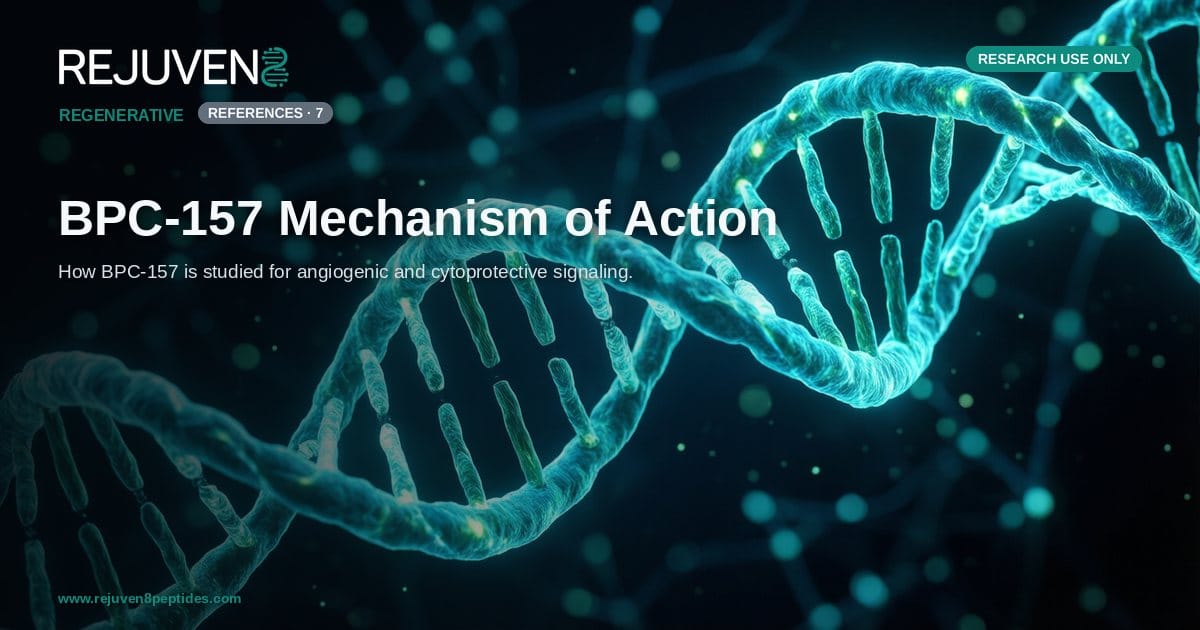
BPC-157 (Body Protection Compound-157) is a synthetic pentadecapeptide that has become a frequent subject of regenerative and cytoprotective research. It corresponds to a partial sequence of a larger protective protein originally isolated from gastric juice, and laboratory groups have examined it primarily for how it appears to influence vascular signaling and cellular resilience. The phrase “bpc-157 mechanism of action” in this context refers to the network of receptors, enzymes, and messengers that investigators have connected to the peptide in cell cultures and animal models, most notably vascular endothelial growth factor receptor 2 (VEGFR2), the nitric oxide (NO) system, and the broad concept of cytoprotection.
This overview summarizes how BPC-157 is described in the preclinical literature, with attention to the VEGFR2-Akt-eNOS signaling axis, NO modulation, and organ-level protective effects reported in experimental settings. Nothing here describes clinical use. These materials are provided for research use only, not for human consumption, and every observation below reflects work performed in vitro or in laboratory animal models rather than in people.
What Is BPC-157?
Molecular Identity and Origin
BPC-157 is a chain of fifteen amino acids, which gives it the pentadecapeptide classification. Its sequence is commonly written as Gly-Glu-Pro-Pro-Pro-Gly-Lys-Pro-Ala-Asp-Asp-Ala-Gly-Leu-Val, and it is derived from a partial sequence of the body protection compound found in gastric juice. Research groups have highlighted its reported stability in gastric acid, a property that made it attractive for early studies of the digestive tract and, later, for work on systemic vascular biology.
The values below reflect commonly reported laboratory attributes and are provided for comparison only.
| Attribute | Reported Value |
|---|---|
| Class | Synthetic pentadecapeptide |
| Amino acid count | 15 residues |
| Amino acid sequence | Gly-Glu-Pro-Pro-Pro-Gly-Lys-Pro-Ala-Asp-Asp-Ala-Gly-Leu-Val |
| Molecular formula | C62H98N16O22 |
| Approximate molecular weight | 1419.5 g/mol |
| Parent origin | Partial sequence of body protection compound (BPC) from gastric juice |
| Research classification | Regenerative and cytoprotective research peptide |
This identity matters because much of the mechanistic literature interprets BPC-157 as a signaling molecule rather than a structural one. Its short, proline-rich sequence is thought to support interactions with receptors and enzymes rather than incorporation into tissue. Suppliers who publish a certificate of analysis typically report purity, mass, and sequence confirmation, and anyone evaluating a research peptide can consult a guide to reading a peptide COA to interpret those values.
The VEGFR2 Signaling Axis
Angiogenesis, the formation of new blood vessels, is the process most consistently linked to BPC-157 in mechanistic studies. VEGFR2 (also called KDR) sits at the center of this line of work.
The VEGFR2-Akt-eNOS Cascade
In cultured endothelial cells, researchers have described BPC-157 as promoting VEGFR2 activation and internalization, which in turn engages the Akt (protein kinase B) pathway and downstream endothelial nitric oxide synthase (eNOS). This VEGFR2-Akt-eNOS cascade is frequently cited as a candidate explanation for the angiogenic patterns observed in laboratory models. Investigators have reported that the peptide can influence VEGFR2 even without adding external VEGF, which suggests the receptor itself is a focus of the interaction rather than a simple amplification of existing growth-factor signaling.
Endothelial Behavior in Culture
In vitro assays have examined endothelial cell migration, tube formation, and the association of VEGFR2 with VE-cadherin at cell junctions. These endpoints are standard readouts for angiogenic signaling. Because a functioning vasculature supplies oxygen and nutrients to healing tissue, the recovery research community often groups BPC-157 with other vascular-active compounds when comparing tissue-repair peptides, a subject explored further in this recovery and tissue-repair peptide overview.
The Nitric Oxide System
Nitric oxide is a gaseous signaling molecule central to vascular tone, endothelial function, and cellular protection. BPC-157 research repeatedly intersects with the NO system, both at the end of the VEGFR2 cascade and as an independent focus.
eNOS and NO Modulation
Beyond its position downstream of VEGFR2 and Akt, BPC-157 has been studied for its broader relationship with NO generation. Experimental work in animal models has examined how the peptide interacts with agents that block nitric oxide synthase, such as L-NAME, and with substrates that feed the pathway, such as L-arginine. Published reports describe BPC-157 counteracting some of the vascular changes produced by NOS blockade in these models, which investigators interpret as participation in NO signaling rather than a single fixed receptor interaction.
Vascular Tone and Endothelial Integrity
This NO-related work has extended to studies of blood pressure regulation and endothelial integrity under stress conditions in laboratory animals. The consistent theme across these reports is that the peptide appears to help maintain endothelial signaling when the NO system is experimentally perturbed. The emphasis in the literature remains on characterizing pathways in controlled models, not on any human application.
Cytoprotection and Organoprotection
The Cytoprotection Concept
Cytoprotection is an established pharmacological idea describing how certain agents shield cells and tissues from injury independent of their primary action. BPC-157 is frequently described within this tradition. Its reported stability in gastric juice and its activity across multiple organ systems in animal studies led investigators to characterize it as an organoprotective peptide, meaning one studied for protective effects that span several tissue types rather than a single target organ.
Growth Factors and Cell Migration
Mechanistic studies have also connected BPC-157 to growth-factor signaling and cell-migration machinery. In tendon and fibroblast cell models, researchers have examined early growth response 1 (EGR1), growth-factor receptor expression, and the FAK-paxillin adhesion pathway, all of which contribute to how cells move and organize during tissue remodeling. Some laboratories have paired BPC-157 with thymosin-derived peptides such as TB-500 to study complementary repair pathways, and a combined BPC-157 and TB-500 preparation is a common subject of comparative research.
The elements summarized below reflect commonly reported laboratory attributes and are provided for comparison only.
| Signaling Element | Studied Role in BPC-157 Research |
|---|---|
| VEGFR2 (KDR) | Receptor examined as an entry point for angiogenic signaling |
| Akt (protein kinase B) | Downstream kinase studied within the VEGFR2-Akt-eNOS cascade |
| eNOS and nitric oxide | Enzyme and messenger studied for endothelial NO modulation |
| VE-cadherin | Junctional protein examined in endothelial culture assays |
| EGR1 and growth factors | Early-response genes and factors studied in tissue-repair models |
| FAK-paxillin | Adhesion pathway examined in cell-migration assays |
Taken together, the VEGFR2, nitric oxide, and cytoprotection findings form a coherent, if still preclinical, picture in which BPC-157 is investigated as a vascular and cytoprotective signaling peptide. None of this work establishes safety or effectiveness in humans, and the compound remains a laboratory material. Researchers who obtain BPC-157 or other research peptides for study are expected to handle them strictly within controlled experimental settings.
Frequently Asked Questions
What is the mechanism of action of BPC-157?
In preclinical research, BPC-157 is studied as a signaling peptide that appears to engage the VEGFR2-Akt-eNOS pathway, interact with the nitric oxide system, and exert cytoprotective effects across several tissue types in animal and in vitro models. It is characterized as a vascular and cytoprotective research compound rather than a structural building block.
How is BPC-157 studied in relation to VEGFR2?
Laboratory studies describe BPC-157 as promoting activation and internalization of vascular endothelial growth factor receptor 2 (VEGFR2), which engages downstream Akt and endothelial nitric oxide synthase signaling. These endpoints are measured in cultured endothelial cells through migration and tube-formation assays.
Does BPC-157 interact with the nitric oxide system?
In experimental models, yes. Researchers have examined how BPC-157 relates to nitric oxide synthase inhibitors and substrates, and reports describe it modulating NO-related vascular responses. This work is part of characterizing its mechanism and does not describe any human effect.
What does cytoprotection mean in BPC-157 research?
Cytoprotection refers to shielding cells and tissues from injury independent of a compound’s primary action. BPC-157 is described as cytoprotective and organoprotective in animal studies, reflecting reported protective activity across multiple organ systems in laboratory settings.
What is the molecular weight and sequence of BPC-157?
BPC-157 is a fifteen-amino-acid pentadecapeptide with the sequence Gly-Glu-Pro-Pro-Pro-Gly-Lys-Pro-Ala-Asp-Asp-Ala-Gly-Leu-Val, an approximate molecular weight near 1419.5 g/mol, and the molecular formula C62H98N16O22.
Is BPC-157 intended for human use?
No. BPC-157 is a research compound offered for laboratory investigation only. It is not a medicine, and it is supplied for research use only, not for human consumption or self-administration.
References and Further Reading
- Sikiric P and colleagues at the University of Zagreb have published extensively on BPC-157 cytoprotection and organoprotection in preclinical models. PubMed: BPC 157 cytoprotection
- Studies of VEGFR2 and angiogenic signaling associated with BPC-157 in endothelial cell cultures. PubMed: BPC 157 VEGFR2
- Research on BPC-157 and the nitric oxide system, including interactions with NOS inhibitors and substrates. PubMed: BPC 157 nitric oxide
- Investigations of BPC-157 and angiogenesis in animal wound and vascular models. PubMed: BPC 157 angiogenesis
- In vitro work on BPC-157 in tendon and fibroblast cells, including growth-factor and cell-migration pathways. PubMed: BPC 157 tendon fibroblast
- Studies of BPC-157 effects on endothelial integrity and blood vessel function in laboratory animals. PubMed: BPC 157 endothelium
- Reviews describing BPC-157 organoprotection and its proposed signaling pathways. PubMed: BPC 157 organoprotection