Research Use Only. The information presented here is for scientific and educational purposes. These compounds are not intended for human consumption, self-administration, or therapeutic use.
Introduction
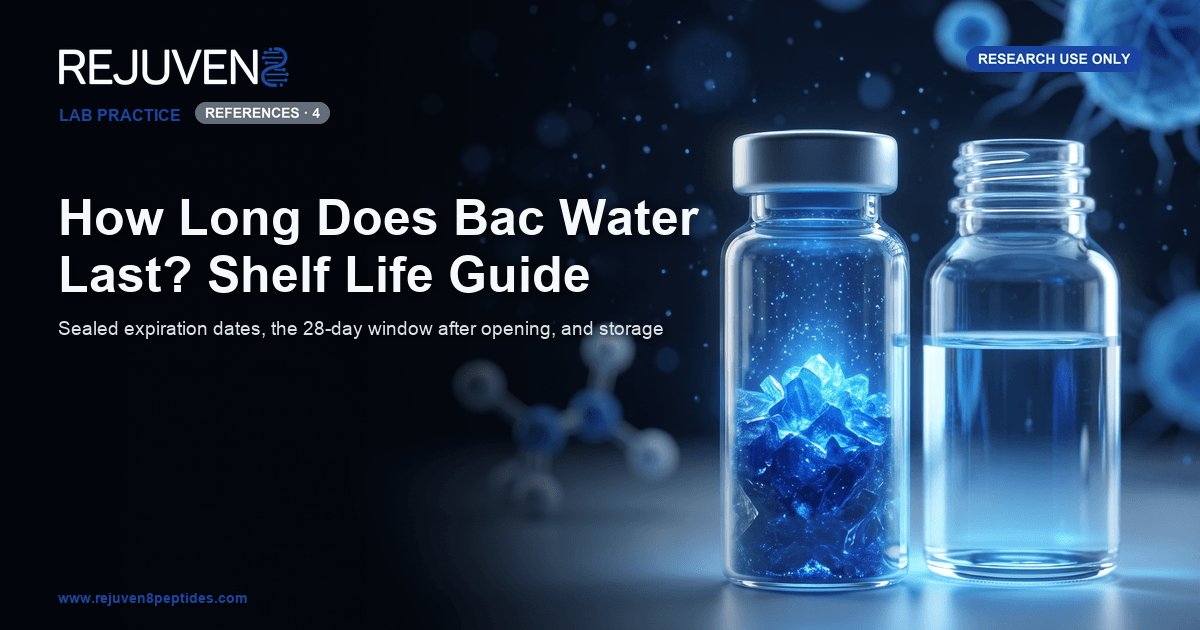
Bacteriostatic water (BAC water or bac water) is sterile, purified water containing 0.9% benzyl alcohol as a preservative, and it is the solvent most laboratories use to reconstitute lyophilized research peptides. Because a single vial is designed to be entered more than once, one of the first practical questions on any bench is how long does bac water last once the seal has been broken, and how long an unopened vial remains within specification. The answer involves two separate clocks: the expiration date printed on the sealed container, and a much shorter working window that starts the moment the stopper is first punctured.
This article separates those two clocks, explains what the benzyl alcohol preservative does and does not do, and describes the variables (temperature, light, oxidation, evaporation, and closure integrity) that decide whether an opened vial is still fit for laboratory use. Both the solvent and the peptides it dissolves are supplied for research use only, not for human consumption, and every practice described here refers to laboratory handling.
What Bacteriostatic Water Is, and Why It Has a Shelf Life
Bacteriostatic water is high-purity water to which benzyl alcohol has been added at 0.9% w/v, or 9 mg per mL. It contains no salts or buffers, so it is hypotonic, and its pH sits near 5.7 (labeled range 4.5 to 7.0). It is sterile and nonpyrogenic when packaged and is supplied in stoppered vials designed for repeated withdrawal.
Benzyl alcohol (C7H8O, about 108.1 g/mol) is an aromatic alcohol that disrupts microbial cell membranes. At 0.9% it is bacteriostatic: it inhibits the growth of bacteria, and to a lesser extent fungi, that enter the vial during repeated use. It does not sterilize an already contaminated solution and does nothing to protect a dissolved peptide from chemical degradation, which is why the solvent has a finite working life once opened.
The values below reflect commonly reported laboratory attributes and are provided for comparison only.
| Attribute | Bacteriostatic Water |
|---|---|
| Base | Sterile purified water |
| Preservative | Benzyl alcohol, 0.9% w/v (9 mg/mL) |
| Preservative class | Aromatic alcohol, bacteriostatic (membrane-active) |
| Preservative molecular weight | Approximately 108.1 g/mol (C7H8O) |
| pH | About 5.7 (labeled range 4.5 to 7.0) |
| Tonicity | Hypotonic (no sodium chloride) |
| Common presentations | 10 mL and 30 mL multiple-entry vials |
| Unopened storage | 20 to 25 C (68 to 77 F), protected from light and heat |
| Working window after first puncture | 28 days by common laboratory convention |
How Long Does BAC Water Last? Unopened Versus Opened
The Unopened Vial
A sealed vial is governed by the expiration date on its label, assigned from real-time stability data and typically measured in years, provided the vial is kept at controlled room temperature (20 to 25 C) with the closure undisturbed. The condition attached to the date is simple: the solution must be clear and the seal intact, because sterility assurance depends entirely on the closure system.
The First Puncture Starts the Second Clock
Once the stopper has been pierced, the sealed-container date no longer applies. The convention for preserved multiple-entry vials is to record the date of first entry and to discard the vial 28 days later, unless the manufacturer specifies otherwise. Each puncture introduces a small volume of room air along with whatever organisms sit on the stopper surface, and benzyl alcohol can only slow the growth of what gets in. The window reflects the limit of what the preservative can be expected to hold in check.
The Reconstituted Peptide Has Its Own Clock
Researchers often ask how long is bacteriostatic water good for as though the solvent were the limiting factor. In practice it rarely is. Once a peptide has been dissolved, its stability in solution (usually days to a few weeks at 2 to 8 C, depending on the sequence) is shorter than the solvent’s 28-day window, and the shorter clock governs. The chemistry of peptide loss in solution (hydrolysis, oxidation, adsorption to glass) is covered in the reconstitution chemistry guide, and temperature recommendations appear in the peptide storage and handling article.
Does BAC Water Go Bad? The Stability Factors
Bacteriostatic water does not spoil like a nutrient-rich solution, but it drifts from specification through several routes, each accelerated by heat, light, or air exposure.
Oxidation of the Preservative
Benzyl alcohol undergoes autoxidation. In the presence of dissolved oxygen, and faster under light or elevated temperature, it converts to benzaldehyde and then to benzoic acid, a time-dependent conversion documented in pharmaceutical stability studies. Each molecule oxidized is one less active preservative molecule, so bacteriostatic capacity declines with age; benzaldehyde also carries an almond-like odor, and benzoic acid can lower the pH. As liquid is drawn down, the air headspace grows and supplies more oxygen, so a half-empty vial that has sat for weeks is chemically different from a fresh one.
Evaporation, Closure, and Temperature
Benzyl alcohol is moderately volatile, and a stopper punctured many times reseals poorly, permitting slow evaporative loss of water and preservative and, if cored, depositing elastomer fragments in the solution. Heat accelerates all of these processes, while freezing expands the water, stressing the glass and forcing the stopper. Neither extreme is part of the labeled storage condition.
The factors below reflect commonly reported laboratory attributes and are provided for comparison only.
| Stability Factor | What Changes in the Vial | Laboratory Control |
|---|---|---|
| Oxygen exposure (headspace) | Benzyl alcohol oxidizes to benzaldehyde and benzoic acid | Minimize entries, discard at 28 days |
| Light | Accelerates oxidation | Store in carton or drawer |
| Heat | Faster oxidation and evaporation | Hold at 20 to 25 C unopened; 2 to 8 C is common after opening |
| Freezing | Glass stress, closure failure | Never freeze the solvent |
| Repeated puncture | Coring, poor reseal, contamination entry | Swab stopper, vary puncture site, log entries |
| Time after first entry | Preservative capacity declines | Date the vial at first use |
Storage Temperature and Handling Practice
Sealed and Opened Vials
Store sealed vials upright at 20 to 25 C in their carton, away from heat sources and light. Refrigerating the unopened solvent is unnecessary but harmless, as long as it never freezes. After the first puncture, write the date on the label. Room temperature remains the labeled condition, and many research laboratories additionally move opened vials to a 2 to 8 C refrigerator to slow the growth of anything that might have entered; neither practice extends the 28-day window. Wipe the stopper with 70% isopropyl alcohol before each entry and avoid puncturing the same point repeatedly.
A Worked Concentration Example
Solvent shelf life matters for reconstitution math because one vial of bacteriostatic water normally serves several peptide vials over time. Reconstituting a 10 mg lyophilized peptide vial with 2 mL of bacteriostatic water yields 5 mg/mL (5000 mcg/mL); 1 mL instead would give 10 mg/mL. A 10 mL vial of Bacteriostatic Water 10mL supports five such reconstitutions, and the 30 mL eBac Bacteriostatic Water supports fifteen. A laboratory reconstituting only one or two peptides a month is better matched to the 10 mL size, since the 28-day clock will run out before the volume does. Technique is covered in the bacteriostatic water reconstitution guide.
Signs a Vial Should Be Discarded
- More than 28 days since the first puncture, regardless of volume remaining.
- Cloudiness, particles or stopper fragments, color change, or an almond-like odor.
- The vial has been frozen, dropped, or left in a hot environment.
- The printed expiration date has passed, even if never opened.
In summary, the question of how long does bac water last has two answers: until the labeled expiration date while the vial is sealed and stored at 20 to 25 C, and 28 days after the first puncture once it has been opened. Between those limits, preservative oxidation, evaporation, light, heat, and closure integrity decide whether a vial is still the solvent specified on its certificate of analysis. Dating every vial at first use and pairing it with correctly stored research peptides keeps both clocks visible on the bench.
Frequently Asked Questions
How long does bacteriostatic water last after opening?
By common laboratory convention, an opened vial is discarded 28 days after the first puncture of the stopper, unless the manufacturer states a different interval. The date of first entry should be written on the vial so the window can be tracked.
How long is bacteriostatic water good for if the vial is unopened?
An unopened vial remains within specification until the expiration date on the label, provided it has been stored at 20 to 25 C with the seal intact and the solution still clear. Those dates are typically set in years from manufacture.
Does bac water expire?
Yes. Every vial carries an expiration date for the sealed container, and once opened a second, shorter 28-day window applies. The benzyl alcohol preservative slowly oxidizes to benzaldehyde and benzoic acid, which reduces its bacteriostatic capacity.
Does bac water go bad if it is not refrigerated?
Not on its own. The labeled storage condition is controlled room temperature, 20 to 25 C, whether the vial is sealed or opened. Many laboratories refrigerate opened vials at 2 to 8 C as a precaution, but refrigeration does not extend the 28-day window.
Can bacteriostatic water be frozen to make it last longer?
No. Freezing is outside the labeled storage condition. Ice expansion can stress the glass and disturb the stopper seal, and freezing does nothing to slow the oxidation that limits the preservative. A vial that has frozen should be discarded.
References and Further Reading
- Stability studies documenting time-dependent conversion of benzyl alcohol to benzaldehyde and benzoic acid in aqueous solution. PubMed: benzyl alcohol benzaldehyde benzoic acid aqueous stability
- Reviews of benzyl alcohol and related antimicrobial preservatives, including mechanism and spectrum. PubMed: benzyl alcohol antimicrobial preservative
- Studies of microbial contamination in repeatedly entered preserved vials and the rationale for a 28-day window. PubMed: multidose vial contamination preservative
- Literature on peptide stability in aqueous solution (hydrolysis, oxidation, adsorption), which governs the life of reconstituted material. PubMed: peptide stability aqueous solution storage