Research Use Only. The information presented here is for scientific and educational purposes. These compounds are not intended for human consumption, self-administration, or therapeutic use.
Introduction
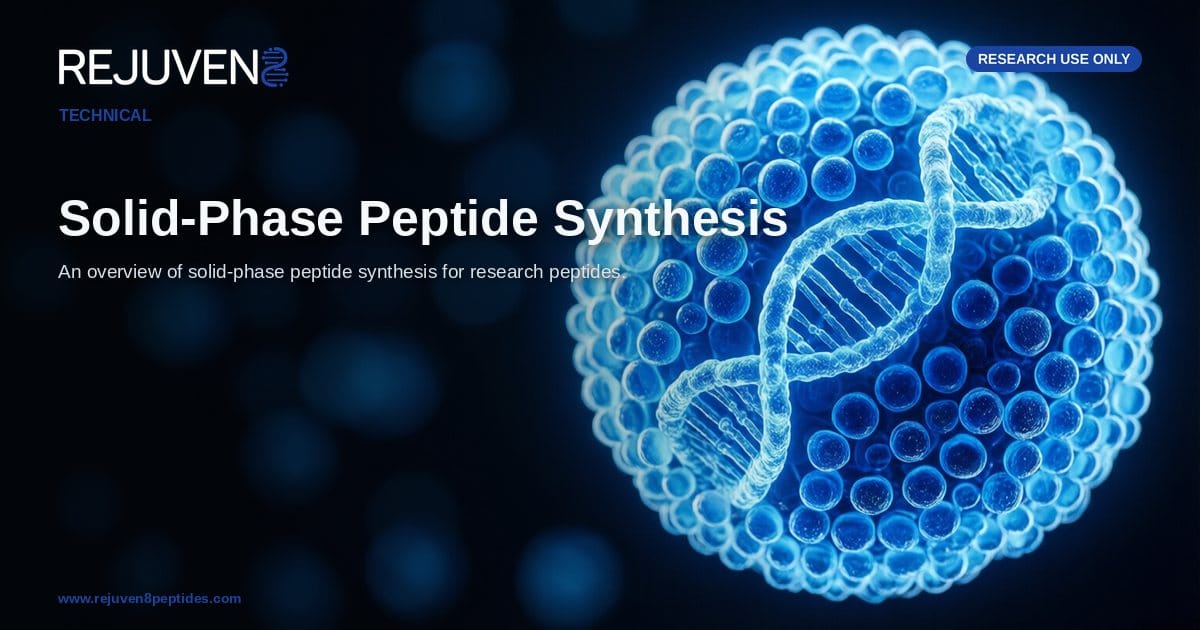
Every research peptide that arrives in a laboratory vial began as a series of individual amino acids assembled in a precise order. The dominant method for building these molecules is solid-phase peptide synthesis (SPPS), a technique in which a growing peptide chain stays anchored to an insoluble polymer support while reagents are added and washed away in repeating cycles. Introduced by Bruce Merrifield in the early 1960s, SPPS transformed peptide chemistry from a slow solution-phase art into a reproducible, largely automated process, and it remains the foundation of how compounds such as BPC-157, ipamorelin, and GHK-Cu are produced for research use only, not for human consumption.
Understanding how peptides are synthesized is directly relevant to anyone evaluating material for in-vitro or preclinical work. The synthesis route determines which impurities are likely to appear, why purification is necessary, and what a certificate of analysis should report. This article walks through the chemistry of SPPS from resin selection through Fmoc coupling cycles, cleavage, and final purification, and explains why analytical quality control is the step that separates a well-characterized research peptide from an unverified powder.
What Is Solid-Phase Peptide Synthesis?
In solution-phase chemistry, each reaction requires isolating and purifying the intermediate before the next step, which becomes impractical for chains longer than a few residues. SPPS solves this by tethering the first amino acid to a solid support, so excess reagents and by-products can simply be filtered and rinsed away between steps. The chain is built one residue at a time in the carboxyl-to-amino (C-to-N) direction, the reverse of how ribosomes assemble proteins inside living cells.
The role of the resin
The resin is a bead of cross-linked polymer, most commonly polystyrene, functionalized with chemical linkers that hold the peptide in place. The choice of linker defines what the peptide’s C-terminus becomes after cleavage: a Wang resin yields a free carboxylic acid, while a Rink amide resin yields a C-terminal amide, a feature many bioactive research peptides require. Loading capacity, how well the bead swells in solvent, and linker stability all influence yield and are matched to the target sequence.
Protecting groups keep the chemistry selective
Amino acids carry reactive side chains in addition to the backbone groups that must join together. To prevent unwanted branching, chemists rely on protecting groups: a temporary group on the alpha-amino terminus that is removed before each coupling, and semi-permanent groups on the side chains that stay in place until the final cleavage step. Managing these groups correctly is what allows a single defined product to emerge from dozens of sequential reactions.
The range of peptides SPPS can build
The same cyclic chemistry can assemble short signaling peptides and longer chains alike, which is why so many commonly studied research compounds share this manufacturing route. The identity values below reflect commonly reported laboratory attributes and are provided for comparison only.
| Example peptide | Sequence length | Approx. molecular weight | General class |
|---|---|---|---|
| GHK-Cu | 3 residues | ~340 Da (copper complex ~404 Da) | Copper-binding tripeptide |
| Ipamorelin | 5 residues | ~712 Da | Growth hormone secretagogue |
| Selank | 7 residues | ~751 Da | Tuftsin-derived neuropeptide |
| Semax | 7 residues | ~813 Da | ACTH(4-10) fragment analog |
| BPC-157 | 15 residues | ~1419 Da | Synthetic peptide |
The Fmoc Synthesis Cycle Step by Step
Modern SPPS is dominated by Fmoc (9-fluorenylmethoxycarbonyl) chemistry, which uses a mild base to unmask the growing chain and has largely replaced the older Boc (tert-butyloxycarbonyl) approach that relied on repeated strong-acid treatment. Each residue is incorporated through a short, repeating cycle that automated synthesizers can run around the clock.
- Deprotection: A solution of piperidine in dimethylformamide removes the Fmoc group from the terminal amine, exposing a free amino group that is ready to react.
- Wash: The resin is rinsed to carry off spent reagent and by-products before the next step.
- Coupling: The next amino acid, its carboxyl group activated by reagents such as HBTU, HATU, or DIC with Oxyma, forms a new amide (peptide) bond to the exposed amine.
- Wash: A second rinse clears unreacted material from the bead.
- Capping (optional): Acetic anhydride blocks any chains that failed to couple, preventing deletion sequences from growing further.
The cycle repeats once per residue, so a 15-amino-acid peptide such as BPC-157 requires fifteen coupling rounds. Because no reaction is perfectly efficient, small quantities of truncated and deletion sequences accumulate along the way, which is precisely why downstream purification and analysis are essential. The two dominant chemistries differ in handling and safety, as summarized below. The attributes in the following table reflect commonly reported laboratory attributes and are provided for comparison only.
| Attribute | Fmoc SPPS | Boc SPPS |
|---|---|---|
| Temporary group removal | Mild base (piperidine) | Strong acid (TFA) |
| Final cleavage reagent | Trifluoroacetic acid (TFA) | Hydrogen fluoride (HF) |
| Typical handling | Standard lab, widely automated | Specialized HF apparatus |
| Common use today | Most research and commercial peptides | Difficult or acid-sensitive sequences |
Cleavage, Purification, and Analytical Quality Control
Cleavage from the resin
Once the full sequence is assembled, a cleavage cocktail based on trifluoroacetic acid releases the peptide from the resin and simultaneously strips away the side-chain protecting groups. Scavengers such as water, triisopropylsilane, and 1,2-ethanedithiol are added to trap the reactive cations that form during cleavage, protecting sensitive residues. The crude peptide is then precipitated in cold diethyl ether, collected, and dried into a raw solid.
Purification by preparative HPLC
The crude product still contains truncated chains, incompletely deprotected species, and other by-products. Reverse-phase preparative high-performance liquid chromatography (HPLC) separates these based on how strongly each molecule interacts with a hydrophobic column, using a gradient of water and acetonitrile. Fractions that meet the target purity are pooled and freeze-dried (lyophilized) into the final powder that ships to a laboratory.
Confirming identity and purity
Purification is only trustworthy when it is paired with analysis. A short panel of orthogonal methods confirms that the material is what the label claims. The specifications below reflect commonly reported laboratory attributes and are provided for comparison only.
| Method | What it checks | Commonly reported target |
|---|---|---|
| Analytical RP-HPLC | Chromatographic purity | Greater than or equal to 98 percent peak area |
| Mass spectrometry (ESI or MALDI) | Molecular weight and identity | Observed mass matches theoretical |
| Amino acid analysis | Composition and peptide content | Consistent with the target sequence |
| Karl Fischer or TGA | Residual water content | Low moisture |
| Counterion analysis | Acetate or TFA content | Quantified and reported |
These results are compiled into a certificate of analysis (COA). Reviewing the batch-specific certificates is the most direct way to confirm that a peptide was actually purified and verified rather than sold on a generic specification alone.
Why Purity and Quality Control Matter for Research Peptides
In a research setting, impurities are not a cosmetic concern: they are experimental variables. A vial reported at 90 percent purity carries roughly ten percent of other material, which may include deletion sequences that differ from the target by a single residue, residual solvents, or counterions that inflate the apparent mass. Any of these can skew assay results, shift dose-response relationships in cell or animal models, and undermine reproducibility across batches.
This is why the synthesis story matters to the end user. Two powders sold under the same name can differ substantially depending on coupling efficiency, purification rigor, and the depth of analytical testing behind them. Evaluating a research peptide supplier therefore comes down to documentation: consistent HPLC and mass-spectrometry data, transparent COAs tied to specific lots, and clear labeling. Compounds like BPC-157 and ipamorelin are only as reliable as the quality system that produced them.
None of this changes the intended context of use. Research peptides made by SPPS are laboratory reagents for in-vitro and preclinical investigation only, and the purity data exists to support valid science, not human or veterinary application.
Frequently Asked Questions
What is solid-phase peptide synthesis in simple terms?
Solid-phase peptide synthesis is a method of building a peptide one amino acid at a time while the chain stays attached to a small polymer bead. Reagents are added and then washed away at each step, which makes the process fast, repeatable, and suitable for automation. It is the standard way most research peptides are manufactured.
What is the difference between Fmoc and Boc peptide synthesis?
Both are SPPS strategies named after the temporary protecting group on the growing chain. Fmoc chemistry removes that group with a mild base and cleaves the finished peptide with trifluoroacetic acid, while Boc chemistry uses strong acid at each step and hydrogen fluoride for final cleavage. Fmoc is the more common choice today because it is safer and easier to automate.
How are peptides purified after synthesis?
After the peptide is cleaved from the resin, the crude mixture is separated by reverse-phase preparative HPLC, which sorts molecules by how strongly they bind a hydrophobic column. Fractions that meet the purity target are collected and freeze-dried into a final powder, removing truncated chains and other by-products generated during synthesis.
Why does peptide purity matter for research?
Impurities behave as uncontrolled variables in an experiment. Deletion sequences, residual solvents, and counterions can distort assay readouts and dose-response data and reduce reproducibility between batches. Reporting purity by HPLC and confirming identity by mass spectrometry allow researchers to trust that observed effects come from the intended compound.
How can I verify a research peptide’s purity and identity?
Request the batch-specific certificate of analysis and review the HPLC purity value and the mass-spectrometry result against the expected molecular weight. Our guide to reading a peptide COA explains each figure, and lot-linked certificates let you confirm the data before use.
Can every peptide be made by solid-phase synthesis?
SPPS is ideal for peptides up to roughly fifty residues. Longer chains accumulate too many small errors to purify efficiently, so chemists turn to native chemical ligation, which joins purified fragments together, or to recombinant expression in cells for large proteins. Most research peptides fall well within the practical range of SPPS.