Research Use Only. The information presented here is for scientific and educational purposes. These compounds are not intended for human consumption, self-administration, or therapeutic use.
Introduction
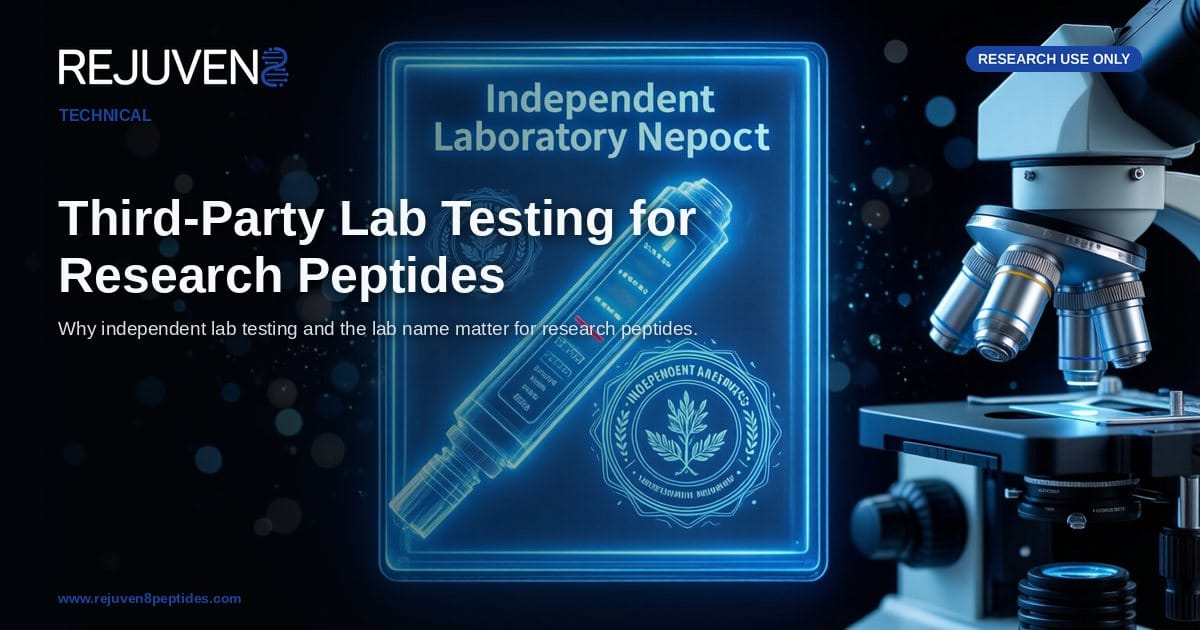
Research peptides are supplied strictly for laboratory investigation, and the quality of any dataset produced with them depends on knowing precisely what a vial contains. Third-party lab testing is the practice of sending a production batch to an independent analytical laboratory that has no commercial stake in the outcome, then publishing the findings on a certificate of analysis (COA). That independent step is what separates a verifiable purity record from an unsupported marketing claim, and it is a foundation of reproducible in-vitro and preclinical work.
The more specific question this article addresses is not only whether a peptide was tested, but who tested it. A COA that names the testing laboratory, references a batch or lot number, and reports the analytical methods used can be cross-checked, while an anonymous or unattributed report cannot. The sections below outline what independent testing measures (chiefly purity by high-performance liquid chromatography and identity by mass spectrometry), why the lab name and batch traceability matter for trust, and how a researcher can verify a COA before relying on it. All materials discussed are for research use only, not for human consumption.
What Third-Party Lab Testing Means
Third-party lab testing refers to analysis performed by a laboratory that is organizationally and financially separate from the supplier selling the compound. The distinction matters because the party generating the purity number is not the same party whose revenue depends on that number being favorable.
In-house testing versus independent analysis
Many suppliers run some form of internal quality check, and in-house data is not worthless. It becomes a problem when it is the only data offered, because there is an inherent conflict of interest: a producer grading its own batch has an incentive to interpret ambiguous results generously. An independent laboratory removes that incentive. When both are available, an in-house screen followed by independent confirmation is stronger than either alone. Weighing this evidence is a core part of how to choose a research peptide supplier.
What accreditation adds
Independence is a starting point, and accreditation is the next tier. A laboratory accredited to a recognized standard such as ISO/IEC 17025 has demonstrated documented methods, calibrated instruments, and competence assessed by an external body. Accreditation does not guarantee a flawless result on every sample, but it means the lab operates under a system that is itself audited. The word independent tells you who ran the test, and the word accredited tells you the conditions it was run under.
Why the Lab Name on the COA Matters
A certificate of analysis is only as trustworthy as the ability to trace it back to its source. Naming the laboratory is what makes that trace possible.
Traceability and accountability
When a COA identifies the testing facility, a batch or lot number, and a test date, each result becomes an accountable record rather than an assertion. A researcher can, in principle, contact the named laboratory, confirm that the batch was analyzed, and check that the reported figures match the lab’s own files. That chain of custody, from batch to lab to published document, is the practical meaning of transparency. Suppliers that maintain a public certificates library make this straightforward.
Red flags in an unattributed report
Several patterns should prompt caution. A COA with the laboratory name removed or blurred cannot be verified and offers little more than a formatted claim. A report with no batch number cannot be tied to the specific vial in hand. A purity figure printed as a bare number, with no accompanying chromatogram or stated method, gives no way to judge how it was derived. Learning to read these documents in detail is covered in a dedicated COA and purity guide, and it is one of the most useful skills for evaluating any research peptide source.
What Independent Testing Measures
A meaningful COA reports more than a single percentage. Independent laboratories typically apply a small panel of complementary methods, each answering a different question about the material. The values below reflect commonly reported laboratory attributes and are provided for comparison only.
| Method | What it assesses | Why it matters for research |
|---|---|---|
| HPLC (High-Performance Liquid Chromatography) | Chromatographic purity, the percentage of target peptide versus related impurities | Establishes how much of the sample is the intended sequence |
| Mass Spectrometry (MS) | Molecular weight and identity confirmation | Confirms the material is the compound claimed, not a mislabeled analog |
| RP-HPLC gradient | Separation of closely related peptide species | Resolves truncated or deletion sequences with similar properties |
| Water and acetate content | Residual moisture and counter-ion load | Affects the stated net peptide mass and storage stability |
Purity thresholds in context
A commonly cited benchmark in research peptide supply is a purity of 98 percent or higher by HPLC, though the appropriate threshold depends on the intended experiment. The important point is not a single number but the pairing of a number with the method that produced it and the laboratory that ran it. A high figure with no method and no lab name conveys less than a slightly lower figure that is fully documented and independently attributed. Identity data from mass spectrometry is equally important, because a sample can be highly pure and still be the wrong molecule.
How to Verify a Third-Party COA
Verification does not require a chemistry background, only a short and repeatable checklist that a researcher can apply to every batch.
- Confirm the lab is named. Look for a specific laboratory identity, not only the supplier logo or an unlabeled letterhead.
- Match the batch number. The lot printed on the COA should match the lot on the vial or the product listing.
- Check the methods. Expect at least HPLC for purity and MS for identity, each supported by a chromatogram or spectrum rather than a lone figure.
- Note the date. A COA should correspond to the batch being received, not a generic or years-old document reused across lots.
- Cross-reference where possible. Suppliers that publish COAs openly allow figures to be compared across batches over time.
Applying this checklist consistently is what turns a purchase into a documented research input. Sources that publish batch-specific certificates and welcome scrutiny of the named laboratory make the process routine, and the research peptide catalog and its certificates are meant to be examined this way. Remember that every compound listed remains for research use only, not for human consumption.
Frequently Asked Questions
What does third-party lab testing mean for research peptides?
It means a production batch is analyzed by an independent laboratory that is separate from the supplier, and the results are published on a certificate of analysis. Because the testing party has no financial stake in the outcome, the purity and identity figures carry more weight than self-reported numbers alone. All such materials remain for research use only.
Why does the name of the lab on a peptide COA matter?
The lab name makes the result traceable. A named, ideally accredited laboratory can be identified and, in principle, contacted to confirm that a specific batch was tested and that the figures match its records. A COA without a lab name cannot be verified and functions as an unbacked claim.
Is an in-house COA good enough for research peptides?
In-house data has value as a first screen, but relying on it alone creates a conflict of interest, since the producer is grading its own batch. Independent confirmation from a third-party laboratory is stronger, and the combination of an internal check plus independent testing is stronger still.
How can I verify a third-party peptide test result?
Confirm the laboratory is named, match the batch or lot number on the COA to the vial, check that both HPLC for purity and mass spectrometry for identity were run with supporting chromatograms, and confirm the test date corresponds to your batch. Suppliers that publish certificates openly make cross-referencing simple.
What tests are typically run on research peptides?
The core panel is HPLC to measure chromatographic purity and mass spectrometry to confirm molecular identity. Additional checks may include water or acetate content and visual appearance. Together these describe how much of the sample is the intended sequence and whether it is the claimed compound.
What is a red flag on a peptide certificate of analysis?
Common warning signs include a missing or blurred laboratory name, no batch number, a purity percentage with no chromatogram or method listed, and a generic document that does not correspond to a specific lot. Any of these makes independent verification impossible.