Research Use Only. The information presented here is for scientific and educational purposes. These compounds are not intended for human consumption, self-administration, or therapeutic use.
Introduction
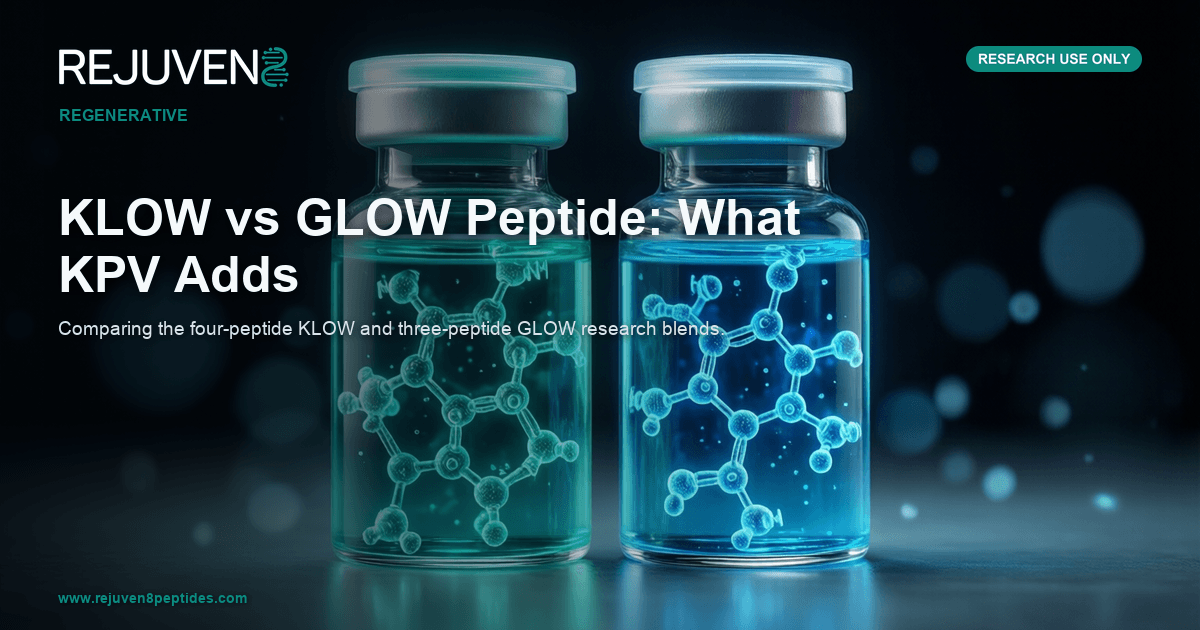
KLOW and GLOW are multi-peptide research blends that group several well characterized regenerative peptides into a single vial for laboratory investigation. The GLOW blend combines three peptides frequently studied together in tissue-repair models: the copper-binding tripeptide GHK-Cu, the pentadecapeptide BPC-157, and the actin-regulating peptide TB-500 (a thymosin beta-4 derivative). The KLOW blend retains that same three-peptide foundation and adds a fourth component, the tripeptide KPV, a C-terminal fragment of alpha-melanocyte-stimulating hormone (alpha-MSH) that is investigated for its anti-inflammatory signaling.
Because the two blends share three of their four ingredients, the central question in any KLOW vs GLOW comparison is one of composition: what the added KPV component contributes to the research profile, and how the pathways studied for each peptide overlap. This article compares the two blends by their constituent peptides, their approximate molecular attributes, and the preclinical pathways each ingredient is associated with. All material here is for research use only, not for human consumption, and describes only what these compounds are investigated for in in-vitro and animal studies.
The Shared Three-Peptide Foundation
Both blends are built on the same trio of peptides, each associated with a distinct arm of tissue-repair research. Understanding these three is the starting point for either formulation, because they account for the entire composition of GLOW and three-quarters of KLOW.
GHK-Cu
GHK-Cu is a copper-binding tripeptide (glycyl-L-histidyl-L-lysine complexed with copper) that occurs naturally in plasma and has been studied extensively for its role in extracellular matrix remodeling. Laboratory work has examined its association with collagen and glycosaminoglycan synthesis, copper transport, and the modulation of genes tied to wound-repair processes in cell culture. In both blends it is typically the highest-mass component. Rejuven8 supplies GHK-Cu as a standalone research item as well.
BPC-157
BPC-157 is a synthetic pentadecapeptide (15 amino acids) derived from a partial sequence of a protein found in gastric juice. Preclinical and animal studies have investigated it in the context of angiogenesis, tendon and ligament fibroblast migration, and the signaling that accompanies soft-tissue repair. It is one of the most frequently referenced compounds in recovery-focused peptide research and is available on its own as BPC-157.
TB-500
TB-500 is a synthetic version of thymosin beta-4 (or its active fragment), a peptide studied for its ability to sequester actin and to influence cell migration. Research models have looked at its association with new blood-vessel formation and with cellular movement during tissue reorganization. It is commonly paired with BPC-157 in the literature and is stocked individually as TB-500.
The KPV Addition That Defines KLOW
The single compositional difference between the two blends is the presence of KPV in KLOW. The letter K in the KLOW acronym refers to this tripeptide, which is absent from GLOW.
KPV (lysine-proline-valine) is the C-terminal tripeptide fragment of alpha-MSH. Unlike the melanocortin peptides studied for pigmentation, KPV is investigated primarily for anti-inflammatory signaling: laboratory studies have examined its association with the down-regulation of pro-inflammatory pathways such as NF-kB and its activity in models of intestinal and epithelial inflammation. By adding KPV to the GHK-Cu, BPC-157, and TB-500 base, the KLOW blend is positioned in research as a four-pathway formulation, layering an inflammation-modulation component onto the matrix-remodeling, angiogenic, and actin-regulating arms already present in GLOW.
This distinction is the practical core of the comparison. GLOW concentrates on the three-peptide regenerative base, while KLOW extends it with a fourth peptide whose studied mechanisms sit in a separate signaling category. Neither arrangement outranks the other; they simply cover different combinations of pathways for a given research question.
KLOW vs GLOW: Composition Compared
The table below summarizes which peptides appear in each blend. These values reflect commonly reported laboratory attributes and are provided for comparison only.
| Attribute | GLOW Blend | KLOW Blend |
|---|---|---|
| Number of peptides | 3 | 4 |
| GHK-Cu | Included | Included |
| BPC-157 | Included | Included |
| TB-500 | Included | Included |
| KPV | Not included | Included |
| Studied pathway arms | Matrix, angiogenic, actin | Matrix, angiogenic, actin, plus anti-inflammatory |
The following identity table lists approximate molecular attributes for each constituent peptide. These values reflect commonly reported laboratory attributes and are provided for comparison only.
| Peptide | Class | Sequence length | Approx. molecular weight | Studied focus |
|---|---|---|---|---|
| GHK-Cu | Copper-binding tripeptide complex | 3 amino acids | ~340 Da (peptide), ~404 Da (copper complex) | Matrix remodeling, collagen signaling |
| BPC-157 | Synthetic pentadecapeptide | 15 amino acids | ~1419 Da | Angiogenesis, soft-tissue repair |
| TB-500 | Thymosin beta-4-derived peptide | Derived from 43-residue Tb4 (supplied length per lot COA) | Parent Tb4 ~4963 Da (supplied mass per lot COA) | Actin binding, cell migration |
| KPV | alpha-MSH C-terminal tripeptide | 3 amino acids | ~342 Da | Anti-inflammatory signaling |
KLOW is supplied as an 80 mg blend, reflecting the added mass of the fourth peptide relative to the three-peptide GLOW formulation. Researchers comparing the two should note that the shared components behave identically in each vial. The compositional variable under study is the KPV fraction, so a controlled comparison isolates that peptide while holding GHK-Cu, BPC-157, and TB-500 constant.
Selecting a Blend for a Research Protocol
Choice between the two blends in a laboratory setting depends on the pathways under investigation rather than on any comparative ranking. A protocol focused strictly on the interplay of matrix remodeling, angiogenesis, and actin dynamics may use GLOW to keep the variable set to three peptides. A protocol that also seeks to model an anti-inflammatory component alongside those three may select KLOW so the KPV arm is present.
As with any multi-peptide preparation, the value of a comparison depends on verified identity and purity of each component. Reviewing a batch certificate of analysis allows the composition described here to be checked against the actual material, lot by lot. For broader context on how these peptides sit within the recovery category, the recovery and tissue-repair peptides overview compares them alongside related compounds. Both blends can be found next to their individual components in the full research peptide catalog.
Frequently Asked Questions
What is the difference between KLOW and GLOW blends?
The difference is one peptide. GLOW is a three-peptide research blend containing GHK-Cu, BPC-157, and TB-500. KLOW contains those same three peptides plus a fourth, KPV, a tripeptide studied for anti-inflammatory signaling. Everything else about the shared components is the same.
What peptides are in the GLOW blend?
The GLOW blend combines GHK-Cu (a copper-binding tripeptide studied for matrix remodeling), BPC-157 (a pentadecapeptide studied for angiogenesis and soft-tissue repair), and TB-500 (a thymosin beta-4 peptide studied for actin binding and cell migration).
What does the K in KLOW stand for?
The K refers to KPV, the tripeptide (lysine-proline-valine) that KLOW adds to the GLOW base. KPV is a C-terminal fragment of alpha-MSH investigated in laboratory models for its association with anti-inflammatory pathways.
Is KLOW just GLOW with an extra peptide?
Compositionally, yes. KLOW keeps the entire three-peptide GLOW foundation and layers KPV on top of it, which is why KLOW is described as a four-peptide blend and GLOW as a three-peptide blend. The added KPV component introduces an anti-inflammatory signaling arm not present in GLOW.
What is KPV studied for?
KPV is investigated in preclinical and in-vitro research for anti-inflammatory signaling, including its reported association with down-regulation of pathways such as NF-kB in models of epithelial and intestinal inflammation. It is studied strictly as a research compound, not for human use.
Are KLOW and GLOW blends intended for human use?
No. Both blends are research use only and are not intended for human consumption, self-administration, or therapeutic use. Any comparison of their composition is for scientific and educational purposes within a laboratory context.