Research Use Only. The information presented here is for scientific and educational purposes. These compounds are not intended for human consumption, self-administration, or therapeutic use.
Introduction
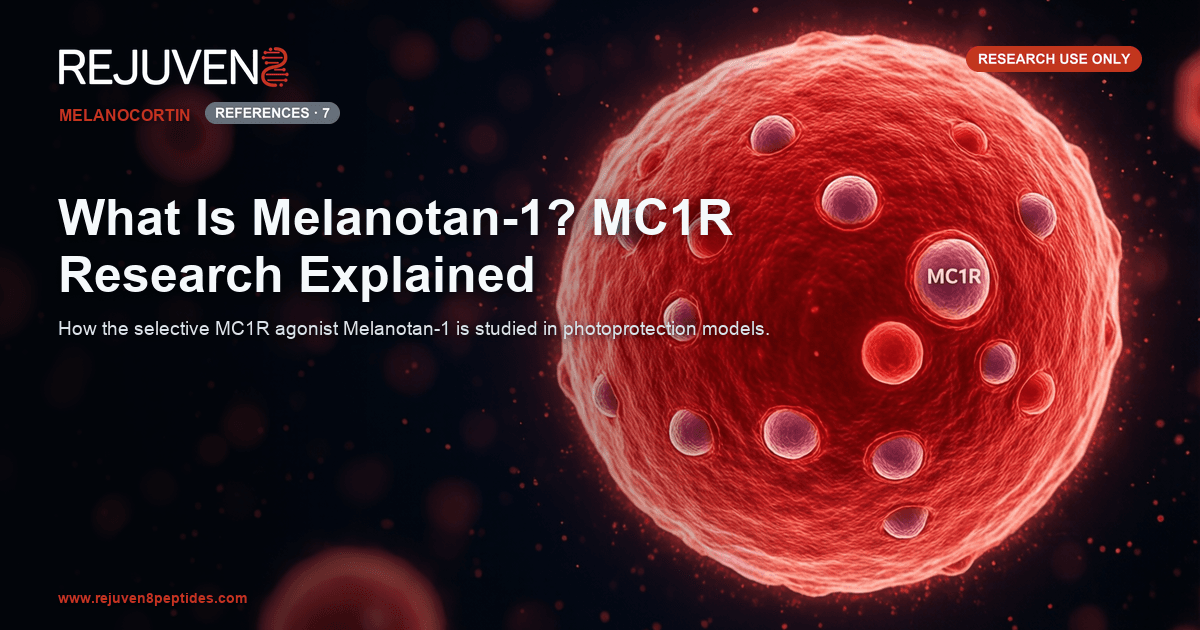
Melanotan-1, known by the international nonproprietary name afamelanotide, is a synthetic analog of alpha-melanocyte-stimulating hormone (alpha-MSH) that has become a reference tool in melanocortin-1 receptor (MC1R) research. First designed in academic peptide chemistry programs during the 1980s, the molecule is studied primarily for how it engages the MC1R signaling axis that governs pigment biology in melanocytes. In the laboratory literature it is frequently identified as NDP-alpha-MSH or [Nle4-D-Phe7]-alpha-MSH, designations that describe the specific amino acid substitutions distinguishing it from the native hormone.
This overview summarizes what Melanotan-1 is at the molecular level and how it is investigated in photoprotection models, where researchers examine the relationship between MC1R activation, eumelanin synthesis, and cellular responses to ultraviolet (UV) exposure. The material below is provided for research use only, not for human consumption, and describes preclinical, in-vitro, and mechanistic findings rather than any human application. Every attribute discussed reflects how the peptide is characterized in the scientific study of the melanocortin system.
What Is Melanotan-1 (Afamelanotide)?
Melanotan-1 belongs to the melanocortin family of peptides, a group that also includes the endogenous agonists alpha-MSH, beta-MSH, gamma-MSH, and adrenocorticotropic hormone (ACTH). Structurally it is a linear tridecapeptide, meaning it is built from thirteen amino acids arranged in a single unbranched chain, capped with an acetyl group at the N-terminus and an amide at the C-terminus. This architecture mirrors the core message sequence of native alpha-MSH, which is the reason the two molecules share a common receptor preference.
A Modified Alpha-MSH Analog
Native alpha-MSH is a short-lived signaling molecule that is rapidly broken down by enzymes. To create a more durable research tool, chemists introduced two targeted substitutions into its sequence. The methionine residue at position 4 was replaced with norleucine (Nle), and the L-phenylalanine at position 7 was replaced with its mirror-image form, D-phenylalanine (D-Phe). Together these changes define the [Nle4-D-Phe7] label that appears throughout the melanocortin literature.
Structural Modifications and Stability
The two substitutions do more than rename the peptide. Norleucine removes the oxidation-prone sulfur of methionine, while the D-amino acid at position 7 resists cleavage by proteases that would normally degrade the native hormone. The net result reported in binding studies is a molecule with markedly greater metabolic stability and higher affinity at MC1R than alpha-MSH itself, which makes Melanotan-1 a robust probe for studying receptor activation over extended experimental windows.
The values below reflect commonly reported laboratory attributes and are provided for comparison only.
| Attribute | Reported Detail |
|---|---|
| Common designations | Melanotan-1, Afamelanotide, NDP-alpha-MSH, [Nle4-D-Phe7]-alpha-MSH |
| Peptide class | Linear synthetic alpha-MSH analog (melanocortin agonist) |
| Sequence length | 13 amino acids (tridecapeptide) |
| Molecular formula | C78H111N21O19 |
| Molecular weight | approximately 1646.9 g/mol |
| Primary receptor target | Melanocortin-1 receptor (MC1R) |
| Key modifications | Norleucine at position 4, D-phenylalanine at position 7 |
MC1R Agonism and the Melanogenesis Pathway
The melanocortin-1 receptor is a G-protein-coupled receptor expressed on the surface of melanocytes, the pigment-producing cells of the skin, hair follicles, and eyes. When an agonist such as Melanotan-1 binds MC1R, the receptor couples to a stimulatory G-protein and activates the enzyme adenylyl cyclase. This binding event is the entry point that melanocortin research uses to model how an external signal is translated into a change in cellular pigment output.
The cAMP Signaling Cascade
Adenylyl cyclase activation raises intracellular levels of cyclic AMP (cAMP), which in turn activates protein kinase A. Downstream, this cascade increases the activity of microphthalmia-associated transcription factor (MITF), the master regulator of the pigment program. MITF drives expression of the enzymes tyrosinase, TRP-1, and TRP-2 (DCT), which catalyze the conversion of the amino acid tyrosine into melanin. Because Melanotan-1 is a potent and selective MC1R agonist, it is widely used to switch this cascade on under controlled conditions in cell studies.
Eumelanin and Pheomelanin
Melanocytes can produce two broad classes of pigment: brown-black eumelanin and red-yellow pheomelanin. Research on MC1R indicates that strong receptor signaling shifts synthesis toward eumelanin, the form most associated with absorbing and scattering ultraviolet radiation. This eumelanin bias is central to why Melanotan-1 is studied in a photoprotection context: models that raise eumelanin content are used to ask whether pigment can reduce UV-induced stress at the cellular level.
Photoprotection Research in Preclinical Models
Photoprotection is the primary theme under which Melanotan-1 is investigated. The underlying question is mechanistic: if MC1R activation increases eumelanin, does that pigment measurably change how cells and tissues respond to ultraviolet exposure? Cultured human melanocytes, keratinocyte co-cultures, and rodent models provide the experimental settings where this relationship is examined.
UV Stress and DNA Damage Endpoints
In cell-based work, investigators expose melanocytes to defined doses of UV radiation and measure endpoints such as cyclobutane pyrimidine dimer formation, reactive oxygen species accumulation, and apoptosis. Studies associated with researchers including Zalfa Abdel-Malek have reported that alpha-MSH analogs acting through MC1R can be linked to reductions in these markers of UV-induced damage, supporting the hypothesis that melanocortin signaling participates in a cellular stress-response network that extends beyond pigment color alone.
The Afamelanotide Research Context
Under the name afamelanotide, the same molecule has been examined in the scientific literature in relation to conditions marked by light sensitivity, such as erythropoietic protoporphyria (EPP). Within a research-use-only framework, the compound serves as a well-characterized MC1R agonist for interrogating the melanocortin photoprotection pathway, and any interpretation of its activity belongs strictly to the laboratory rather than to human application.
Melanotan-1 Compared With Related Melanocortin Peptides
Melanotan-1 is often contrasted with the related research peptide Melanotan-2 and with the endogenous hormone alpha-MSH. The three share a melanocortin lineage but differ in size, shape, and receptor selectivity, which is why they are used to answer different research questions.
The values below reflect commonly reported laboratory attributes and are provided for comparison only.
| Peptide | Structure | Approx. Length | Approx. Weight | Receptor Profile |
|---|---|---|---|---|
| Melanotan-1 (Afamelanotide) | Linear analog | 13 amino acids | 1646.9 g/mol | Comparatively selective MC1R agonist |
| Melanotan-2 | Cyclic analog | 7 amino acids | 1024.2 g/mol | Non-selective (MC1R, MC3R, MC4R, MC5R) |
| alpha-MSH (endogenous) | Linear native peptide | 13 amino acids | 1664.9 g/mol | Endogenous melanocortin agonist |
Receptor Selectivity
The defining pharmacological distinction is selectivity. Melanotan-1 is comparatively selective for MC1R, the pigment-associated receptor, whereas Melanotan-2 is a cyclic, non-selective agonist that also engages other melanocortin receptor subtypes including MC3R, MC4R, and MC5R. For researchers focused specifically on the pigment and photoprotection axis, the narrower MC1R profile of Melanotan-1 is often the reason it is chosen as a mechanistic probe. Other melanocortin research peptides, such as PT-141, engage different receptor subtypes and are studied along separate pathways.
Research Handling and Sourcing
Like other lyophilized research peptides, Melanotan-1 is typically supplied as a freeze-dried powder that is reconstituted with bacteriostatic water before use in laboratory work. Because peptide behavior in an assay depends heavily on identity and purity, researchers evaluating any melanocortin compound should confirm its certificate of analysis and review third-party certificates before designing an experiment. Rejuven8 Peptides supplies Melanotan-1 and a broader catalog of research peptides for these purposes, strictly for in-vitro and preclinical investigation.
Frequently Asked Questions
What is Melanotan-1 (afamelanotide)?
Melanotan-1, also called afamelanotide or NDP-alpha-MSH, is a synthetic linear analog of alpha-melanocyte-stimulating hormone. It is a thirteen-amino-acid peptide studied as a selective agonist of the melanocortin-1 receptor (MC1R) in pigment and photoprotection research.
How does Melanotan-1 activate MC1R?
Melanotan-1 binds the MC1R receptor on melanocytes and triggers a G-protein-coupled cascade that raises cyclic AMP, activates protein kinase A, and increases MITF activity. This pathway drives the synthesis of eumelanin, the brown-black pigment most studied in the context of ultraviolet photoprotection.
What is the difference between Melanotan-1 and Melanotan-2?
Melanotan-1 is a linear thirteen-amino-acid peptide that is comparatively selective for MC1R, while Melanotan-2 is a smaller cyclic peptide that acts on multiple melanocortin receptors, including MC3R, MC4R, and MC5R. The narrower selectivity of Melanotan-1 is why it is often chosen for pigment-focused mechanistic studies.
Why is Melanotan-1 studied for photoprotection?
Because MC1R activation shifts melanocytes toward eumelanin production, and eumelanin absorbs and scatters ultraviolet radiation, researchers use Melanotan-1 to investigate whether increased pigment changes how cells respond to UV stress and DNA damage in laboratory models.
What is the molecular weight of Melanotan-1?
Melanotan-1 has the molecular formula C78H111N21O19 and a molecular weight of approximately 1646.9 g/mol. Its thirteen-residue sequence carries norleucine at position 4 and D-phenylalanine at position 7, modifications that increase its stability relative to native alpha-MSH.
Is Melanotan-1 intended for human use?
Within this context Melanotan-1 is presented strictly as a research chemical for in-vitro and preclinical investigation. It is not intended for human consumption, self-administration, or any therapeutic use, and the discussion here is limited to its studied molecular pharmacology.
References and Further Reading
- Hadley ME, Hruby VJ, and colleagues (University of Arizona): design and characterization of [Nle4-D-Phe7]-alpha-MSH (NDP-MSH) superpotent melanotropin analogs. PubMed: NDP-MSH melanotan alpha-MSH analog
- Cone RD and colleagues: cloning and pharmacology of the melanocortin receptor family. PubMed: melanocortin receptor Cone
- Abdel-Malek ZA and colleagues (University of Cincinnati): MC1R signaling and melanocyte photoprotection. PubMed: MC1R melanocyte photoprotection Abdel-Malek
- Research on alpha-MSH analogs and reduction of UV-induced DNA damage in cultured melanocytes. PubMed: alpha-MSH melanocyte UV DNA damage
- Rees JL and colleagues: MC1R gene variants and human pigmentation phenotypes. PubMed: MC1R gene variants pigmentation
- Studies of afamelanotide as an MC1R agonist in photoprotection research. PubMed: afamelanotide MC1R photoprotection
- Mechanistic work on the cAMP and MITF axis in melanogenesis. PubMed: MC1R cAMP MITF melanogenesis