Research Use Only. The information presented here is for scientific and educational purposes. These compounds are not intended for human consumption, self-administration, or therapeutic use.
Introduction
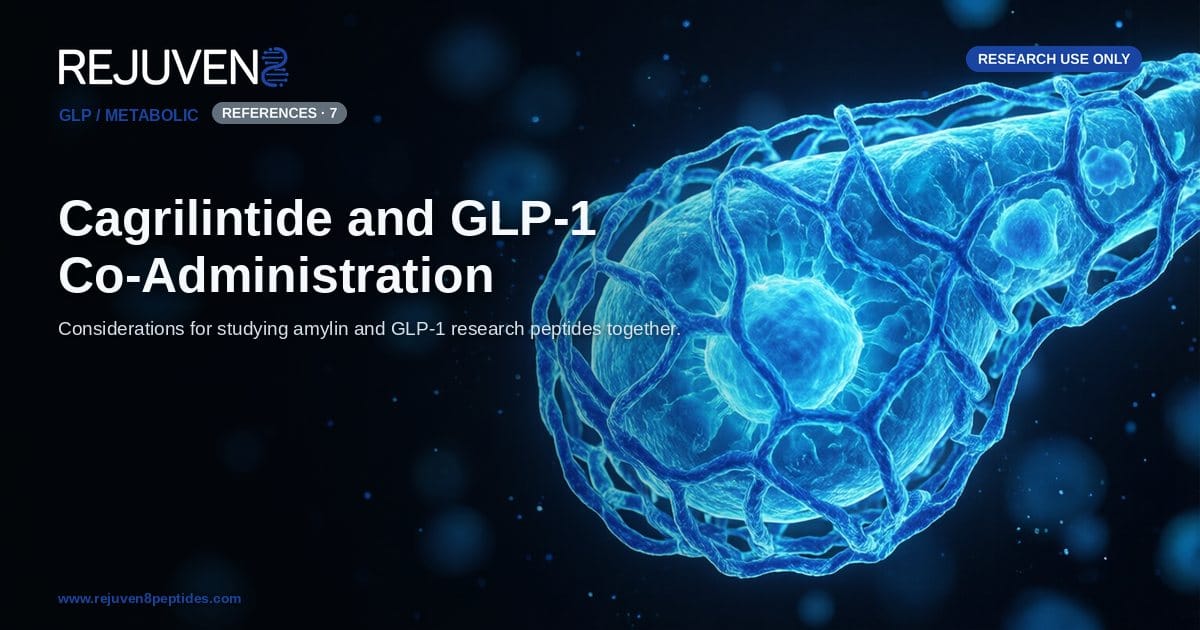
Cagrilintide is a long-acting amylin analog that is studied for its interaction with the amylin receptor family, a set of calcitonin-receptor complexes expressed in regions of the hindbrain associated with satiety signaling in animal models. In parallel, GLP-1 SM is a research peptide investigated at the glucagon-like peptide-1 (GLP-1) receptor, an incretin target linked in preclinical systems to glucose-dependent insulin signaling and gastric motility. The pairing of these two peptides, often described as amylin plus incretin co-administration, has become a recurring theme in metabolic peptide literature because the two receptors sit on distinct but complementary signaling axes.
This article examines Cagrilintide and GLP-1 co-administration strictly as a question of preclinical research design: how the two molecules are characterized, why investigators model them together, and which handling and control variables matter when they are studied side by side. Nothing here describes clinical application. These materials are for research use only, not for human consumption, and every attribute discussed reflects laboratory characterization rather than any therapeutic claim.
Two Distinct Signaling Pathways
Metabolic peptide research frequently separates satiety and glucose-handling signals into two broad families: the amylin axis and the incretin axis. Cagrilintide and GLP-1 SM are studied as representative tool compounds for each family, which is a large part of why they appear together in co-administration models. Understanding the two pathways in isolation is a prerequisite for interpreting any combined-exposure experiment.
Amylin receptor signaling and Cagrilintide
Amylin is a 37-amino-acid peptide co-secreted with insulin from pancreatic beta cells. Its signaling is mediated by amylin receptors (designated AMY1 through AMY3), which form when the calcitonin receptor associates with receptor-activity-modifying proteins (RAMPs). In animal research, activation of these receptors is associated with meal-ending satiety signals in the area postrema and the nucleus tractus solitarius. Cagrilintide is engineered as a long-acting amylin analog, with sequence modifications and acylation that extend its reported half-life relative to native amylin, making it a practical probe for sustained amylin-receptor studies. Researchers sourcing it for characterization work can review the identity data on the Cagrilintide product page.
GLP-1 receptor signaling and GLP-1 SM
GLP-1 is an incretin hormone released from intestinal L cells after nutrient intake. Acting through the GLP-1 receptor, a class B G-protein-coupled receptor, it is linked in preclinical systems to glucose-dependent insulin secretion, slowed gastric emptying, and central satiety circuits. GLP-1 SM is a research peptide investigated as a long-acting GLP-1 receptor agonist and is catalogued alongside related tools on the GLP-1 SM listing. Because the GLP-1 and amylin pathways converge on overlapping hindbrain regions while engaging different receptors, investigators often ask whether signals from the two integrate in an additive or complementary fashion.
Molecular Profiles at a Glance
Placing the two research peptides in a single reference frame helps clarify why they are treated as separate, non-interchangeable tools. The following values reflect commonly reported laboratory attributes and are provided for comparison only.
| Attribute | Cagrilintide | GLP-1 SM |
|---|---|---|
| Class | Amylin analog (amylinomimetic) | GLP-1 receptor agonist (incretin mimetic) |
| Primary target | Amylin receptors (AMY1-AMY3) | GLP-1 receptor (class B GPCR) |
| Sequence length | Approx. 37 amino acids | Approx. 31 amino acids |
| Approx. molecular weight | Approx. 3750 Da | Approx. 4100 Da |
| Modification strategy | Acylation for extended half-life | Acylation for extended half-life |
| Reported duration profile | Long-acting (once-weekly profile in literature) | Long-acting (once-weekly profile in literature) |
| Typical research form | Lyophilized powder | Lyophilized powder |
The two peptides share a long-acting design philosophy but differ in target, backbone length, and receptor pharmacology. Verifying these attributes against a supplier certificate of analysis is standard practice before either compound enters a study.
Why Researchers Model the Two Together
The interest in co-administration is a direct consequence of the pathway biology described above. When two peptides engage complementary circuits, a combined-exposure design lets investigators ask whether the observed readouts reflect one pathway, the other, or an interaction between them.
Complementary, non-identical circuits
The central rationale for pairing an amylin analog with a GLP-1 receptor agonist is that they act on parallel but non-identical signaling routes. Amylin-receptor activation and GLP-1-receptor activation both feed into hindbrain satiety networks in animal models, yet they originate at different receptors with different downstream couplings. A co-administration model is therefore a way to probe whether the two inputs converge, reinforce one another, or operate independently at the level of a measured endpoint.
Additive, synergistic, or independent effects
A well-constructed combination study is designed to distinguish among several possibilities: purely additive effects, where the combined readout equals the sum of the single-agent readouts; synergistic effects, where the combination exceeds that sum; and independent effects, where each peptide acts on separate endpoints. Because these outcomes are only interpretable against single-agent controls, the comparison structure of the experiment matters as much as the peptides themselves. This is why amylin and GLP-1 tools are frequently stocked together for research, as reflected across the broader research peptide catalog.
Preclinical Research Design Considerations
Treating co-administration as an experimental design problem, rather than a formulation exercise, keeps the work squarely within a research framing. Two categories of variable tend to dominate: physical handling of the peptides, and the control architecture of the study.
Reconstitution and handling
Both Cagrilintide and GLP-1 SM are supplied as lyophilized powders and must be reconstituted before laboratory use. As a worked example, reconstituting a 10 mg vial of Cagrilintide with 2 mL of bacteriostatic water yields a nominal 5 mg/mL stock (10 mg divided by 2 mL). Peptides of this class are generally stored cold, protected from repeated freeze-thaw cycles, and prepared with gentle mixing rather than vigorous agitation. When two peptides are studied together, researchers typically keep separate stock solutions and record concentrations independently, which preserves the ability to adjust one arm without disturbing the other. General preparation theory is covered in the bacteriostatic water reconstitution guide and is not repeated here.
Controls, sequencing, and endpoints
A defensible co-administration design includes single-agent arms for each peptide, a vehicle control, and clearly defined molar or mass-matched quantities so that the combination can be compared against its components. Investigators also decide whether the two peptides are introduced simultaneously or in a staggered sequence, since timing can influence how overlapping pathways are engaged. Endpoints should be specified in advance and measured identically across arms. None of these design choices imply or support any human application; they exist purely to make the in-vitro or animal-model data interpretable. Confirming compound identity and purity through a documented certificate library is part of the same rigor.
Frequently Asked Questions
What is the difference between Cagrilintide and GLP-1 SM?
Cagrilintide is a long-acting amylin analog studied at the amylin receptors (AMY1 through AMY3), while GLP-1 SM is a research peptide investigated at the GLP-1 receptor. They belong to different pharmacological classes and act on separate receptors, even though both are associated with satiety-related circuits in animal models.
Why are Cagrilintide and GLP-1 studied together in research?
Because the amylin and GLP-1 pathways are complementary but non-identical, co-administration models let researchers ask whether the two signals combine in an additive, synergistic, or independent manner at a measured endpoint. The combination is meaningful only when compared against single-agent controls.
Do Cagrilintide and GLP-1 SM act on the same receptor?
No. Cagrilintide targets the amylin receptor family, which is built from the calcitonin receptor paired with RAMP proteins, whereas GLP-1 SM targets the GLP-1 receptor, a class B G-protein-coupled receptor. Their pathways can converge on shared hindbrain regions while remaining pharmacologically distinct.
How are amylin and GLP-1 research peptides reconstituted?
Both are typically supplied as lyophilized powders and reconstituted with bacteriostatic water. For example, adding 2 mL of bacteriostatic water to a 10 mg vial of Cagrilintide gives a nominal 5 mg/mL stock. Separate stocks, cold storage, and minimal freeze-thaw handling are standard laboratory practices.
What molecular weight is reported for Cagrilintide?
Commonly reported laboratory values place Cagrilintide at approximately 3750 Da with a sequence length near 37 amino acids, consistent with an acylated amylin analog. These figures are provided for comparison only and should be verified against the certificate of analysis for a given batch.
Is Cagrilintide and GLP-1 co-administration intended for human use?
No. All discussion here is limited to preclinical, in-vitro, and animal-model research design. These compounds are for research use only, not for human consumption, and nothing in this article describes clinical dosing, efficacy, or therapeutic use.
References and Further Reading
- Cooper and colleagues (1987) first characterized islet amyloid polypeptide (amylin) from pancreatic tissue. PubMed: amylin islet amyloid polypeptide
- Reviews of amylin receptor pharmacology and RAMP-modified calcitonin receptors. PubMed: amylin receptor pharmacology
- Holst and colleagues on GLP-1 receptor physiology and incretin signaling. PubMed: GLP-1 receptor physiology
- Preclinical characterization of cagrilintide as a long-acting amylin analogue. PubMed: cagrilintide amylin analogue
- Studies of amylin and GLP-1 pathway co-administration in animal models. PubMed: amylin GLP-1 co-administration
- Drucker and colleagues on incretin biology and GLP-1 receptor agonism. PubMed: incretin biology GLP-1
- Methodological reviews of peptide reconstitution and stability for laboratory research. PubMed: peptide reconstitution stability