Research Use Only. The information presented here is for scientific and educational purposes. These compounds are not intended for human consumption, self-administration, or therapeutic use.
Introduction
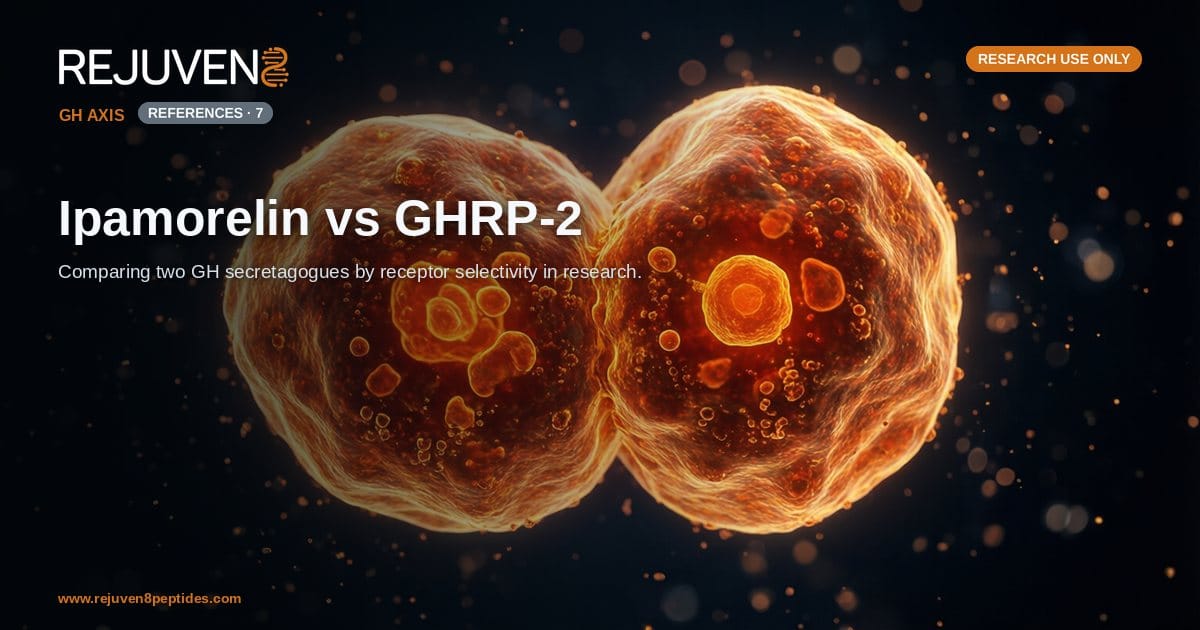
Ipamorelin and GHRP-2 are two synthetic growth hormone secretagogues (GHS) that have been widely studied for their ability to stimulate growth hormone (GH) release from the anterior pituitary in preclinical and in-vitro models. Both compounds are peptide agonists at the growth hormone secretagogue receptor type 1a (GHS-R1a), the same receptor targeted by the endogenous hormone ghrelin. Because they share a common molecular target yet differ in structure and downstream hormonal profile, the two peptides are frequently placed side by side in the research literature on GH-axis pharmacology.
The defining theme of any ipamorelin versus GHRP-2 comparison is selectivity: the degree to which a secretagogue drives GH release without simultaneously activating adjacent endocrine pathways such as cortisol, prolactin, or adrenocorticotropic hormone (ACTH). This article examines how each peptide engages the ghrelin receptor, how their structural profiles differ, and why selectivity has made ipamorelin a common reference point for cleaner GH-secretagogue signaling in laboratory studies. All discussion here concerns research use only, not for human consumption.
The Ghrelin Receptor and GH-Secretagogue Signaling
The GHS-R1a is a G-protein-coupled receptor expressed densely in the hypothalamus and pituitary. When activated, it triggers a phospholipase-C cascade that raises intracellular calcium and prompts somatotroph cells to release stored GH. Ghrelin is the natural ligand for this receptor, but a family of synthetic growth hormone-releasing peptides (GHRPs) was developed to mimic and probe this pathway years before ghrelin itself was identified.
Both ipamorelin and GHRP-2 belong to this GHRP family. They act in a manner complementary to growth hormone-releasing hormone (GHRH), which signals through a separate receptor. In research settings, secretagogues that work on GHS-R1a are often studied together with GHRH analogs because the two mechanisms can produce additive effects on measured GH output. This is why compounds such as CJC-1295 frequently appear in the same experimental frameworks as the peptides compared here.
Why Selectivity Matters
The GHS-R1a pathway does not operate in isolation. Depending on the ligand and its potency, receptor activation can spill over into the hypothalamic-pituitary-adrenal axis, producing measurable increases in ACTH, cortisol, and prolactin. A secretagogue described as selective is one that elevates GH while leaving these other markers comparatively unchanged. Selectivity is therefore a central variable when researchers characterize a GHS compound and compare one candidate against another.
Structural and Molecular Profiles
Ipamorelin is a pentapeptide, while GHRP-2 (also known as pralmorelin) is a hexapeptide. Both are short synthetic sequences built partly from D-amino acids and unnatural residues, a design that improves their stability against enzymatic breakdown relative to native ghrelin. The values in the table below reflect commonly reported laboratory attributes and are provided for comparison only.
| Attribute | Ipamorelin | GHRP-2 (Pralmorelin) |
|---|---|---|
| Compound class | Synthetic GH secretagogue (GHRP) | Synthetic GH secretagogue (GHRP) |
| Peptide length | Pentapeptide (5 residues) | Hexapeptide (6 residues) |
| Amino acid sequence | Aib-His-D-2-Nal-D-Phe-Lys-NH2 | D-Ala-D-2-Nal-Ala-Trp-D-Phe-Lys-NH2 |
| Molecular formula | C38H49N9O5 | C45H55N9O6 |
| Approximate molecular weight | 711.9 g/mol | 817.9 g/mol |
| Primary molecular target | GHS-R1a (ghrelin receptor) | GHS-R1a (ghrelin receptor) |
| Reported GH selectivity | High (minimal ACTH and cortisol signal) | Moderate (broader hormonal footprint) |
The structural takeaway is that both molecules are compact, protease-resistant agonists engineered around the same pharmacophore. Their differences in residue count and composition contribute to the distinct receptor-binding behavior and hormonal selectivity that separate them in comparative studies.
Selectivity: The Central Distinction
Ipamorelin gained attention in the endocrine literature as one of the first secretagogues characterized specifically for its GH selectivity. In the foundational work by Raun and colleagues at Novo Nordisk (1998), ipamorelin released GH with a potency comparable to earlier GHRPs but, notably, did not produce the increases in ACTH and cortisol seen with less selective compounds. This clean profile made it a useful research tool for isolating GHS-R1a-mediated GH release from confounding stress-axis activation.
GHRP-2, by contrast, is frequently described as a more potent overall GH releaser that carries a broader hormonal footprint. Studies of GHRP-2 report a stronger tendency to raise cortisol and prolactin, and its pronounced ghrelin-like activity has made it a subject of appetite and food-intake research in animal models. GHRP-2 has also been investigated as a diagnostic probe of pituitary GH reserve. The trade-off commonly drawn in the literature is potency and breadth for GHRP-2 versus selectivity and a narrower endocrine signature for ipamorelin.
Comparative Hormonal Footprint
The qualitative comparison below summarizes how the two peptides are typically characterized across measured endocrine outputs in preclinical research. As with all such summaries, these reflect commonly reported laboratory attributes and are provided for comparison only.
| Measured output | Ipamorelin | GHRP-2 |
|---|---|---|
| Growth hormone (GH) | Marked increase | Marked increase |
| ACTH and cortisol | Minimal reported change | Reported increase |
| Prolactin | Minimal reported change | Reported increase |
| Appetite and ghrelin-like activity | Modest | Pronounced |
Research Applications and Handling
Because their mechanisms are complementary, GHS-R1a agonists are often paired with a GHRH analog in experimental designs intended to maximize measurable GH pulses. Blended research formats such as the CJC-1295 and Ipamorelin blend reflect this dual-pathway logic, and comparing a pure secretagogue like GHRP-2 against such combinations is a recurring theme in GH-axis experiments.
Both peptides are supplied as lyophilized powders that require reconstitution before in-vitro use. Handling considerations include cold storage of the reconstituted solution, minimizing freeze-thaw cycles, and protecting stock from prolonged light exposure. Detailed procedure sits outside this comparison; the bacteriostatic water reconstitution guide covers general technique. Verifying identity and purity through a certificate of analysis is standard practice before any comparative work, so that observed differences can be attributed to the compounds rather than to material quality.
Both Ipamorelin and GHRP-2 are offered strictly as research compounds for controlled laboratory investigation.
Frequently Asked Questions
What is the main difference between ipamorelin and GHRP-2?
Both are synthetic growth hormone secretagogues that activate the GHS-R1a ghrelin receptor, but they differ in selectivity. Ipamorelin is characterized in research as releasing GH with minimal effect on cortisol, ACTH, and prolactin, whereas GHRP-2 is a more potent overall releaser that also raises those other markers and shows stronger ghrelin-like appetite activity.
Which is more selective, ipamorelin or GHRP-2?
Ipamorelin is the more selective of the two. It was one of the first secretagogues described specifically for its clean GH-releasing profile, which makes it a common reference compound when researchers want to isolate GHS-R1a signaling from stress-axis activation.
Do ipamorelin and GHRP-2 act on the same receptor?
Yes. Both peptides are agonists at the growth hormone secretagogue receptor type 1a (GHS-R1a), the receptor that also binds endogenous ghrelin. Their differences arise from structure, potency, and downstream selectivity rather than from targeting separate receptors.
Does GHRP-2 raise cortisol and prolactin in research models?
Published characterizations of GHRP-2 report measurable increases in cortisol and prolactin alongside GH release, which is the main reason it is considered less selective than ipamorelin. These observations come from preclinical and laboratory research contexts only.
Are ipamorelin and GHRP-2 studied alongside GHRH analogs?
Frequently. Because GHS-R1a agonists and GHRH analogs act through complementary pathways, researchers often examine them together to study additive GH output. Compounds in the GHRH analog class commonly appear in these dual-pathway experimental designs.
How are these peptides handled in a research setting?
Both are supplied as lyophilized powders that require reconstitution before in-vitro use. Standard handling includes cold storage of the prepared solution, limiting freeze-thaw cycles, and protecting material from light. Confirming identity and purity through a certificate of analysis is routine before comparative work.
References and Further Reading
- Raun, K., et al. (1998). Ipamorelin, the first selective growth hormone secretagogue. European Journal of Endocrinology. PubMed: ipamorelin selective growth hormone secretagogue
- Bowers, C.Y. Foundational research on growth hormone-releasing peptides (GHRPs). PubMed: Bowers growth hormone releasing peptide
- Kojima, M., et al. (1999). Ghrelin is a growth-hormone-releasing acylated peptide from stomach. Nature. PubMed: ghrelin growth hormone releasing peptide
- Howard, A.D., et al. (1996). A receptor in pituitary and hypothalamus that functions in growth hormone release. Science. PubMed: growth hormone secretagogue receptor
- Research on GHRP-2 (pralmorelin) as a growth hormone secretagogue and diagnostic probe. PubMed: GHRP-2 pralmorelin growth hormone
- Comparative studies of GH-secretagogue selectivity and effects on cortisol and prolactin. PubMed: growth hormone secretagogue selectivity
- Reviews of GHS-R1a signaling and the ghrelin receptor in GH regulation. PubMed: GHS-R1a ghrelin receptor