Research Use Only. The information presented here is for scientific and educational purposes. These compounds are not intended for human consumption, self-administration, or therapeutic use.
Introduction
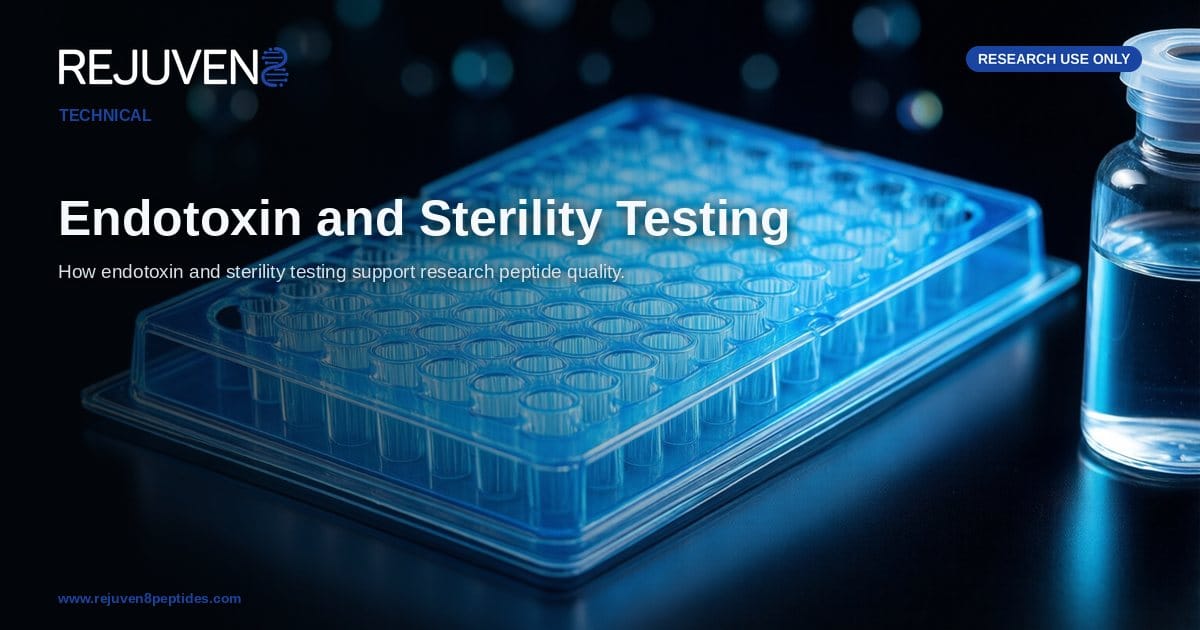
Bacterial endotoxin and sterility testing are two of the most informative quality checkpoints applied to research peptides, yet they are frequently confused or treated as interchangeable. Endotoxin testing measures a specific molecular contaminant, the lipopolysaccharide (LPS) shed from the outer membrane of Gram-negative bacteria, while sterility testing asks a different question entirely: whether any viable microorganisms remain in a preparation. For laboratories evaluating lyophilized peptides intended strictly for research use only, not for human consumption, understanding both assays clarifies what a certificate of analysis can and cannot document.
These attributes matter because contamination can quietly distort experimental data. Endotoxin is a potent activator of the innate immune system through the Toll-like receptor 4 (TLR4) pathway, and even trace amounts can trigger cytokine release, alter cell viability, or confound in-vitro and animal studies. This article explains how the Limulus Amebocyte Lysate (LAL) assay detects endotoxin, how sterility is assessed in a laboratory setting, and how these results sit alongside purity data when researchers evaluate peptide quality.
What Bacterial Endotoxins Are
Endotoxins are lipopolysaccharides, large amphipathic molecules built from a lipid A anchor, a core oligosaccharide region, and a variable O-antigen polysaccharide chain. They form part of the structural backbone of the outer membrane of Gram-negative bacteria such as Escherichia coli and are released when those cells divide or die. The lipid A portion is the biologically active center responsible for the pyrogenic and immunostimulatory properties associated with endotoxin exposure.
Why Endotoxin Is Distinct From Live Bacteria
A crucial point for any quality program is that endotoxin is a molecule, not an organism. Standard sterilization such as autoclaving or filtration can kill or remove bacteria while leaving the heat-stable LPS behind. Endotoxin withstands temperatures that destroy most microbial life and is not eliminated by conventional 0.22 micron filtration. Consequently, a peptide preparation can be sterile yet still carry a measurable endotoxin burden, which is precisely why the two tests are reported as separate parameters.
Units and Reporting
Endotoxin activity is expressed in endotoxin units per milliliter (EU/mL) or per milligram of peptide. Reference standards let laboratories relate one assay to another, and results are compared against a defined sensitivity threshold, historically denoted by the term lambda in LAL testing. Reporting endotoxin on a per-milligram basis is especially useful for solid lyophilized peptides, since the final solution concentration depends on how the researcher reconstitutes the vial.
The LAL Assay: How Endotoxin Testing Works
The Limulus Amebocyte Lysate assay is the most widely used method for endotoxin detection. It exploits a natural defense reaction found in the blood cells (amebocytes) of the horseshoe crab (Limulus polyphemus), where contact with endotoxin triggers an enzymatic coagulation cascade. Modern laboratories run this reaction in several formats that trade throughput for quantitative precision.
Common LAL Formats
Gel-clot methods are the simplest, producing a visible gel when endotoxin meets or exceeds the assay sensitivity, giving a pass or fail style readout. Turbidimetric assays track the cloudiness that develops as the clotting proteins react, and chromogenic assays use a synthetic substrate that releases a colored compound in proportion to endotoxin concentration. Kinetic versions of the latter two measure the time needed to reach a defined signal, enabling quantitative results across a broad range.
Recombinant Alternatives
A newer approach uses recombinant Factor C (rFC), a laboratory-produced version of the first enzyme in the horseshoe crab cascade. Because rFC is synthesized rather than harvested, it reduces reliance on wild horseshoe crab populations while offering comparable specificity for endotoxin detection.
The values below reflect commonly reported laboratory attributes and are provided for comparison only.
| LAL Format | Output Type | Typical Sensitivity Range (EU/mL) | Notes |
|---|---|---|---|
| Gel-clot | Qualitative / semi-quantitative | 0.03 to 0.25 | Simple, low equipment needs |
| Turbidimetric (kinetic) | Quantitative | 0.001 to 1.0 | Wide range, plate reader based |
| Chromogenic (kinetic) | Quantitative | 0.005 to 1.0 | Color signal, high precision |
| Recombinant Factor C | Quantitative (fluorescent) | 0.005 to 5.0 | Animal-free, endotoxin specific |
How Sterility Testing Is Performed
Where endotoxin testing detects a molecule, sterility testing confirms the absence of viable, culturable microorganisms including bacteria, yeasts, and molds. Pharmacopeial frameworks describe two principal techniques, both of which incubate samples in nutrient media designed to encourage any surviving organisms to grow to a detectable level.
Membrane Filtration and Direct Inoculation
In membrane filtration, a sample is passed through a fine filter that captures microorganisms, which is then transferred into growth media. This method suits samples that could otherwise inhibit microbial growth, since rinsing helps remove the test article. Direct inoculation instead adds the sample straight into the culture media and is often used for small volumes. Cultures are typically split between a medium favoring aerobic and anaerobic bacteria and a second medium favoring fungi.
Incubation and Reading
Standard sterility protocols incubate cultures for 14 days, with media held at roughly 30 to 35 degrees C for bacterial growth and 20 to 25 degrees C for fungal growth. Turbidity or visible colonies indicate contamination. Because live organisms need time to multiply, this extended incubation window is what separates a genuine sterility result from a quick visual inspection. Rapid microbial methods using ATP bioluminescence or nucleic acid detection are increasingly adopted to shorten this timeline in some laboratories.
The distinctions summarized below reflect commonly reported laboratory attributes and are provided for comparison only.
| Attribute | Endotoxin (LAL) Testing | Sterility Testing |
|---|---|---|
| What it detects | Lipopolysaccharide molecule | Viable microorganisms |
| Target class | Gram-negative bacterial residue | Bacteria, yeasts, molds |
| Approx. analyte size | LPS subunits, roughly 10 to 20 kDa | Whole cells (micron scale) |
| Survives autoclaving | Yes (heat-stable) | No (organisms killed) |
| Typical readout | EU/mL or EU/mg | Growth / no growth |
Reading These Results in a Quality Context
Endotoxin and sterility figures rarely appear in isolation. On a well-documented certificate of analysis (COA), they sit alongside identity confirmation by mass spectrometry and purity by high-performance liquid chromatography (HPLC). A researcher assessing a lyophilized peptide benefits from reading these data points together: purity describes the peptide itself, while endotoxin and sterility describe the biological cleanliness of the preparation. Our guide to reading a peptide COA walks through how these sections relate.
What to Look For From a Supplier
Not every vendor commissions endotoxin or sterility testing, and testing scope varies widely across the research market. Evaluating documentation practices is therefore part of choosing a research peptide supplier, and published third-party certificates provide a transparent record. When a preparation will be reconstituted for cell-based or animal research, low endotoxin becomes particularly relevant, and careful handling during reconstitution with bacteriostatic water helps preserve the low-contamination state established at the manufacturing stage. Researchers can review these attributes across the current catalog of research peptides, all handled strictly within a research context.
Frequently Asked Questions
What is endotoxin testing for peptides?
Endotoxin testing measures the amount of bacterial lipopolysaccharide present in a peptide preparation, usually with the LAL assay, and reports the result in endotoxin units. It is a research quality metric that indicates how much Gram-negative bacterial residue remains, which matters because endotoxin can activate immune pathways and confound experimental results.
Is sterility testing the same as endotoxin testing?
No. Sterility testing confirms that no viable microorganisms can grow from a sample, while endotoxin testing detects a specific molecule that can persist even after all bacteria are dead. A preparation can pass sterility yet still contain endotoxin, so laboratories treat them as separate attributes.
What does LAL stand for?
LAL stands for Limulus Amebocyte Lysate, a reagent derived from the blood cells of the horseshoe crab. It clots in the presence of endotoxin, and that reaction is the basis of the most common endotoxin detection assays.
Can autoclaving remove endotoxin from a peptide?
Autoclaving kills bacteria but does not reliably destroy endotoxin, because lipopolysaccharide is heat-stable. Removing or inactivating endotoxin typically requires specialized depyrogenation steps rather than standard sterilization, which is one reason endotoxin is measured independently.
Why does endotoxin matter for research peptides?
In cell culture and animal research, endotoxin can trigger the TLR4 pathway and provoke cytokine release, skewing outcomes that have nothing to do with the peptide under study. Keeping endotoxin low helps ensure that observed effects reflect the compound rather than contamination. These materials remain for research use only.
How is endotoxin reported on a certificate of analysis?
Endotoxin is generally listed as a value in EU/mL or EU/mg alongside purity and identity data. Reviewing it in the context of the full COA, together with sterility status where available, gives a fuller picture of preparation quality.