Research Use Only. The information presented here is for scientific and educational purposes. These compounds are not intended for human consumption, self-administration, or therapeutic use.
Introduction
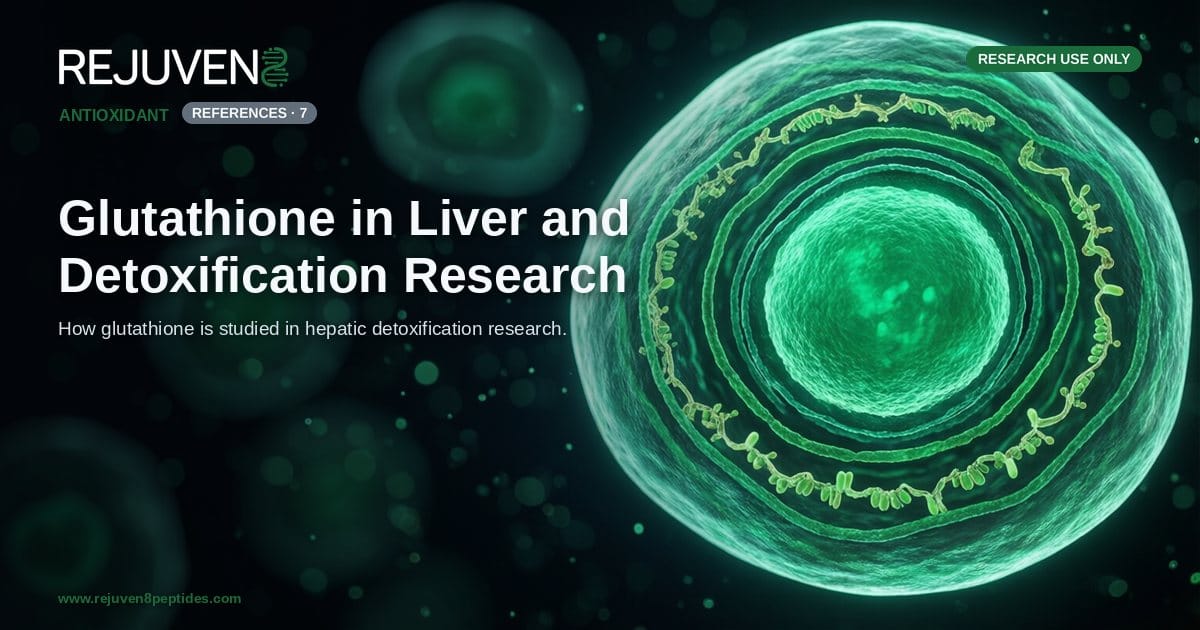
Glutathione is a low-molecular-weight thiol tripeptide, gamma-L-glutamyl-L-cysteinyl-glycine, that accumulates to millimolar concentrations in hepatocytes and makes the liver one of the most intensively studied organs in glutathione research. Because the liver is the principal site of glutathione biosynthesis, export, and turnover, experimental models of hepatic detoxification routinely use glutathione status as a readout of xenobiotic handling and cellular stress. The material described here is intended for research use only, not for human consumption.
The framing throughout this overview is mechanistic and preclinical. Rather than restating the general redox biology of the glutathione and glutathione disulfide couple, the discussion concentrates on hepatic conjugation chemistry, compartmentalized glutathione pools, and the toxicant models (such as acetaminophen and carbon tetrachloride exposure) that laboratories use to perturb and quantify liver glutathione. Investigators who evaluate reference-grade glutathione generally pair it with defined analytical endpoints and verified certificates of analysis so that measured depletion or repletion can be attributed to the experimental variable.
Glutathione and Hepatic Detoxification Pathways
Hepatic detoxification is often organized into functional phases. Phase I reactions, catalyzed largely by cytochrome P450 enzymes, introduce or expose reactive groups on lipophilic substrates. Phase II reactions then conjugate those intermediates to water-soluble carriers for elimination. Glutathione is central to this second phase, and much of its studied liver function stems from the reactivity of its cysteine thiol toward electrophilic metabolites.
Phase II Conjugation and Glutathione S-Transferases
The glutathione S-transferases (GSTs) are a family of hepatic enzymes that accelerate nucleophilic attack of the glutathione thiol on electrophilic centers. In preclinical systems, this activity is examined with model substrates and with genuinely reactive metabolites such as NAPQI (N-acetyl-p-benzoquinone imine), the acetaminophen intermediate generated by CYP2E1. When glutathione is abundant, GST-mediated conjugation neutralizes such electrophiles before they can arylate cellular proteins. When glutathione is depleted, the same electrophiles accumulate, and covalent binding to macromolecules becomes measurable. This threshold behavior is a recurring theme in hepatic toxicology research and is one reason glutathione concentration is treated as a protective reserve rather than a simple antioxidant.
The Mercapturic Acid Pathway
Once a glutathione conjugate forms, the liver processes it through the mercapturic acid pathway. Gamma-glutamyltransferase removes the glutamate residue, a dipeptidase removes glycine, and N-acetyltransferase acetylates the remaining cysteine conjugate to yield a mercapturic acid that is exported for urinary excretion. Measuring mercapturic acid output in animal models provides an integrated index of how much reactive material passed through glutathione conjugation. The gamma-glutamyl bond, an unusual peptide linkage formed through the glutamate side chain, is what makes glutathione resistant to ordinary peptidases and dependent on this specialized catabolic route.
The values below reflect commonly reported laboratory attributes and are provided for comparison only.
| Attribute | Reported value |
|---|---|
| Compound class | Thiol tripeptide (endogenous antioxidant) |
| Sequence | gamma-L-glutamyl-L-cysteinyl-glycine |
| Peptide length | 3 residues |
| Molecular formula | C10H17N3O6S |
| Molecular weight | approximately 307.3 g/mol |
| Reactive moiety | Cysteine thiol (-SH) |
| Primary hepatic role studied | Phase II conjugation and redox buffering |
Preclinical Liver Models in Glutathione Research
A defining feature of hepatic glutathione research is the availability of well-characterized models that deplete, block, or challenge the glutathione system in a controlled way. These models let investigators separate synthesis, consumption, and compartmental transport, and they underpin much of what is known about liver glutathione dynamics.
Chemical Hepatotoxicity Models
The acetaminophen (APAP) model is among the most cited in the field. Classic studies from the National Institutes of Health in the early 1970s, associated with Mitchell, Jollow, Brodie, and coworkers, established that hepatic necrosis in rodents tracked with glutathione depletion and covalent binding of a reactive metabolite. The carbon tetrachloride (CCl4) model instead generates a trichloromethyl radical through CYP2E1, driving lipid peroxidation alongside glutathione consumption, and it remains a standard system for studying oxidative liver injury and fibrosis. Chronic ethanol feeding models add a further dimension by selectively lowering the mitochondrial glutathione pool, a phenotype examined extensively in intragastric rodent studies.
Glutathione Depletion Tools
To study glutathione loss in isolation, researchers use pharmacological tools rather than toxicants. Buthionine sulfoximine (BSO) inhibits glutamate-cysteine ligase, the rate-limiting synthetic enzyme, and produces a progressive, synthesis-based decline in glutathione, an approach developed in the work of Griffith and Meister. Diethyl maleate (DEM) instead conjugates glutathione directly for rapid, consumption-based depletion. Comparing a synthesis block against a direct conjugation challenge helps separate the contributions of glutathione production and glutathione utilization within hepatocytes.
The values below reflect commonly reported laboratory attributes and are provided for comparison only.
| Model or tool | Mechanism studied | Typical system | Glutathione readout |
|---|---|---|---|
| Acetaminophen (APAP) | CYP2E1-derived NAPQI depletes glutathione, binds proteins | Rodent, isolated hepatocytes | Rapid glutathione depletion |
| Carbon tetrachloride (CCl4) | Trichloromethyl radical, lipid peroxidation | Rodent liver | Consumption, disulfide rise |
| Chronic ethanol feeding | CYP2E1 induction, mitochondrial stress | Intragastric rodent models | Selective mitochondrial loss |
| Buthionine sulfoximine (BSO) | Blocks glutamate-cysteine ligase (synthesis) | Cell and animal | Progressive depletion |
| Diethyl maleate (DEM) | Direct conjugation of glutathione | Cell and animal | Acute depletion |
Compartmentalized Hepatic Glutathione Pools
Cytosolic and Mitochondrial Glutathione
Hepatocyte glutathione is not a single uniform pool. Roughly 85 to 90 percent resides in the cytosol, while a smaller fraction, commonly cited near 10 to 15 percent, is sequestered in mitochondria. Mitochondria lack the enzymes to synthesize glutathione, so this pool depends on carrier-mediated import from the cytosol, a process attributed in part to dicarboxylate and 2-oxoglutarate carriers. Research from Kaplowitz, Fernandez-Checa, and coworkers demonstrated that selective depletion of mitochondrial glutathione can sensitize hepatocytes to injury even when total cellular glutathione appears adequate, which is why compartmental measurement, not just whole-cell assay, is emphasized in modern liver studies.
Precursor and Ester Delivery Approaches
Because intact glutathione crosses membranes poorly, model systems often manipulate the pool indirectly. N-acetylcysteine (NAC) supplies cysteine, the limiting synthetic precursor, and is a standard tool in acetaminophen research. Cell-permeant derivatives such as glutathione monoethyl ester deliver glutathione intracellularly and are used to test whether repletion restores a measured endpoint. Glutathione is also studied alongside other mitochondrial and longevity-associated research compounds, including NAD+, MOTS-c, and SS-31, where investigators compare distinct mechanistic entry points into cellular energetics and redox control.
Material Quality and Reproducibility in Glutathione Studies
Reproducible glutathione measurements depend as much on material quality as on assay design. Oxidation of the cysteine thiol during storage can shift the glutathione to glutathione disulfide ratio before an experiment even begins, so purity, handling, and documentation all matter. Investigators are encouraged to review a supplier’s certificate of analysis and to apply consistent supplier vetting criteria when sourcing reference compounds for the liver models described above. A full catalog of characterized research materials is available in the research peptide shop.
Frequently Asked Questions
What is glutathione’s role in the liver?
In liver research, glutathione is studied primarily as a Phase II conjugation substrate and redox buffer. Its cysteine thiol reacts with electrophilic metabolites, and hepatocytes maintain millimolar concentrations that serve as a protective reserve. The liver is also the main site of glutathione synthesis and export in the body.
How is glutathione measured in liver detoxification models?
Common readouts include total glutathione, the ratio of reduced glutathione to glutathione disulfide, and mercapturic acid excretion. Investigators frequently combine these with markers of covalent protein binding or lipid peroxidation to link glutathione status to a specific toxicant challenge.
What is the acetaminophen glutathione model?
It is a preclinical hepatotoxicity model in which acetaminophen is metabolized by CYP2E1 to the reactive intermediate NAPQI. NAPQI is conjugated by glutathione, and when the glutathione reserve is exhausted, covalent binding and hepatocellular injury increase in rodent and cultured hepatocyte systems.
Why do researchers distinguish mitochondrial from cytosolic glutathione?
Mitochondria cannot synthesize glutathione and must import it from the cytosol. Because selective loss of the mitochondrial pool can sensitize hepatocytes to injury even when total glutathione looks normal, compartmental measurement gives a more sensitive picture of hepatic stress than whole-cell assays alone.
How does N-acetylcysteine relate to glutathione in liver research?
N-acetylcysteine supplies cysteine, the rate-limiting precursor for glutathione synthesis, and is widely used in acetaminophen research models to test whether restoring synthetic capacity changes a measured endpoint. It is a research tool for probing the synthetic arm of the pathway.
Is Rejuven8 glutathione intended for human use?
No. Glutathione supplied by Rejuven8 Peptides is a reference compound for laboratory investigation. It is offered for research use only, not for human consumption, self-administration, or therapeutic use.
References and Further Reading
- Meister, A. Foundational studies on glutathione biosynthesis and the gamma-glutamyl cycle (Cornell University Medical College). PubMed: glutathione metabolism Meister
- Mitchell, J.R., Jollow, D.J., and colleagues. Early studies linking acetaminophen-induced hepatic necrosis to glutathione depletion (National Institutes of Health, 1970s). PubMed: acetaminophen glutathione hepatic necrosis
- Kaplowitz, N. Research on hepatic glutathione homeostasis and transport. PubMed: hepatic glutathione Kaplowitz
- Fernandez-Checa, J.C. Studies on mitochondrial glutathione transport in liver. PubMed: mitochondrial glutathione liver
- Griffith, O.W., and Meister, A. Buthionine sulfoximine as an inhibitor of glutathione synthesis. PubMed: buthionine sulfoximine glutathione
- Reviews of glutathione S-transferases and the mercapturic acid pathway in xenobiotic detoxification. PubMed: glutathione S-transferase mercapturic acid
- Investigations of carbon tetrachloride hepatotoxicity and glutathione in liver models. PubMed: carbon tetrachloride glutathione liver