Research Use Only. The information presented here is for scientific and educational purposes. These compounds are not intended for human consumption, self-administration, or therapeutic use.
Introduction
The intestinal epithelium forms one of the most actively studied biological barriers in preclinical science. Researchers investigating gut peptides often examine how short signaling molecules interact with the epithelial lining, the tight junction proteins that seal adjacent cells, and the mucosal repair pathways that follow experimental injury. Two compounds recur across this literature: BPC-157, a synthetic pentadecapeptide derived from a gastric protein fragment, and GLP-2 TZ, a research analog studied within glucagon-like peptide-2 (GLP-2) signaling. This overview surveys what each molecule is investigated for in laboratory and animal-model settings.
The material below is written for research use only, not for human consumption. Every property described reflects in-vitro, ex-vivo, or animal-model observation rather than any clinical claim. Nothing here should be read as a statement of human efficacy, dosing, or therapeutic value. The goal is to map how these peptides are positioned as tools in barrier-function research, and where their studied mechanisms overlap or diverge.
The Intestinal Barrier as a Research Target
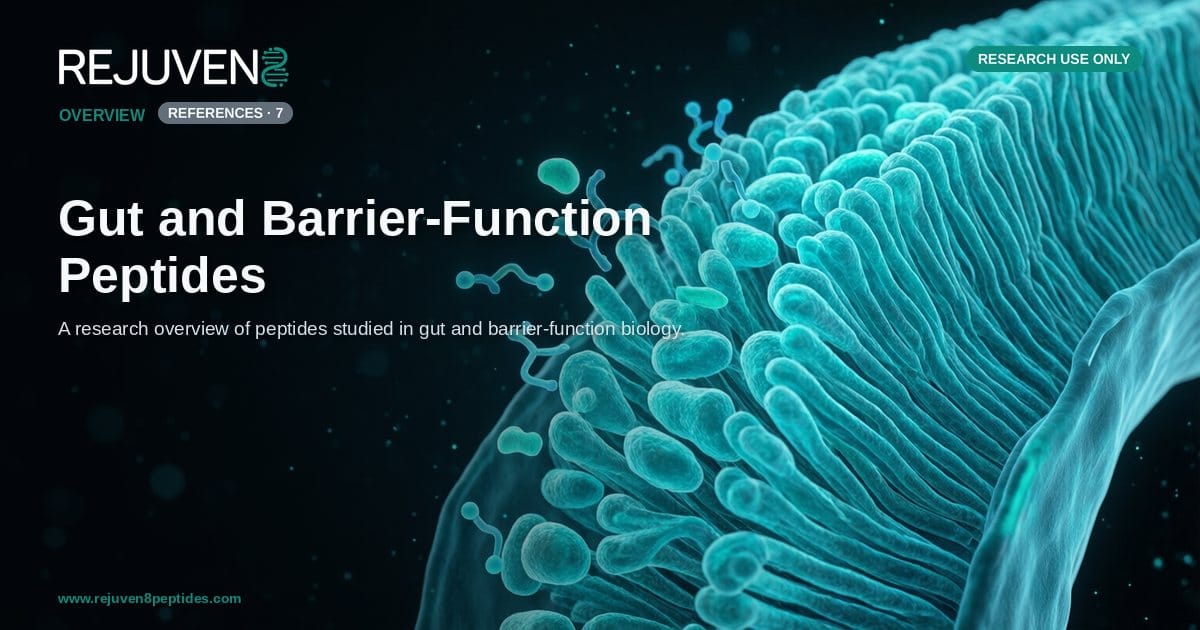
The gut barrier is not a single structure but a layered system. A single sheet of columnar epithelial cells sits on a basement membrane, sealed laterally by tight junctions built from claudins, occludin, and zonula occludens proteins. Above the cells lies a mucus layer populated by antimicrobial peptides and secretory immunoglobulin. Preclinical models that disrupt this system, whether through chemical colitis agents, ischemia-reperfusion protocols, or nonsteroidal anti-inflammatory challenge, provide the experimental backdrop against which gut peptides are studied.
Why barrier integrity matters in models
When epithelial integrity is compromised in an animal model, luminal contents can cross the barrier, a phenomenon researchers quantify using markers such as transepithelial electrical resistance and labeled tracer flux. Compounds that appear to influence these readouts become candidates for further mechanistic study. Because the epithelium turns over rapidly, it is also a convenient system for observing proliferation, migration, and repair on a compressed timeline.
Signaling versus structural peptides
Peptides examined in this space fall loosely into two camps. Some, like BPC-157, are studied as broad cytoprotective and pro-angiogenic agents that act across several tissue types. Others, like the GLP-2 family, are studied as tissue-specific trophic hormones whose receptors concentrate in and around the gut. Understanding which category a peptide belongs to helps frame the questions researchers ask about it.
BPC-157: A Pentadecapeptide in Gut Repair Research
BPC-157 (Body Protection Compound 157) is a synthetic peptide of fifteen amino acids, its sequence corresponding to a partial fragment of a protein identified in gastric juice. In preclinical work it is described as a stable, water-soluble molecule that tolerates a range of laboratory conditions. Investigators have used it to probe angiogenesis, fibroblast behavior, and the gut-brain axis in rodent systems.
Studied mechanisms
Reported research directions include modulation of the vascular endothelial growth factor receptor 2 (VEGFR2) pathway, interaction with the nitric oxide system, and observed changes in tight junction protein expression following experimental gastrointestinal injury in animals. These observations are mechanistic hypotheses drawn from model systems, not demonstrated outcomes in people.
Common research pairings
In the recovery and tissue-repair literature, BPC-157 is frequently examined alongside other peptides such as TB-500. A broader treatment of that topic appears in the recovery and tissue-repair peptide overview. Laboratories sourcing the compound typically review a certificate of analysis to confirm identity and purity before any experimental use.
GLP-2 TZ: Glucagon-Like Peptide-2 Signaling
GLP-2 TZ is studied within the biology of glucagon-like peptide-2 (GLP-2), a 33 amino acid hormone released by intestinal enteroendocrine L-cells. Native GLP-2 is described as intestinotrophic in animal models, meaning it is associated with expansion of the epithelial surface. Because the native hormone is rapidly cleaved by the enzyme dipeptidyl peptidase-4 (DPP-4), analogs studied in this area are engineered for greater enzymatic stability, and GLP-2 TZ is positioned as one such research analog.
Studied mechanisms
Research on the GLP-2 axis describes signaling through the GLP-2 receptor (GLP-2R), which in animal studies is linked to crypt cell proliferation, greater villus height, and reduced epithelial apoptosis. The receptor is expressed largely on subepithelial cells, so the signal is thought to reach the epithelium indirectly through local mediators. These are laboratory observations in model systems and are not human outcomes.
Distinct from GLP-1 pathways
Although the naming is similar, the GLP-2 pathway is mechanistically distinct from the GLP-1 axis explored by compounds such as GLP-1 SM. GLP-2 research centers on the intestinal epithelium itself, whereas GLP-1 research is oriented toward systemic glucose handling and satiety signaling. Keeping the two axes separate is important when interpreting the literature.
Comparative Overview and Laboratory Attributes
The identity values in the table below reflect commonly reported laboratory attributes and are provided for comparison only.
| Attribute | BPC-157 | GLP-2 TZ |
|---|---|---|
| Class | Synthetic pentadecapeptide | Glucagon-like peptide-2 analog |
| Sequence length | 15 amino acids | 33 amino acid class |
| Approximate molecular weight | About 1.4 kDa (near 1419 Da) | About 3.7 to 3.9 kDa |
| Primary studied pathway | Angiogenesis and cytoprotection | GLP-2 receptor trophic signaling |
| Typical research context | Gastrointestinal and soft-tissue repair models | Intestinal epithelial growth models |
| Laboratory form | Lyophilized powder | Lyophilized powder |
Handling and reconstitution
Both peptides are typically supplied as a lyophilized powder that is reconstituted with bacteriostatic water for laboratory work. The general procedure is covered in the bacteriostatic water reconstitution guide. As with most research peptides, cold storage and minimal freeze-thaw cycling are commonly recommended to preserve molecular integrity.
Sourcing considerations
Selecting a supplier for barrier-function research generally involves reviewing third-party testing. The supplier vetting guide and the COA reading guide outline what to look for in documentation. Product-specific pages are available for BPC-157 and GLP-2 TZ within the broader research peptide catalog.
Frequently Asked Questions
What are gut peptides in research?
In a laboratory context, gut peptides are short amino acid chains studied for their interactions with the intestinal epithelium, its barrier proteins, and mucosal repair pathways. The term spans endogenous signaling hormones such as GLP-2 as well as synthetic compounds such as BPC-157 that are investigated in gastrointestinal models.
Is BPC-157 studied specifically for the gut barrier?
Yes. A portion of the BPC-157 literature examines gastrointestinal injury models, where investigators report observations on tight junction protein expression and epithelial repair in animals. This work is preclinical and is intended for research use only, not for human consumption.
What does GLP-2 TZ refer to?
GLP-2 TZ is a coded research designation for an analog studied within glucagon-like peptide-2 signaling. Native GLP-2 is a 33 amino acid intestinotrophic hormone that is quickly degraded by DPP-4, so research analogs are engineered for greater stability.
How do BPC-157 and GLP-2 TZ differ mechanistically?
BPC-157 is studied as a broad cytoprotective and pro-angiogenic peptide that acts across several tissues, while GLP-2 TZ is studied through the tissue-specific GLP-2 receptor that concentrates in and around the gut. One is general, the other is pathway-focused.
Are these peptides approved for human use?
No. The compounds discussed here are offered strictly for laboratory research and are not approved for human or veterinary use. All described properties come from in-vitro and animal-model studies.
How are gut peptides stored and handled in the lab?
They are usually supplied as a lyophilized powder, reconstituted with bacteriostatic water, kept under cold storage, and protected from repeated freeze-thaw cycles. Confirming identity and purity against a certificate of analysis is standard practice before use.
References and Further Reading
- Sikiric P, et al. Research on BPC-157 and gastrointestinal cytoprotection in preclinical models. PubMed: BPC-157 gastrointestinal
- BPC-157 and angiogenic signaling in animal studies. PubMed: BPC-157 angiogenesis
- Drucker DJ, et al. Glucagon-like peptide-2 and intestinal growth in model systems. PubMed: glucagon-like peptide-2 intestinal
- GLP-2 receptor signaling and epithelial proliferation. PubMed: GLP-2 receptor intestinal
- Intestinal epithelial tight junctions and barrier permeability. PubMed: intestinal tight junction permeability
- Dipeptidyl peptidase-4 and GLP-2 enzymatic stability. PubMed: GLP-2 dipeptidyl peptidase-4
- Peptide approaches in gut barrier-function research. PubMed: gut barrier function peptide