Research Use Only. The information presented here is for scientific and educational purposes. These compounds are not intended for human consumption, self-administration, or therapeutic use.
Introduction
Cagrilintide is a long-acting amylin analog that has become a useful reference tool in preclinical studies of energy-balance signaling. Amylin is a pancreatic peptide co-secreted with insulin, and it acts on receptor populations concentrated in the hindbrain to influence satiation circuits. In laboratory settings, Cagrilintide is investigated as a stable, acylated molecule that engages these same amylin receptor systems, which makes it a convenient probe for researchers who study how peripheral hormones communicate with central neurons. All discussion here is framed for research use only, not for human consumption.
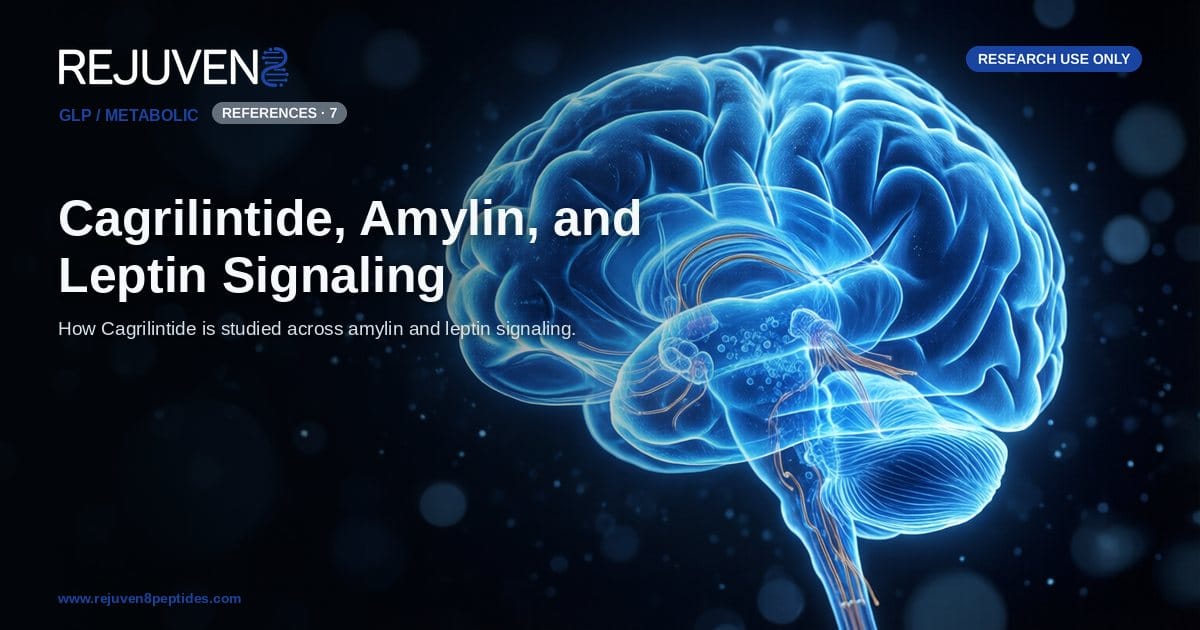
This article surveys how Cagrilintide is studied at the intersection of two signaling systems: the amylin pathway of the area postrema and the leptin pathway of the hypothalamus. A recurring theme in the preclinical literature is the observation that amylin agonism appears to modulate leptin responsiveness in rodent models, a phenomenon sometimes described as leptin sensitization. The sections below outline receptor pharmacology, the proposed amylin and leptin interplay, and practical notes on handling this peptide in a controlled laboratory environment. No human outcomes, dosing, or therapeutic effects are described or implied.
Cagrilintide and the Amylin Receptor System
Amylin, also called islet amyloid polypeptide (IAPP), is a 37-amino-acid peptide first characterized by Cooper and colleagues in the late 1980s. Its native form aggregates readily, which limits its usefulness as a research reagent. Cagrilintide was engineered as an acylated amylin analog carrying a fatty-acid moiety that extends its half-life and improves solubility, so that investigators can maintain stable receptor exposure across longer in-vitro and in-vivo timelines.
Receptor architecture
The amylin receptor is not a single protein. It forms when the calcitonin receptor (CTR) associates with one of three receptor activity-modifying proteins (RAMP1, RAMP2, RAMP3), producing the AMY1, AMY2, and AMY3 receptor subtypes. This combinatorial arrangement, mapped in detail by Sexton, Hay, and colleagues, explains why amylin analogs also show measurable activity at the calcitonin receptor. For this reason Cagrilintide is often classified in the literature as a dual amylin and calcitonin receptor agonist.
The values below reflect commonly reported laboratory attributes and are provided for comparison only.
| Molecule | Studied class | Primary receptor target | Approx. molecular weight | Approx. length |
|---|---|---|---|---|
| Amylin (IAPP) | Pancreatic peptide hormone | Amylin receptors (AMY1 to AMY3) | ~3,900 Da | 37 amino acids |
| Cagrilintide | Long-acting amylin analog (acylated) | Amylin and calcitonin receptors | ~3,750 Da | amylin-derived backbone |
| Leptin | Adipokine (protein hormone) | Leptin receptor (LepRb) | ~16 kDa | 146 amino acids |
Amylin Signaling in the Hindbrain
A defining feature of amylin biology is its point of entry into the brain. The area postrema, a circumventricular organ in the hindbrain that lacks a complete blood-brain barrier, is densely populated with amylin receptors. Work by Lutz and colleagues established the area postrema as a primary site where circulating amylin is detected, after which the signal propagates to the nucleus of the solitary tract and onward to hypothalamic and forebrain regions.
Satiation circuits in preclinical models
In rodent studies, amylin receptor activation is associated with meal-related satiation signaling rather than long-term adiposity signaling. Cagrilintide is used experimentally to sustain this activation, allowing researchers to observe how prolonged amylin tone shapes neuronal firing patterns in the hindbrain. Because the area postrema communicates with reward and homeostatic centers, these studies also probe how amylin agonism intersects with other neuropeptide systems. Findings in this area are strictly preclinical and describe cellular and circuit-level responses in animal and tissue models, not human outcomes.
The Amylin and Leptin Interplay
Leptin is an adipokine, a hormone secreted by fat tissue in proportion to energy stores. Cloned by Zhang, Friedman, and colleagues in 1994, leptin signals through the long-form leptin receptor (LepRb) in the arcuate nucleus of the hypothalamus, activating the JAK2-STAT3 cascade to report the status of energy reserves. Whereas amylin conveys a short-term, meal-associated signal, leptin conveys a slower, adiposity-associated signal, and the two pathways converge on overlapping neuronal populations.
Amylin as a studied leptin sensitizer
One of the most cited themes in this field comes from preclinical work by Roth and colleagues, who reported that amylin agonism could restore leptin responsiveness in diet-challenged rodents that had become relatively unresponsive to leptin alone. In these animal models, combining an amylin agonist with leptin produced signaling responses greater than either molecule produced separately. This observation, often summarized as amylin acting as a leptin sensitizer, is a central reason Cagrilintide is studied alongside leptin pathway reagents.
Proposed mechanisms
Several mechanisms have been proposed to explain the interplay. Amylin signaling in the area postrema and hindbrain may increase downstream STAT3 phosphorylation in the hypothalamus, effectively priming leptin-responsive neurons. Amylin may also modulate the expression of leptin receptors or influence intracellular inhibitors of leptin signaling such as SOCS3 and PTP1B. These hypotheses remain under active preclinical investigation, and researchers frequently choose stable analogs such as Cagrilintide precisely because a durable amylin signal makes these slower, cross-pathway effects easier to resolve in cell culture and rodent experiments.
Handling Cagrilintide in the Laboratory
Because Cagrilintide is supplied as a lyophilized powder for research, careful handling preserves the integrity of experiments that depend on consistent receptor engagement. Investigators typically confirm identity and purity against a certificate of analysis before use, and store the peptide cold to limit degradation. As one worked example, reconstituting a 10 mg vial with 2 mL of bacteriostatic water yields a stock concentration of 5 mg/mL, from which smaller working aliquots can be prepared to minimize freeze-thaw cycles.
Quality and comparison notes
Within a research catalog, Cagrilintide sits alongside other metabolic-signaling reagents, including the coded GLP-1 SM peptide, and comparative studies often examine amylin-pathway and incretin-pathway tools side by side. Verifying documentation for any of these reagents is essential; guidance on vetting a supplier and browsing a lab-tested research peptide catalog helps investigators keep results reproducible. As with every item in this category, Cagrilintide is intended for research use only, not for human consumption.
Frequently Asked Questions
What is Cagrilintide studied for in amylin signaling research?
In preclinical and in-vitro research, Cagrilintide is studied as a long-acting amylin analog that engages amylin and calcitonin receptors. Investigators use it to probe hindbrain satiation circuits and cross-talk with other metabolic pathways. It is a research reagent only and is not intended for human consumption.
How is Cagrilintide related to amylin?
Cagrilintide is an acylated analog of amylin, the 37-amino-acid pancreatic peptide also known as islet amyloid polypeptide. The fatty-acid modification improves stability and extends its signaling duration in laboratory models compared with native amylin.
What is the amylin and leptin interplay?
The amylin and leptin interplay refers to preclinical observations that amylin agonism can enhance leptin responsiveness in rodent models. Amylin conveys a meal-related signal through the hindbrain, while leptin conveys an adiposity signal through the hypothalamus, and the two appear to converge on shared neuronal circuits.
Does Cagrilintide bind leptin receptors?
No. Cagrilintide acts on amylin and calcitonin receptors, not on the leptin receptor. Its studied connection to leptin is indirect: preclinical work suggests amylin signaling can prime or sensitize leptin-responsive neurons rather than activating the leptin receptor directly.
Where does amylin signaling take place in the brain?
Amylin receptors are concentrated in the area postrema, a hindbrain circumventricular organ that lacks a full blood-brain barrier. From there the signal relays to the nucleus of the solitary tract and onward to hypothalamic and forebrain regions in animal models.
How is Cagrilintide reconstituted for research?
Cagrilintide is typically supplied as a lyophilized powder and reconstituted with bacteriostatic water. As one worked example, adding 2 mL of bacteriostatic water to a 10 mg vial yields a 5 mg/mL stock. Handling details should always follow the accompanying certificate of analysis.
References and Further Reading
- Cooper and colleagues on the identification of amylin (islet amyloid polypeptide), 1987. PubMed: amylin islet amyloid polypeptide
- Zhang, Friedman, and colleagues on positional cloning of the leptin gene, 1994. PubMed: leptin gene positional cloning
- Roth and colleagues on amylin as a leptin sensitizer in preclinical models. PubMed: amylin leptin sensitization
- Sexton, Hay, and colleagues on amylin receptor pharmacology and RAMP-calcitonin receptor complexes. PubMed: amylin receptor RAMP calcitonin
- Lutz and colleagues on amylin action at the area postrema and satiation. PubMed: amylin area postrema satiation
- Preclinical characterization of Cagrilintide as a long-acting amylin analog. PubMed: cagrilintide amylin analog
- Leptin receptor signaling through JAK2 and STAT3 in the hypothalamus. PubMed: leptin receptor STAT3 hypothalamus