Research Use Only. The information presented here is for scientific and educational purposes. These compounds are not intended for human consumption, self-administration, or therapeutic use.
Introduction
Freeze-dried, or lyophilized, research peptides are among the most physically stable forms in which a laboratory compound can be distributed, a property that makes peptide cold chain shipping comparatively forgiving. Removing nearly all residual water from a peptide vial slows the chemical reactions that otherwise drive degradation, including hydrolysis, oxidation, deamidation, and aggregation. Because these pathways depend heavily on molecular mobility and available water, the dry powder state gives a peptide a meaningful buffer against the temperature swings that occur during ordinary parcel shipping.
This article reviews how cold chain practices and transit conditions intersect with peptide shipping stability for research materials. The focus is narrow and practical: the transient warming tolerance of lyophilized powder, the role of cold packs and insulation, and what typical United States domestic transit means for sample integrity. All discussion here describes what is studied and reported in analytical and formulation literature rather than any use in living subjects.
The Lyophilized State and Why It Travels Well
Lyophilization removes water from a peptide preparation by sublimation under vacuum, converting frozen ice directly to vapor and leaving behind a dry amorphous cake or fine powder. In this immobilized solid the peptide molecules have very little freedom of movement, and the chemical reactions that require water or molecular collisions proceed extremely slowly. That is the central reason a freeze-dried vial is far more forgiving of temperature variation than the same peptide dissolved in solution.
Water content and molecular mobility
Residual moisture is the single most important variable in dry-state stability. A well-processed lyophilized peptide typically retains only a small percentage of water, and this low moisture content suppresses hydrolysis of the peptide backbone and deamidation of sensitive asparagine and glutamine residues. Vials sealed under an inert atmosphere or vacuum further limit exposure to atmospheric oxygen, which slows oxidation of methionine, cysteine, and tryptophan side chains. The combined effect is a compound that can sit outside deep-cold storage for the length of a normal shipment without meaningful loss of integrity.
Degradation pathways in the dry state
No preparation is perfectly inert. Even as a powder, a peptide can slowly oxidize if oxygen is present, and it can begin to aggregate or clump if the cake absorbs ambient moisture after a seal is compromised. These risks are why suppliers distribute peptides as dry powder rather than pre-mixed solution, and why reconstitution is performed at the destination immediately before use. Guidance on preparing the powder correctly, including choice of diluent and aliquoting, is covered in the bacteriostatic water reconstitution guide.
Transient Warming Tolerance During Transit
The practical shipping question is not whether a peptide remains stable indefinitely at room temperature. It is whether the brief, transient warming that occurs over a few days in a delivery vehicle causes measurable harm. For lyophilized powder, the behavior reported in formulation and stability studies is generally reassuring: short excursions above refrigerated temperatures contribute only a small amount of cumulative degradation, because the dry matrix holds reaction rates low even as the parcel warms.
The governing concept is cumulative thermal exposure, the product of temperature and time, rather than any single warm moment. A vial that spends two or three days near room temperature in transit experiences far less total stress than one stored improperly for months. The following values reflect commonly reported laboratory attributes and are provided for comparison only.
| Physical State | Ambient (about 20 to 25 C) | Refrigerated (2 to 8 C) | Frozen (about -20 C or below) |
|---|---|---|---|
| Lyophilized powder, sealed vial | Tolerant for limited transit windows | Suitable for medium-term storage | Preferred for long-term storage |
| Reconstituted solution | Limited, on the order of days | Short-term, limited weeks | Aliquot to avoid repeated freeze-thaw |
This tolerance is exactly what a well-designed peptide cold chain relies upon. A frozen gel pack that has fully thawed by the second day of transit has still done its job if it held the package cool through the warmest early hours, keeping cumulative exposure well within a safe margin for dry powder.
Peptide Class and Handling Characteristics
Research peptides are not uniform, and molecular size and composition influence how conservative handling should be. Smaller, robust sequences tolerate ordinary shipping easily, while larger analogs and those carrying oxidation-prone residues or metal cofactors deserve extra care. The identity attributes below reflect commonly reported laboratory attributes and are provided for comparison only.
| Example Class | Approx. Molecular Weight | Sequence Length | Handling Note |
|---|---|---|---|
| Copper tripeptide (GHK-Cu) | ~340 Da | 3 residues plus copper | Protect from light; copper complex is oxidation-sensitive |
| Pentapeptide secretagogue (Ipamorelin) | ~711 Da | 5 residues | Robust as dry powder; standard cold chain |
| Cyclic peptide (Melanotan-2) | ~1024 Da | 7 residues, cyclic | Melanocortin-receptor research; standard cold chain |
| Short peptide (BPC-157) | ~1419 Da | 15 residues | Robust as dry powder; standard cold chain |
| Larger analog (IGF-1 LR3) | ~9100 Da | 83 residues | More sensitive; minimize warming and freeze-thaw |
The takeaway is proportional care. A light-sensitive copper complex such as GHK-Cu benefits from opaque packaging in addition to cool transit, whereas a compact and robust sequence tolerates standard conditions. Verifying that the material received matches its stated identity and purity is a separate but related step, addressed through the certificate of analysis guide and the supplier’s published third-party certificates.
Peptide Cold Chain: Cold Packs, Insulation, and Domestic Transit
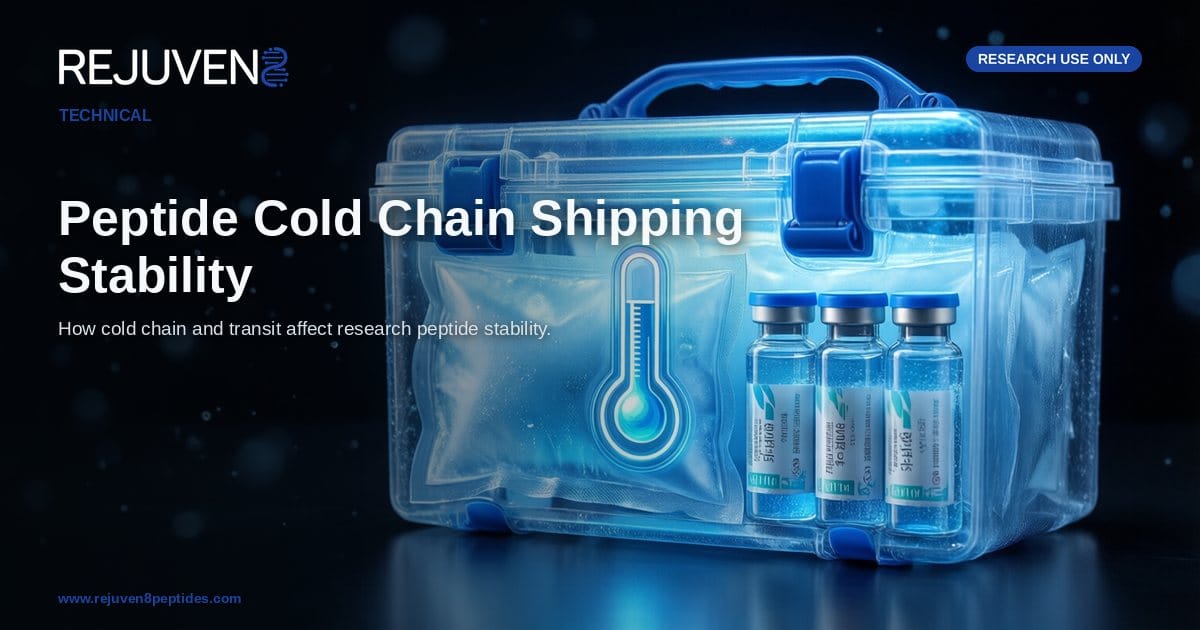
Cold chain packaging for research peptides is usually straightforward because the payload is dry powder rather than a temperature-critical biologic. The goal is to buffer the parcel against heat during the first and warmest portion of its journey, not to keep it frozen from end to end.
Coolants and insulation
The comparison below reflects commonly reported laboratory attributes and is provided for comparison only.
| Packaging Option | Typical Role | Approximate Behavior | Fit for Lyophilized Powder |
|---|---|---|---|
| Frozen gel cold packs | Standard peptide coolant | Holds cool for roughly one to three days inside insulation | Sufficient for most domestic routes |
| Insulated foam or liner | Thermal buffering | Slows the rate of warming | Pairs with gel packs |
| Dry ice | Ultra-cold shipments | Very low, around -78 C | Usually unnecessary for stable powder |
| No insulation | Not recommended | Tracks ambient temperature | Higher cumulative exposure |
United States domestic transit
Most domestic shipments in the United States clear in one to three business days when expedited service is used, which keeps cumulative thermal exposure comfortably within the tolerance of sealed lyophilized powder. Overnight or two-day service further narrows the warming window during the hottest months. A supplier’s willingness to maintain a peptide cold chain with appropriate coolant and expedited transit is itself a quality signal, and evaluating that practice is part of the broader vetting process described in the guide on choosing a research peptide supplier.
On arrival
Prompt handling at the destination matters more than the fine details of the journey. On receipt, samples should be inspected and moved into appropriate storage without delay, typically refrigerated for near-term work or frozen for longer holds. Powder that arrives warm to the touch after a short expedited transit is generally still sound, since the dry state limits degradation, but leaving any vial in a hot mailbox or vehicle for an extended period should be avoided. Compounds discussed here are for research use only, not for human consumption. When a peptide is ready to be prepared for laboratory work, browse the tested inventory in the research peptide shop.
Frequently Asked Questions
Do lyophilized research peptides need to be shipped frozen?
In most cases they do not need to remain frozen throughout transit. Sealed lyophilized powder is stable enough that a cool, insulated parcel with gel packs protects it adequately over a normal one to three day domestic shipment. Frozen or dry-ice shipping is generally reserved for reconstituted solutions or unusually sensitive larger analogs.
Can research peptides survive a few days at room temperature during shipping?
For dry lyophilized powder, brief exposure to room temperature during transit typically causes only minimal cumulative degradation. Stability depends on total time and temperature combined, so a short expedited shipment is far less stressful than prolonged improper storage.
Are cold packs or dry ice better for shipping research peptides?
Frozen gel cold packs paired with insulation are sufficient for most lyophilized research peptides in domestic transit. Dry ice reaches much lower temperatures, around -78 C, and is usually unnecessary for stable dry powder, though it may be used for especially sensitive materials.
How long can peptides stay stable during United States domestic transit?
Expedited domestic service usually delivers within one to three business days, which keeps cumulative thermal exposure well within the tolerance of sealed lyophilized powder. Faster overnight or two-day service further reduces any warming window during hot weather.
What should you do with research peptides as soon as they arrive?
Inspect the vials on arrival and move them into appropriate storage promptly, refrigerated for near-term laboratory work or frozen for longer holds. Reconstitution should be performed at the destination immediately before use rather than in advance.
Does a warm mailbox ruin lyophilized peptide powder?
A short period of warmth is unlikely to ruin sealed dry powder, because the lyophilized state keeps degradation rates low. Prolonged exposure to heat, such as hours in a hot mailbox or vehicle, is still best avoided to minimize cumulative thermal stress.