Research Use Only. The information presented here is for scientific and educational purposes. These compounds are not intended for human consumption, self-administration, or therapeutic use.
Introduction
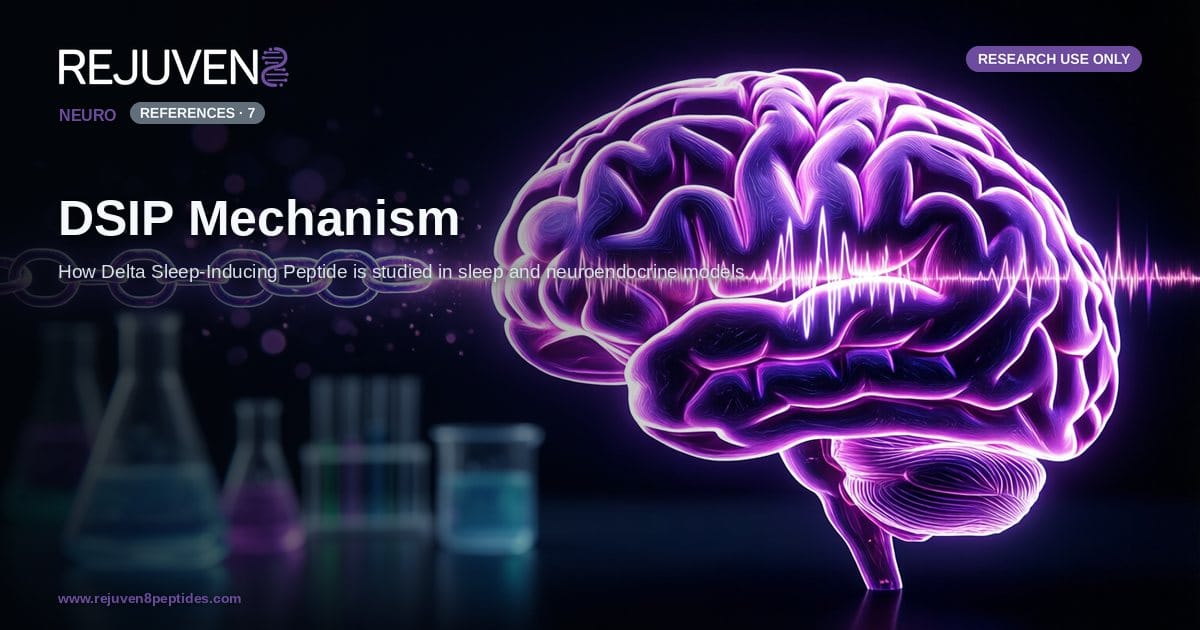
Delta Sleep-Inducing Peptide (DSIP) is one of the most studied endogenous neuropeptides in the sleep and neuroendocrine literature. It was first isolated in the 1970s from the cerebral venous blood of rabbits during electrically induced sleep, and it has since served as a model compound for researchers examining how small peptides may relate to delta-wave activity, stress signaling, and circadian regulation. The search phrase dsip mechanism captures a long-running scientific question: how does a nine-amino-acid sequence appear to interact with such a broad range of central nervous system processes?
This article surveys DSIP strictly within a research context. It describes what the peptide is, how its structure has been characterized, and the pathways that preclinical, in-vitro, and animal investigations have associated with it. Nothing here concerns human use. DSIP offered by Rejuven8 Peptides is supplied for research use only, not for human consumption, and the discussion below reflects laboratory framing rather than any clinical claim. Readers can review the compound on the DSIP (15 mg) product page or browse the wider catalog in the research peptides shop.
What Is DSIP? Molecular Identity and Origin
A Nonapeptide From Early Sleep Research
DSIP is a small, hydrophilic neuropeptide composed of nine amino acids. Its sequence, Trp-Ala-Gly-Gly-Asp-Ala-Ser-Gly-Glu, was characterized by Schoenenberger, Monnier, and colleagues, who reported that infusing the isolated fraction into recipient animals appeared to promote the delta-frequency electroencephalogram (EEG) pattern associated with deep, slow-wave sleep. The name reflects that original observation rather than a single confirmed mechanism.
Because the molecule is compact and structurally simple, it became a useful tool compound in basic neuroscience. Investigators have used DSIP to probe questions about peptide transport across the blood-brain barrier, enzymatic stability in plasma, and the relationship between short amino acid sequences and centrally mediated effects. The identity attributes most often cited in the literature are summarized below.
The following values reflect commonly reported laboratory attributes and are provided for comparison only.
| Attribute | Reported value |
|---|---|
| Full name | Delta Sleep-Inducing Peptide |
| Common abbreviation | DSIP |
| Amino acid sequence | Trp-Ala-Gly-Gly-Asp-Ala-Ser-Gly-Glu |
| Sequence length | 9 amino acids (nonapeptide) |
| Approximate molecular weight | 848.8 Da |
| Molecular formula | C35H48N10O15 |
| Class | Endogenous neuropeptide |
| First described | Schoenenberger and Monnier, 1970s |
The Delta Sleep Mechanism in Research Models
EEG and Slow-Wave Activity
The defining observation behind DSIP is its association with delta-wave activity, the low-frequency oscillations (roughly 0.5 to 4 Hz) that dominate the EEG during slow-wave sleep. In early rabbit and rodent studies, administration of the peptide was reported to increase the proportion of delta activity in some paradigms. Later work produced a more nuanced picture: the reported effects varied with dose, with timing relative to the circadian cycle, and with the species or model used. That variability is itself a central theme in the dsip mechanism literature.
Proposed Signaling and Receptor Questions
Unlike many peptides that act through a single well-characterized receptor, DSIP does not have one universally agreed molecular target. Studies have explored possible interactions with GABAergic and glutamatergic signaling, modulation of oscillatory activity in thalamocortical circuits, and downstream involvement of second-messenger systems. Some researchers frame DSIP less as a classical ligand and more as a modulator that shifts the balance between excitatory and inhibitory tone. The absence of a definitive receptor is one reason the peptide remains an active subject of investigation rather than a closed chapter.
Neuroendocrine Research: DSIP and the HPA Axis
Stress and Corticosteroid Signaling
Beyond sleep, a large share of the DSIP literature concerns the hypothalamic-pituitary-adrenal (HPA) axis, the neuroendocrine system that coordinates the stress response. Animal studies have examined whether DSIP influences the release of adrenocorticotropic hormone (ACTH) and corticosteroids such as corticosterone and cortisol. Several reports describe a modulatory or normalizing pattern, in which the peptide appeared to blunt exaggerated stress-axis activity rather than simply suppress or stimulate it outright. These observations remain preclinical and are studied to understand signaling, not to support any health outcome.
Other Neuroendocrine Observations
DSIP has also appeared in research on thermoregulation, oxidative-stress markers, and the secretion of other pituitary hormones, including growth hormone, luteinizing hormone, and somatostatin. Chronobiology studies have looked at how the peptide interacts with circadian timing and stress adaptation. Because these reported effects span several systems, DSIP is frequently discussed alongside other regulatory peptides such as Selank and Semax within the broader nootropic and neuromodulation research category.
The following research contexts reflect commonly reported laboratory attributes and are provided for comparison only.
| Research domain | Reported focus in preclinical or in-vitro models |
|---|---|
| Sleep architecture | Delta-wave (slow-wave) EEG activity |
| HPA axis | Modulation of ACTH and corticosteroid signaling |
| Thermoregulation | Body-temperature responses in rodent studies |
| Oxidative stress | Antioxidant-related tissue markers |
| Chronobiology | Circadian timing and stress-adaptation paradigms |
Handling DSIP in the Laboratory
Reconstitution and Storage
DSIP is typically supplied as a lyophilized (freeze-dried) powder, commonly in a vial size such as the 15 mg presentation. For laboratory work it is reconstituted with bacteriostatic water and kept cold. As a worked example, adding 3 mL of bacteriostatic water to a 15 mg vial yields a working concentration of 5 mg/mL. The peptide is generally protected from repeated freeze-thaw cycles and from prolonged light or heat exposure to limit degradation. Solvent selection and volume calculations are covered in detail in the bacteriostatic water reconstitution guide.
Purity Verification
For reproducible results, the identity and purity of any research peptide should be documented before use. A certificate of analysis (COA) reporting mass spectrometry and high-performance liquid chromatography (HPLC) data allows a laboratory to confirm that a given vial matches the expected molecular weight and purity threshold. Rejuven8 Peptides publishes third-party certificates of analysis, and guidance on interpreting those documents is available in the COA purity primer.
Frequently Asked Questions
What is the DSIP mechanism of action?
There is no single confirmed mechanism. In research models, DSIP is associated with increased delta-wave EEG activity and with modulation of the HPA stress axis. It appears to act as a broad neuromodulator rather than through one well-defined receptor, which is why the dsip mechanism is still described as an open question in basic neuroscience.
What does DSIP stand for?
DSIP stands for Delta Sleep-Inducing Peptide. The name comes from early experiments in which the isolated peptide fraction was linked to delta-frequency brain-wave activity during slow-wave sleep in animal models.
Is DSIP a hormone or a neuropeptide?
DSIP is classified as an endogenous neuropeptide, a short chain of nine amino acids produced within the nervous system. It is studied for its apparent signaling and neuromodulatory roles, and some research also examines its interaction with the hormone-secreting pathways of the pituitary gland.
How is DSIP connected to delta sleep?
The connection is historical and observational. When the peptide was first isolated from sleeping animals, infusing it into recipients was reported to promote delta-wave EEG patterns. Subsequent studies found the effect to be variable and dependent on dose and timing, so the relationship continues to be characterized as an area of active research.
Why is DSIP studied in neuroendocrine research?
DSIP is of interest because it appears to influence the hypothalamic-pituitary-adrenal axis and the release of hormones such as ACTH and corticosterone in animal studies. Researchers use it to explore how small peptides may relate to regulation of the stress response and circadian signaling.
How should DSIP be stored for laboratory use?
Lyophilized DSIP is generally kept refrigerated or frozen and protected from light. After reconstitution with bacteriostatic water it is stored cold and used within a limited window, with freeze-thaw cycles minimized to preserve peptide integrity. It is intended for research use only, not for human consumption.
References and Further Reading
- Schoenenberger GA, Monnier M. Isolation and characterization of a delta sleep-inducing peptide. PubMed: delta sleep-inducing peptide Schoenenberger Monnier
- Delta sleep-inducing peptide and slow-wave EEG activity in animal models. PubMed: delta sleep-inducing peptide EEG
- DSIP and the hypothalamic-pituitary-adrenal axis. PubMed: DSIP hypothalamic pituitary adrenal
- DSIP modulation of ACTH and corticosterone in stress paradigms. PubMed: DSIP ACTH corticosterone
- Blood-brain barrier transport of delta sleep-inducing peptide. PubMed: delta sleep-inducing peptide blood-brain barrier
- DSIP and thermoregulation in rodent research. PubMed: DSIP thermoregulation
- Delta sleep-inducing peptide: structure and neuromodulatory review. PubMed: delta sleep-inducing peptide review