Research Use Only. The information presented here is for scientific and educational purposes. These compounds are not intended for human consumption, self-administration, or therapeutic use.
Introduction
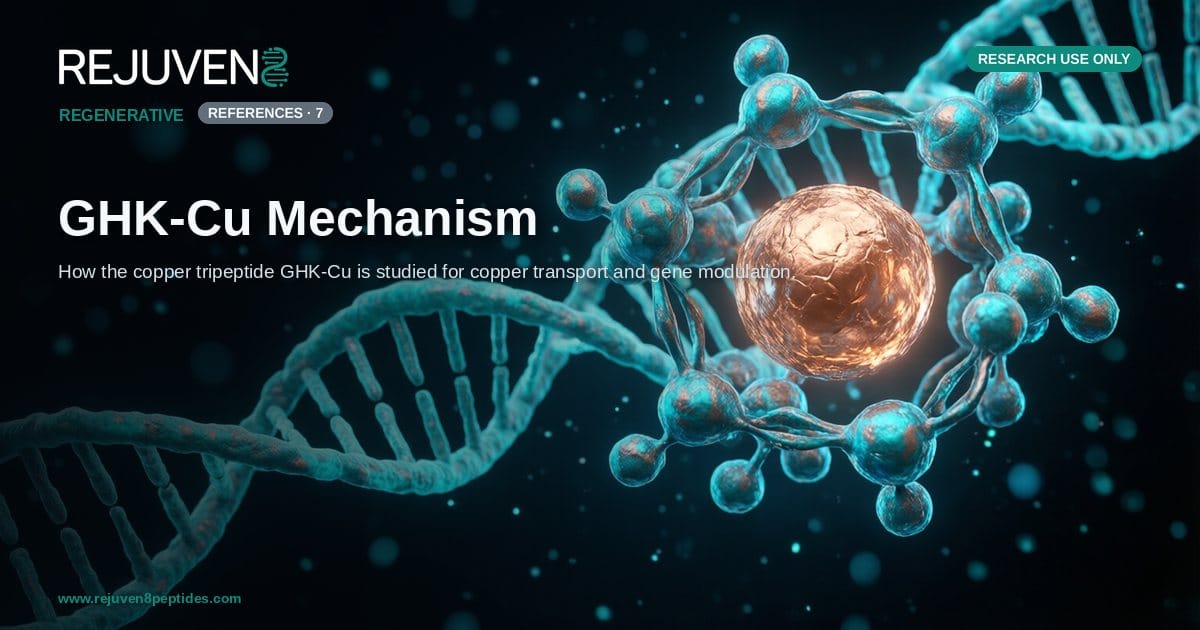
GHK-Cu is the copper(II) complex of the tripeptide glycyl-L-histidyl-L-lysine, a small copper-binding molecule first isolated from human plasma in the 1970s by Loren Pickart. In preclinical and in-vitro research it is studied for two closely linked properties: its ability to coordinate a copper ion with high affinity, and its reported capacity to modulate gene-expression patterns in cultured cells. Because copper is an essential cofactor for many enzymes, the way this tripeptide binds and presents copper has made it a recurring subject in cell-biology and biochemistry laboratories.
The following overview describes the studied mechanism of GHK-Cu strictly as a research topic. It covers how the GHK sequence chelates copper(II), how the resulting complex is investigated as a vehicle for copper delivery across cell membranes, and how laboratory transcriptomics has examined the peptide as a signal that shifts the activity of large gene sets. Nothing here describes human use: these are observations drawn from cell cultures, isolated proteins, and animal models.
What GHK-Cu Is: A Copper-Binding Tripeptide
A tripeptide with a copper-shaped binding site
The GHK sequence is only three amino acids long: glycine, histidine, and lysine. Its significance in copper research comes from the histidine residue, whose imidazole ring, together with the free amino terminus and a backbone amide nitrogen, forms a pocket that is geometrically suited to holding a copper(II) ion. Free GHK and the copper-loaded GHK-Cu are therefore studied as two states of one molecule: the apo-peptide and its metal complex. The peptide belongs to a class often described as matrikines, small signaling fragments derived from larger matrix proteins.
Molecular identity
The values below reflect commonly reported laboratory attributes and are provided for comparison only.
| Attribute | Reported value |
|---|---|
| Peptide sequence | Glycyl-L-histidyl-L-lysine (Gly-His-Lys) |
| Sequence length | 3 residues (tripeptide) |
| Compound class | Copper-binding tripeptide (matrikine) |
| Coordinated metal | Copper(II), Cu 2+ |
| Empirical formula (free peptide) | C14H24N6O4 |
| Free peptide molecular weight | approx 340.4 g/mol |
| Copper complex molecular weight | approx 403.9 g/mol |
Copper Coordination Chemistry
How GHK holds copper(II)
In coordination-chemistry studies, GHK binds copper(II) through nitrogen donor atoms: the terminal amino group of glycine, the deprotonated amide nitrogen linking glycine and histidine, and the imidazole nitrogen of the histidine side chain. This arrangement produces a roughly square-planar geometry around the copper center, with the lysine side chain and solvent molecules contributing to weaker axial interactions. The complex forms with high stability at physiological pH, which is one reason GHK is described in the literature as a natural copper chelator rather than a simple carrier that releases its metal indiscriminately.
Copper as the studied payload
Copper is required by enzymes such as lysyl oxidase, superoxide dismutase, and cytochrome c oxidase. Research on GHK-Cu frames the peptide as a copper carrier that can present the ion in a form cultured cells appear able to take up. In cell-based experiments the complex is studied for how it exchanges copper with cellular transport proteins and how the resulting copper availability intersects with redox and enzymatic pathways. This copper-delivery hypothesis is the mechanistic bridge between the coordination chemistry and the downstream gene-expression observations discussed next. It is worth stressing that these are laboratory models: GHK-Cu is a material for research use only, not for human consumption.
Gene-Expression Modulation as Preclinical Research
Transcriptome-wide screening
A widely cited line of research applied gene-expression profiling to cells exposed to GHK. Using public transcriptomic resources, including the Broad Institute Connectivity Map, investigators reported that the peptide was associated with expression changes across a large number of genes, with some transcripts increased and others decreased. In some dataset analyses the number of affected genes has been reported in the thousands. The described patterns spanned gene groups linked to tissue remodeling, antioxidant defense, and DNA repair. These analyses are bioinformatic and in-vitro in nature.
A resetting signal, as described in vitro
Reviews of this work describe GHK-Cu as a compound studied for an apparent tendency to shift stressed or aberrant expression profiles toward patterns seen in less stressed cells. These descriptions should be read as hypotheses generated from cell and dataset analyses, not as demonstrated outcomes in people. The gene sets most often discussed include those governing extracellular-matrix proteins, inflammatory mediators, and oxidative-stress responses. How copper availability, delivered by the tripeptide, connects mechanistically to these transcriptional shifts remains an active question in the primary literature.
Downstream Pathways and Laboratory Handling
Extracellular matrix and fibroblast studies
Some of the earliest GHK-Cu research examined fibroblast cultures, where the peptide was studied for its association with collagen and glycosaminoglycan synthesis. These extracellular-matrix components are central to how connective tissue is assembled and remodeled, which is why GHK-Cu appears frequently across the broader recovery and tissue-repair research literature. The research directions summarized below reflect commonly reported laboratory attributes and are provided for comparison only.
| Research focus (preclinical / in vitro) | What laboratory studies have examined |
|---|---|
| Copper transport | GHK as a carrier facilitating copper(II) uptake by cultured cells |
| Gene expression | Shifts in transcript levels across broad gene sets in cell assays |
| Extracellular matrix | Collagen and glycosaminoglycan synthesis in fibroblast cultures |
| Redox signaling | Modulation of oxidative-stress-related gene groups in vitro |
Handling notes for GHK-Cu in research settings
Because GHK-Cu carries a copper ion, laboratory handling accounts for the metal’s chemistry. Copper complexes can be sensitive to oxidation and light, so reconstituted material is generally protected from prolonged light exposure, kept cold, and subjected to as few freeze-thaw cycles as possible. As a worked example for research calculations, reconstituting a 50 mg vial with 5 mL of bacteriostatic water yields a 10 mg/mL stock. General reconstitution technique is covered in the bacteriostatic water guide, and confirming identity and purity before any experiment is covered in the COA guide. Batch documentation is available on the certificates page.
Frequently Asked Questions
What is the mechanism of GHK-Cu?
In research terms, GHK-Cu is studied as a copper-binding tripeptide with two linked mechanisms: it coordinates a copper(II) ion through nitrogen donor atoms, and it is associated in cell-based studies with changes in the expression of many genes. The copper-delivery role and the gene-modulation observations are the two pillars of its studied mechanism.
How does GHK-Cu bind copper?
Laboratory coordination studies report that the tripeptide holds copper(II) using the amino terminus of glycine, an ionized backbone amide nitrogen, and the imidazole nitrogen of histidine, forming a stable, roughly square-planar complex at physiological pH.
Does GHK-Cu change gene expression?
In-vitro and bioinformatic studies, including analyses using the Connectivity Map, have associated GHK with altered expression across a large set of genes, some increased and some decreased. These are cell-level and dataset-level findings, not demonstrated effects in humans.
What is the molecular weight of GHK-Cu?
The free GHK tripeptide has a molecular weight of approximately 340.4 g/mol, and the copper complex is commonly reported near 403.9 g/mol. The sequence is three residues long: glycine, histidine, and lysine.
Is GHK-Cu intended for human use?
No. GHK-Cu supplied for laboratory work is a research chemical intended for in-vitro and preclinical study only. It is not a drug, is not for human consumption, and no dosing or therapeutic guidance is provided.
Why is GHK-Cu handled with light and temperature precautions?
Because the molecule carries a copper ion, its complex chemistry can be sensitive to oxidation. Researchers commonly protect reconstituted GHK-Cu from light, store it cold, and limit freeze-thaw cycles to preserve sample integrity for analysis.
References and Further Reading
- Pickart L, Margolina A. Reviews of the regenerative and protective actions of the GHK-Cu peptide in preclinical and in-vitro models. PubMed: GHK-Cu peptide regenerative
- Pickart L. Foundational work on the human tripeptide GHK and its copper affinity. PubMed: GHK tripeptide copper
- Coordination-chemistry studies of copper(II) binding by the GHK sequence. PubMed: GHK copper coordination
- Gene-expression profiling of GHK using the Connectivity Map and related datasets. PubMed: GHK gene expression Connectivity Map
- Fibroblast and extracellular-matrix studies of collagen synthesis with GHK-Cu. PubMed: GHK-Cu collagen synthesis
- Antioxidant and anti-inflammatory investigations of the copper tripeptide in vitro. PubMed: GHK-Cu antioxidant
- Preclinical wound-healing and tissue-remodeling research involving GHK-Cu. PubMed: GHK-Cu wound healing