Research Use Only. The information presented here is for scientific and educational purposes. These compounds are not intended for human consumption, self-administration, or therapeutic use.
Introduction
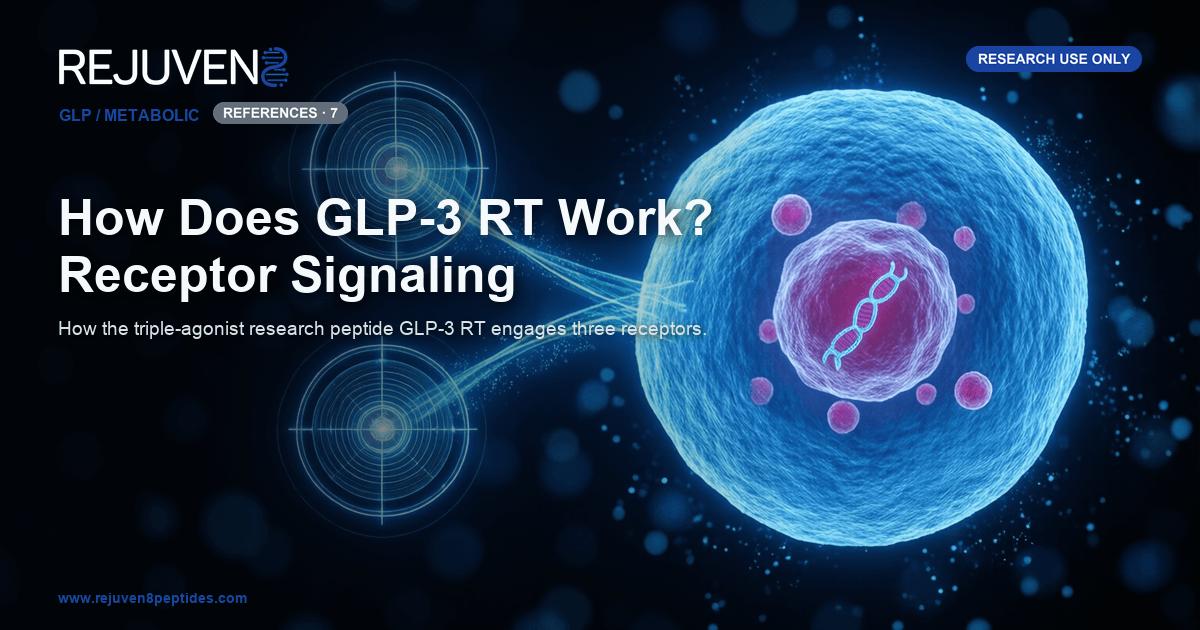
GLP-3 RT is a synthetic multi-receptor research peptide studied in preclinical and in-vitro settings for its simultaneous engagement of three metabolic receptors: the glucagon-like peptide-1 receptor (GLP-1R), the glucose-dependent insulinotropic polypeptide receptor (GIPR), and the glucagon receptor (GCGR). Because one peptide sequence is investigated for activity across all three targets, GLP-3 RT is commonly described in the laboratory literature as a triple-agonist, or tri-agonist, research compound. This article surveys the receptor pharmacology that defines the molecule and how reported characterizations position it alongside related incretin research peptides.
The triple-agonist concept builds on decades of incretin biology. Investigators first mapped how gut-derived peptides signal through class B G-protein-coupled receptors to modulate cyclic AMP (cAMP) and downstream pathways in pancreatic, hepatic, and adipose tissue models. GLP-3 RT is examined as a tool for probing what happens when a single molecular scaffold recruits GLP-1, GIP, and glucagon signaling at once. Every point below is framed for research use only, not for human consumption, and reflects observations drawn from cell-based assays and animal models rather than any clinical endpoint.
What Is GLP-3 RT?
GLP-3 RT is a single-chain peptide of 39 amino acids constructed on a modified GIP-like backbone. Structural reports describe amino-acid substitutions that stabilize the peptide helix along with a fatty-diacid (lipid) moiety attached through a linker, a design strategy that promotes reversible albumin binding and extends the circulating half-life observed in animal pharmacokinetic work. The molecule belongs to the broader class of multi-receptor incretin agonists, a research category that also spans mono-agonist and dual-agonist peptides.
Molecular identity
The values below reflect commonly reported laboratory attributes and are provided for comparison only.
| Attribute | Reported Value |
|---|---|
| Designation | GLP-3 RT |
| Peptide class | Multi-receptor (triple) incretin agonist |
| Sequence length | 39 amino acids |
| Approx. molecular weight | ~4731 Da (about 4.7 kDa) |
| Receptor targets | GLP-1R, GIPR, GCGR |
| Backbone | Modified GIP-based scaffold |
| Half-life strategy | Fatty-diacid albumin binding |
The Three Receptor Systems Under Study
What distinguishes GLP-3 RT in receptor pharmacology is that it is characterized against three separate class B GPCRs. Each receptor contributes a different arm of metabolic signaling in preclinical models, and the research interest lies in how the balance between them behaves when a single peptide activates all three.
GLP-1 receptor (GLP-1R)
The GLP-1 receptor is the most extensively studied incretin target. In cell-based assays, GLP-1R activation raises intracellular cAMP and is investigated for glucose-dependent insulinotropic signaling in pancreatic beta-cell models. Researchers frequently use GLP-1R engagement as a benchmark for comparing agonist potency across peptide candidates, which makes it the reference arm for characterizing GLP-3 RT.
GIP receptor (GIPR)
The glucose-dependent insulinotropic polypeptide receptor represents the second incretin axis. Preclinical work examines how concurrent GIPR and GLP-1R signaling may produce additive or complementary activity on insulin-secretion pathways in rodent and cell models, a question that dual-agonist research peptides were originally designed to probe. GLP-3 RT carries this dual-incretin activity forward as its foundation.
Glucagon receptor (GCGR)
The glucagon receptor is the feature that separates a triple agonist from a dual agonist. In hepatic tissue models, GCGR signaling is studied for its role in glucose output and cellular energy expenditure. The research rationale behind GLP-3 RT is that controlled glucagon-receptor engagement, balanced against incretin signaling, can be investigated as a lever on metabolic-rate pathways in animal studies, strictly as a preclinical research question rather than a demonstrated outcome.
Mono-, Dual-, and Triple-Agonist Research Peptides Compared
GLP-3 RT is best understood next to the peptides that preceded it. The GLP research family spans single-receptor, dual-receptor, and triple-receptor designs, and each is studied for a different combination of signaling arms. The values below reflect commonly reported laboratory attributes and are provided for comparison only.
| Research Peptide | Receptor Targets | Agonism Class | Approx. MW | Sequence Length |
|---|---|---|---|---|
| GLP-1 SM | GLP-1R | Mono-agonist | ~4114 Da | 31 aa |
| GLP-2 TZ | GLP-1R, GIPR | Dual-agonist | ~4814 Da | 39 aa |
| GLP-3 RT | GLP-1R, GIPR, GCGR | Triple-agonist | ~4731 Da | 39 aa |
| Cagrilintide | Amylin / calcitonin receptor | Amylin analog | ~3752 Da | 32 aa |
Related coded designations in this family include the mono-agonist GLP-1 SM, the dual-agonist GLP-2 TZ, and the amylin-analog research peptide Cagrilintide. Each occupies a different position on the receptor-engagement spectrum, which is why comparative assays across the group are a common design in incretin pharmacology research. GLP-3 RT sits at the widest end of that spectrum by adding the glucagon arm to the two incretin arms.
Handling and Quality Considerations for Laboratory Use
Multi-receptor peptides like GLP-3 RT are typically supplied as a lyophilized powder that requires reconstitution before assay work. A common laboratory approach uses bacteriostatic water: for example, reconstituting a 10 mg vial with 2 mL of bacteriostatic water yields a 5 mg/mL stock concentration for downstream calculations. For the underlying reconstitution theory, consult the bacteriostatic water reconstitution guide rather than repeating it here.
Because receptor-binding and cAMP-signaling assays depend on peptide integrity, purity documentation carries real weight. Reviewing a certificate of analysis and understanding how to read a peptide COA helps researchers confirm identity and purity grade before an experiment begins, supporting reproducible results across replicates. Cold storage, protection of the reconstituted stock, and minimized freeze-thaw cycles all help preserve stability during a study. As with any research compound in this category, GLP-3 RT is intended for research use only and not for human consumption.
Frequently Asked Questions
What is a GLP-3 triple agonist?
A GLP-3 triple agonist is a research peptide, designated GLP-3 RT, that is studied for simultaneous agonist activity at three receptors: the GLP-1 receptor, the GIP receptor, and the glucagon receptor. The triple label refers to this three-way receptor engagement observed in laboratory assays.
Which three receptors does GLP-3 RT target?
In receptor-binding and signaling assays, GLP-3 RT is characterized against the glucagon-like peptide-1 receptor (GLP-1R), the glucose-dependent insulinotropic polypeptide receptor (GIPR), and the glucagon receptor (GCGR). All three are class B G-protein-coupled receptors.
How does GLP-3 RT differ from a dual agonist such as GLP-2 TZ?
A dual agonist such as GLP-2 TZ is studied for activity at two receptors, GLP-1R and GIPR. GLP-3 RT adds glucagon-receptor engagement as a third signaling arm, which is the defining difference between dual-agonist and triple-agonist research peptides.
What are the molecular weight and sequence length of GLP-3 RT?
GLP-3 RT is commonly reported as a 39-amino-acid peptide with an approximate molecular weight near 4731 Da, roughly 4.7 kDa. These values reflect commonly reported laboratory attributes and are provided for comparison only.
How is GLP-3 RT reconstituted for laboratory research?
GLP-3 RT is typically supplied as a lyophilized powder and reconstituted with bacteriostatic water before assay work. As a worked example, adding 2 mL of bacteriostatic water to a 10 mg vial yields a 5 mg/mL stock concentration for calculations.
Is GLP-3 RT intended for human use?
No. GLP-3 RT is offered for research use only, not for human consumption. All available information describes preclinical, in-vitro, and animal-model observations, and none of it constitutes evidence of safety or efficacy in humans.
References and Further Reading
- Overview of GLP-1 receptor signaling and incretin pharmacology. PubMed: GLP-1 receptor pharmacology
- Biology of the glucose-dependent insulinotropic polypeptide receptor. PubMed: GIP receptor incretin
- Glucagon receptor signaling and hepatic energy metabolism. PubMed: glucagon receptor signaling metabolism
- Preclinical characterization of triple-agonist peptides in metabolic models. PubMed: triple agonist peptide preclinical metabolic
- Design principles of multi-receptor incretin-based agonists. PubMed: multi receptor incretin agonist
- Structure and function of class B G-protein-coupled receptors. PubMed: class B GPCR peptide agonist structure
- Fatty-acid conjugation and albumin binding for long-acting peptides. PubMed: peptide fatty acid albumin binding half-life