Research Use Only. The information presented here is for scientific and educational purposes. These compounds are not intended for human consumption, self-administration, or therapeutic use.
Introduction
Glutathione is a low-molecular-weight tripeptide assembled from glutamate, cysteine, and glycine, and it occupies a central position in the study of cellular redox biology. Across preclinical and in vitro research, glutathione is examined less as a single-target molecule and more as a recyclable electron reservoir: a compound whose reduced thiol group can be donated to neutralize reactive oxygen species (ROS) and then regenerated through a well-characterized enzymatic cycle. Investigators studying oxidative stress frequently treat the intracellular pool of glutathione as a readout of a cell’s antioxidant capacity, which is why the glutathione mechanism is a recurring subject in redox and mitochondrial literature.
This article outlines how the glutathione mechanism is framed in laboratory research, covering its molecular identity, the reduced (GSH) and oxidized (GSSG) redox couple, and the enzyme systems that depend on it. The material is provided for research use only, not for human consumption, and it describes what glutathione is investigated for rather than any outcome in people. Laboratory-grade material such as the catalog Glutathione compound is handled strictly as a research reagent, and the wider inventory can be reviewed through the research peptide shop.
Molecular Identity of the Glutathione Tripeptide
At the structural level, glutathione is defined by an arrangement that distinguishes it from most peptides. The bond linking glutamate to cysteine is formed through the gamma-carboxyl group of glutamate rather than the standard alpha-carboxyl group. This gamma-glutamyl linkage resists cleavage by most common peptidases, which is one reason the intact tripeptide accumulates to relatively high intracellular concentrations in many of the cell types used in research.
The Reactive Cysteine Thiol
The functional heart of the molecule is the cysteine thiol (-SH) group. This sulfhydryl is the site that donates a reducing equivalent when glutathione encounters an oxidant. When two oxidized glutathione molecules pair, their thiols join to form a disulfide bond, producing glutathione disulfide (GSSG). The reversible interconversion between the free thiol and the disulfide is the chemical basis of the entire redox cycle. Confirming the purity and identity of any research thiol reagent matters here, and standardized documentation such as a certificate of analysis is routinely referenced for that purpose.
The values below reflect commonly reported laboratory attributes and are provided for comparison only.
| Attribute | Reduced Glutathione (GSH) |
|---|---|
| Compound class | Antioxidant tripeptide (thiol) |
| Amino acid sequence | L-gamma-glutamyl-L-cysteinyl-glycine |
| Sequence length | 3 residues |
| Molecular formula | C10H17N3O6S |
| Molecular weight | approx 307.32 g/mol |
| Key functional group | Cysteine sulfhydryl (-SH) |
| Primary research framing | Redox cycling and antioxidant defense |
The Glutathione Redox Cycle
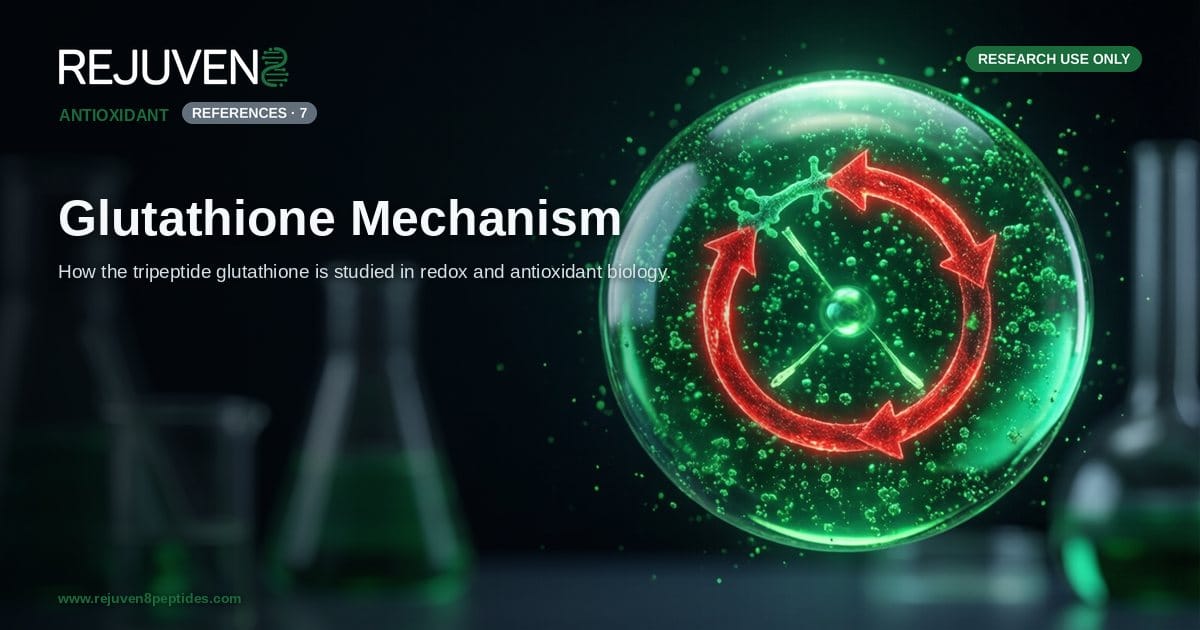
The glutathione mechanism is most often described as a cycle rather than a one-way reaction. In its reduced form, glutathione (GSH) acts as an electron donor that quenches oxidants and, in the process, is converted to its oxidized disulfide form (GSSG). A dedicated enzyme system then restores the reduced pool, so that the same molecular inventory can be used repeatedly. This turnover, rather than any single reaction, is what researchers mean when they refer to glutathione redox cycling.
Glutathione Peroxidase and Reductase
Two enzyme activities anchor the cycle. Glutathione peroxidase (GPx) catalyzes the reduction of hydrogen peroxide and lipid hydroperoxides, oxidizing two GSH molecules to one GSSG in the process. Glutathione reductase (GR) then restores the pool by reducing GSSG back to two molecules of GSH, drawing its reducing power from NADPH. The coupled action of these enzymes keeps the bulk of the pool in the reduced state under normal laboratory conditions.
Reduced Versus Oxidized Glutathione
The following values reflect commonly reported laboratory attributes and are provided for comparison only.
| Property | Reduced (GSH) | Oxidized (GSSG) |
|---|---|---|
| Molecular state | Free monomeric thiol | Disulfide-linked dimer |
| Approx molecular weight | 307.32 g/mol | 612.63 g/mol |
| Redox role | Electron donor, scavenges ROS | Oxidation product, awaiting recycling |
| Relationship to reductase | Regenerated product | Substrate reduced using NADPH |
| Typical abundance in healthy cells | Predominant fraction | Minor fraction |
NADPH Supply and the GSH/GSSG Ratio
Because glutathione reductase runs on NADPH, the cycle is tied to the cell’s supply of that cofactor, which is regenerated largely through the pentose phosphate pathway. The ratio of GSH to GSSG is widely used in research as an index of cellular redox state: a high ratio reflects a reducing intracellular environment, and a decline in the ratio is often interpreted as a marker of oxidative stress. Because this recycling draws on the same nicotinamide cofactor pool studied alongside NAD+ metabolism, glutathione is frequently examined within broader energy and redox research programs.
Enzymatic Systems That Depend on Glutathione
Much of the research interest in glutathione centers on the families of enzymes that use it as a substrate or cofactor. These systems extend the reach of the tripeptide well beyond simple chemical scavenging and are studied as distinct branches of the antioxidant and detoxification network.
Glutathione Peroxidases
The glutathione peroxidase family comprises selenium-dependent enzymes that reduce hydrogen peroxide and organic hydroperoxides using GSH as the electron source. In laboratory models of oxidative stress, this activity is studied as a primary route for clearing peroxides before they can propagate lipid peroxidation. The selenocysteine residue at the active site makes selenium availability a variable that researchers frequently control in cell culture.
Glutathione S-Transferases
Glutathione S-transferases (GSTs) catalyze the conjugation of the glutathione thiol to electrophilic centers on a wide range of xenobiotics and reactive metabolites. This phase II conjugation is examined in cell-based detoxification research as a mechanism for tagging reactive compounds for downstream export and elimination. Because GST activity influences how model systems handle electrophiles, it is a common endpoint in in vitro toxicology work.
Glutaredoxins and Protein Glutathionylation
Beyond detoxification, glutathione participates in redox signaling through reversible protein S-glutathionylation, the attachment of glutathione to specific cysteine residues on target proteins. Glutaredoxins are small enzymes that catalyze the removal of these adducts, allowing glutathionylation to act as a reversible switch. Researchers study this modification as a way cells may encode redox information and modulate protein activity without permanent oxidative damage.
Synthesis, Compartments, and Mitochondrial Research
Glutathione is synthesized in the cytosol through two ATP-dependent steps. The first, catalyzed by glutamate-cysteine ligase (GCL), is generally rate-limiting, and cysteine availability is often the constraining substrate. Glutathione synthetase then adds glycine to complete the tripeptide. Because synthesis is tightly regulated, experimental manipulation of these steps is a common approach to probing how the antioxidant network responds to stress.
The Mitochondrial Glutathione Pool
Mitochondria maintain a distinct glutathione pool that is imported from the cytosol rather than synthesized locally. This compartment-specific pool is a focus of longevity and bioenergetics research, because mitochondria generate a large share of cellular ROS. Investigators studying mitochondrial redox balance often examine glutathione alongside mitochondria-targeted compounds such as SS-31. Sourcing and documentation matter in this work, and third-party certificates of analysis are commonly consulted to confirm reagent identity before experiments begin.
Frequently Asked Questions
What is the mechanism of glutathione as an antioxidant?
Glutathione acts as an antioxidant by donating a reducing equivalent from its cysteine thiol group to reactive oxygen species and peroxides. In doing so it becomes oxidized to glutathione disulfide (GSSG), which enzymes then recycle back to the reduced form. Research describes this as a continuous redox cycle rather than a single neutralizing event.
What is the difference between reduced (GSH) and oxidized (GSSG) glutathione?
Reduced glutathione (GSH) is the free monomeric form carrying an available thiol group, while oxidized glutathione (GSSG) is a dimer in which two glutathione molecules are joined by a disulfide bond. The reduced form is the electron donor, and the oxidized form is the product that glutathione reductase converts back to GSH.
How is glutathione recycled inside cells?
Recycling depends on glutathione reductase, an enzyme that reduces GSSG back to two molecules of GSH using electrons supplied by NADPH. The NADPH is regenerated largely through the pentose phosphate pathway, linking glutathione recycling to central carbohydrate metabolism.
Which enzymes use glutathione?
Major glutathione-dependent enzymes include the glutathione peroxidases, which reduce hydrogen peroxide and lipid hydroperoxides; the glutathione S-transferases, which conjugate glutathione to electrophilic compounds; and the glutaredoxins, which manage reversible protein glutathionylation. Each is studied in vitro as part of the broader antioxidant and detoxification network.
Why is the GSH/GSSG ratio important in redox research?
The ratio of reduced to oxidized glutathione is widely used as an indicator of cellular redox state. A high GSH/GSSG ratio reflects a more reducing intracellular environment, while a fall in the ratio is often used experimentally as a marker of oxidative stress.
Is glutathione a peptide or a protein?
Glutathione is a tripeptide, meaning it is built from three amino acids: glutamate, cysteine, and glycine. It is far smaller than a protein, and it is distinguished by an unusual gamma-glutamyl bond that resists cleavage by most standard peptidases.
References and Further Reading
- Meister A, Anderson ME. Foundational reviews on glutathione biosynthesis and metabolism. PubMed: glutathione biosynthesis Meister
- Flohe L. Glutathione peroxidase and selenium biochemistry. PubMed: glutathione peroxidase selenium
- Glutathione reductase and NADPH-dependent recycling of the redox couple. PubMed: glutathione reductase NADPH
- Jones DP. The GSH/GSSG couple and the redefinition of oxidative stress. PubMed: glutathione redox oxidative stress Jones
- Glutathione S-transferases in phase II conjugation and detoxification. PubMed: glutathione S-transferase conjugation
- Protein S-glutathionylation and glutaredoxin-mediated redox signaling. PubMed: protein S-glutathionylation glutaredoxin
- Mitochondrial glutathione pools and subcellular compartmentalization. PubMed: mitochondrial glutathione