Research Use Only. The information presented here is for scientific and educational purposes. These compounds are not intended for human consumption, self-administration, or therapeutic use.
Introduction
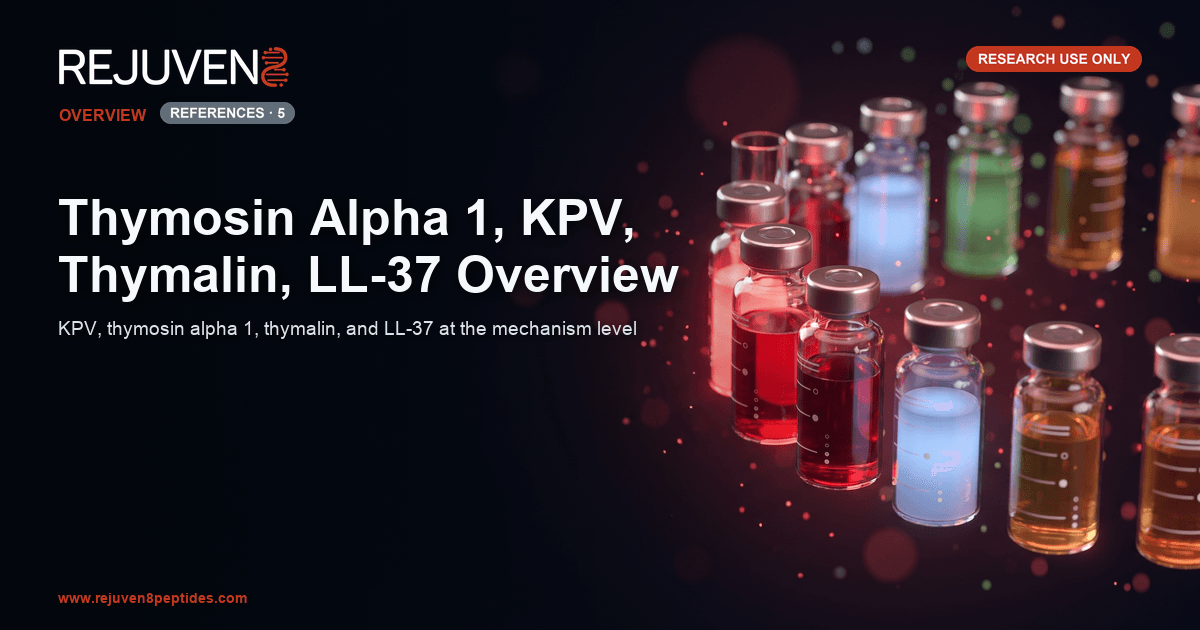
Immune-modulating peptides are studied for how they tune the signals immune cells exchange: the transcription factors that switch inflammatory genes on, the pattern-recognition receptors that detect microbes, and the programs that mature T-cells. This overview compares four compounds that recur in that literature. KPV is a three-residue fragment of alpha-melanocyte-stimulating hormone (alpha-MSH). Thymosin alpha 1 is a 28-amino-acid acetylated peptide derived from prothymosin alpha. Thymalin is a polypeptide fraction extracted from thymus tissue, and LL-37 is the mature form of the only human cathelicidin.
They are grouped because each is investigated at the level of immune signaling, not because they work alike. Each section covers identity (sequence, length, origin), mechanism as characterized, and the models used. All of it is preclinical or in vitro work on materials supplied for research use only, not for human consumption.
Four Immune-Modulating Peptides at a Glance
- KPV (Lys-Pro-Val): alpha-MSH C-terminal tripeptide; NF-kB modulation after PepT1 uptake.
- Thymosin alpha 1: 28-residue N-acetylated peptide from prothymosin alpha; TLR2/TLR9 signaling in dendritic cells, T-cell maturation.
- Thymalin: low-molecular-weight polypeptide extract of bovine thymus; characterized analog Glu-Trp (Thymogen).
- LL-37: 37-residue human cathelicidin from hCAP18; membrane-disruptive antimicrobial activity, double-edged immunomodulation.
The values below reflect commonly reported laboratory attributes and are provided for comparison only.
| Compound | Origin | Length and approx. mass | Primary studied pathway | Typical research models |
|---|---|---|---|---|
| KPV | Residues 11-13 of alpha-MSH | 3 amino acids; ~342 Da | PepT1 uptake; NF-kB and MAPK signaling | Caco-2 cells, Jurkat T-cells, DSS and TNBS colitis in mice |
| Thymosin alpha 1 | N-terminal 28 residues of prothymosin alpha; calf thymus fraction 5 | 28 amino acids; ~3108 Da | TLR2/TLR9-MyD88 signaling in dendritic cells; IDO1 induction | Dendritic cell cultures, TLR9- and MyD88-deficient mice, thymocyte cultures |
| Thymalin | Polypeptide fraction from calf thymus | Mixture below ~10 kDa; Glu-Trp ~333 Da | Thymocyte differentiation markers; proposed gene-expression regulation | Lymphoid cell cultures, rat models of immunodepression and aging |
| LL-37 | C-terminal 37 residues of hCAP18, released by proteinase 3 | 37 amino acids; ~4493 Da; charge about +6 | Membrane disruption; FPR2, P2X7, and TLR modulation | Membrane assays, keratinocyte and monocyte cultures, CRAMP-deficient mice |
KPV Peptide: The Anti-Inflammatory Tail of Alpha-MSH
Identity and Origin
The KPV peptide is lysine-proline-valine, residues 11 through 13 of the thirteen-residue hormone alpha-MSH. At roughly 342 Da it is among the smallest peptides in immune research, and it lacks the His-Phe-Arg-Trp motif alpha-MSH uses to engage melanocortin receptors. Early dermatology work identified it as the minimal alpha-MSH sequence retaining anti-inflammatory activity in keratinocyte and monocyte cultures.
Mechanism as Studied
PepT1 (SLC15A1), a proton-coupled di- and tripeptide transporter on intestinal epithelial cells and, under inflammatory conditions, on immune cells, is the best-characterized entry route. Work published in Gastroenterology in 2008 reported that PepT1 carries KPV into cells, after which NF-kB activation, MAP kinase signaling, and expression of cytokines such as IL-8 and IL-6 fall. The tripeptide therefore acts as an intracellular signal rather than a surface ligand.
Research Models
KPV has been characterized in Caco-2 epithelial monolayers, Jurkat T-cells, and mouse colitis induced by dextran sulfate sodium (DSS) or trinitrobenzene sulfonic acid (TNBS). Later work added PepT1-deficient mice, a colitis-associated tumorigenesis model, and nanoparticle carriers that concentrate KPV in inflamed colon. The dedicated KPV peptide research article covers this literature in depth.
Thymosin Alpha 1: Toll-Like Receptor Signaling and T-Cell Maturation
Identity and Origin
Thymosin alpha 1 is a 28-amino-acid peptide first isolated in 1977 from thymosin fraction 5, a calf thymus preparation, by Goldstein and colleagues. Its N-terminal serine is acetylated and its mass is close to 3108 Da. It corresponds to the first 28 residues of prothymosin alpha, a nuclear protein from which it is released by the asparaginyl endopeptidase legumain.
Toll-Like Receptor Signaling in Dendritic Cells
Romani, Garaci, and collaborators have reported that in murine bone-marrow-derived dendritic cells thymosin alpha 1 engages TLR9, and in some settings TLR2, through the adaptor MyD88, increasing IL-12 and type I interferon output. The same pathway induces indoleamine 2,3-dioxygenase (IDO1), which shifts dendritic cells toward a tolerogenic phenotype and supports Foxp3-positive regulatory T-cells. A 2025 review in the International Journal of Molecular Sciences frames this dual profile as modulation rather than one-directional activation.
T-Cell Maturation and Research Models
Older in vitro work examined thymocyte differentiation markers such as Thy-1, Th1 cytokine output, and IL-7 release in thymic epithelium co-cultures. Key models include TLR9- and MyD88-deficient mice, murine fungal challenge models, and human peripheral blood mononuclear cells.
Thymalin: A Thymic Polypeptide Fraction and Its Dipeptide Analog
A Fraction, Not a Sequence
Thymalin differs from the other three in kind: a complex of low-molecular-weight polypeptides extracted from calf thymus, developed by Morozov and Khavinson in Leningrad in the 1970s as a peptide bioregulator. As a mixture it has no single sequence or mass; components are commonly cited below approximately 10 kDa. Most of the literature is Russian and Eastern European and predates receptor-level methods, so its mechanism should be read conservatively.
Glu-Trp (Thymogen) as the Characterized Analog
The most useful handle is L-glutamyl-L-tryptophan (Glu-Trp, known as Thymogen; approximately 333 Da), identified as the most active component of thymalin’s low-molecular-weight fraction. In lymphoid cell cultures it has been studied for effects on thymocyte differentiation markers, lymphocyte proliferation, and cytokine profiles, and modeling work proposes that short bioregulator peptides bind DNA promoter regions and alter chromatin accessibility. A D-configured Glu-Trp isomer (Thymodepressin) shows reciprocal, inhibitory activity in the same assays, supporting a stereospecific interaction. Models are mainly lymphoid cultures and rat models of immunodepression and aging, and the extract origin makes lot-to-lot composition a study variable.
LL-37: The Human Cathelicidin
Identity and Origin
LL-37 is the only cathelicidin encoded in the human genome (CAMP gene). It is stored as the 170-residue precursor hCAP18, chiefly in neutrophil granules, and released as the C-terminal 37 residues by proteinase 3. It carries a net charge of about +6 and a mass near 4493 Da, and in membrane-mimicking environments it folds into an amphipathic alpha-helix.
Membrane-Disruptive Antimicrobial Mechanism
That helix underlies its first studied function. The cationic face binds anionic bacterial surfaces (lipopolysaccharide on gram-negative and teichoic acids on gram-positive organisms), while the neutral, cholesterol-rich mammalian outer leaflet is a weaker target. Above a threshold surface density the peptide destabilizes the bilayer, described by carpet and toroidal-pore models.
Immunomodulation and Double-Edged Roles
LL-37 is also a signaling molecule: chemotactic for neutrophils, monocytes, and T-cells through the formyl peptide receptor FPR2, an activator of the ATP-gated channel P2X7 on monocytes, and a modulator of TLR4 responses to LPS. The double edge appears with nucleic acids: LL-37 binds self-DNA and self-RNA and converts them into TLR9 and TLR7 ligands in plasmacytoid dendritic cells, driving type I interferon release, a mechanism first reported in 2007 and studied in models of autoimmune-type skin and systemic inflammation.
Where KPV Sits in Combination Research: The KLOW Blend
KPV is the only one of the four in the Rejuven8 catalog, where it appears within KLOW Blend 80mg alongside GHK-Cu, BPC-157, and TB-500. Those three are studied for matrix remodeling, angiogenic signaling, and actin-dependent cell migration; KPV supplies the inflammation-modulating arm. The KLOW blend research overview maps each component to a phase of tissue repair in preclinical models.
Thymosin alpha 1, thymalin, and LL-37 are not offered by Rejuven8 as single products; they appear here as compounds of interest in the literature. Lot-specific certificates of analysis for the blend can be reviewed alongside the individual peptides in the research peptide catalog.
Closing Perspective
Together the four trace a spectrum: KPV is a minimal intracellular signal acting on NF-kB; thymosin alpha 1 is a receptor-level co-activator shaping dendritic cell and T-cell programs; thymalin is an extract whose active dipeptide is still being mapped to targets; and LL-37 is a multifunctional effector whose antimicrobial and immunomodulatory faces cannot be separated. Comparing them by mechanism and model rather than by outcome is the most defensible way to read this literature.
Frequently Asked Questions
What is thymosin alpha 1?
A 28-amino-acid peptide with an acetylated N-terminus and a mass near 3108 Da, corresponding to the first 28 residues of prothymosin alpha. It was first isolated from calf thymus fraction 5.
How does thymosin alpha 1 act in laboratory models?
In preclinical and in vitro studies it engages TLR9, and in some cases TLR2, through MyD88 in dendritic cells, raising IL-12 and type I interferon output and inducing IDO1, which supports regulatory T-cells.
What is the KPV peptide studied for?
KPV is the tripeptide Lys-Pro-Val, the C-terminal fragment of alpha-MSH. After PepT1-mediated uptake into intestinal epithelial and immune cells it is associated with reduced NF-kB activation in cell culture and mouse colitis models.
Is thymalin the same as thymosin alpha 1?
No. Thymosin alpha 1 is a single, sequence-defined 28-residue peptide. Thymalin is a polypeptide extract of bovine thymus with multiple low-molecular-weight components; its characterized synthetic analog is the dipeptide Glu-Trp (Thymogen).
Why is LL-37 called double-edged?
It is studied for host-defense functions such as membrane-disruptive antimicrobial activity, yet it also converts self-DNA and self-RNA into TLR9 and TLR7 ligands in plasmacytoid dendritic cells, a pro-inflammatory pathway examined in autoimmune-type models.
Which of these peptides does Rejuven8 supply?
Only KPV, as one of four components of KLOW Blend 80mg alongside GHK-Cu, BPC-157, and TB-500. The other three are discussed as compounds of interest and are not offered as single products. All materials are for laboratory research only.
References and Further Reading
- Dalmasso G and colleagues, Gastroenterology, 2008: PepT1-mediated KPV uptake and intestinal inflammation. PubMed: KPV tripeptide PepT1 intestinal inflammation
- Romani L, Garaci E, and colleagues: thymosin alpha 1, Toll-like receptor signaling, and IDO1 induction in dendritic cells. PubMed: thymosin alpha 1 toll-like receptor dendritic cells
- Goldstein AL and colleagues, 1977: isolation and sequencing of thymosin alpha 1, and its prothymosin alpha origin. PubMed: thymosin alpha 1 prothymosin alpha sequence
- Khavinson V and colleagues: thymalin, the Glu-Trp dipeptide (Thymogen), and peptide bioregulators in lymphoid and rat models. PubMed: thymalin Glu-Trp dipeptide immunomodulation
- Reviews of LL-37 immunomodulation, including FPR2 and P2X7 signaling and self-DNA complexes with TLR9, with 2025 and 2026 updates. PubMed: LL-37 cathelicidin immunomodulation review