Research Use Only. The information presented here is for scientific and educational purposes. These compounds are not intended for human consumption, self-administration, or therapeutic use.
Introduction
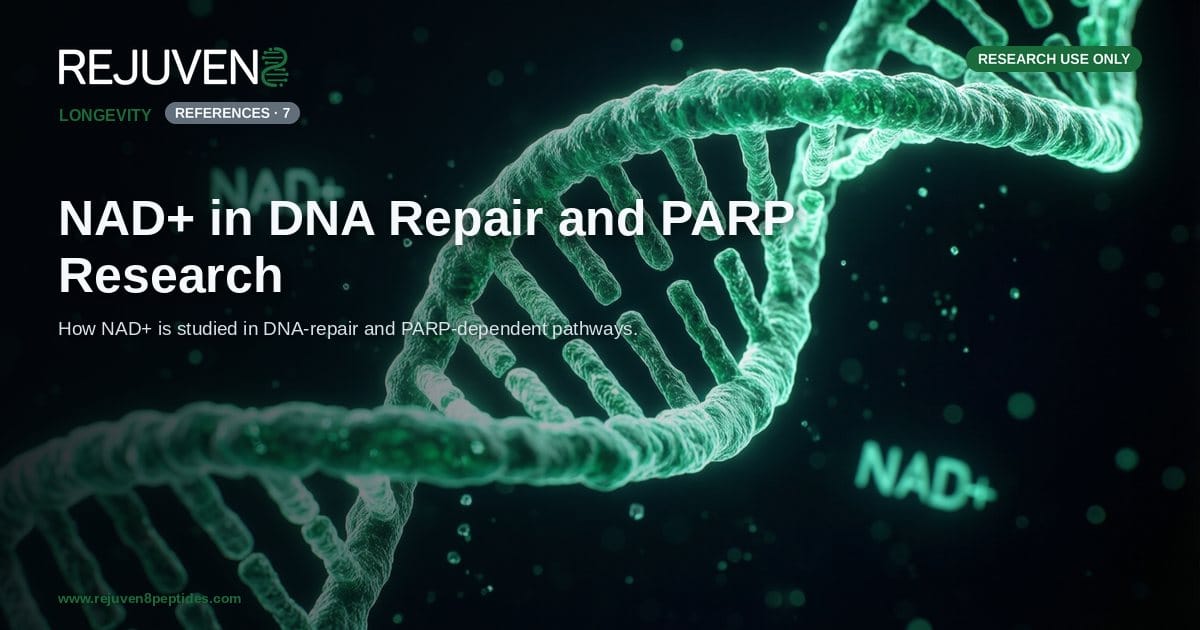
Nicotinamide adenine dinucleotide (NAD+) is one of the most extensively studied coenzymes in cell biology, best known as a carrier of electrons in metabolism. A second role has drawn increasing attention in the research literature: NAD+ serves as the direct molecular substrate for a family of DNA-repair enzymes known as poly(ADP-ribose) polymerases, or PARPs. When a cell detects damage to its genome, these enzymes consume NAD+ to flag the injury and recruit the repair machinery. This article examines how NAD+ is investigated in the context of DNA repair and PARP-dependent signaling.
The focus here is deliberately narrow. Rather than surveying NAD+ as a sirtuin activator or reviewing dietary precursors, the discussion below centers on the biochemistry of strand-break detection, poly(ADP-ribosyl)ation, and the proposed link between NAD+ availability and genome maintenance in preclinical and in-vitro models. All material is presented for research use only, not for human consumption, and describes what NAD+ is studied for rather than any claimed outcome.
NAD+ as a Substrate in the DNA Damage Response
NAD+ occupies an unusual position in cell biology because it participates in two fundamentally different classes of reaction. In its classical redox role, the molecule cycles between oxidized (NAD+) and reduced (NADH) forms without being consumed, shuttling electrons through glycolysis and the mitochondrial electron transport chain. In its signaling role, by contrast, NAD+ is cleaved and permanently spent. The glycosidic bond between nicotinamide and the adenine dinucleotide portion is broken, releasing nicotinamide and transferring the remaining ADP-ribose unit onto a target protein.
A consumable signaling molecule
This second, consumptive branch is what connects NAD+ to DNA repair. Enzymes that catalyze ADP-ribosylation cannot recycle NAD+ the way dehydrogenases do; every signaling event uses up a molecule of NAD+. Because of this, the cellular pool of NAD+ is understood in the literature as a shared and finite resource, drawn upon by several enzyme families at once. The DNA damage response is one of the most demanding claimants on that pool, which is why researchers frequently study NAD+ concentration and genome maintenance together.
PARP Enzymes and Poly(ADP-ribosyl)ation
The poly(ADP-ribose) polymerase family sits at the center of NAD+-dependent DNA repair research. PARP1, the most abundant and most studied member, functions as a rapid sensor of DNA strand breaks.
PARP1 as a strand-break sensor
When PARP1 encounters a single-strand break, its zinc-finger domains bind the exposed DNA ends and the enzyme becomes catalytically active within seconds. Using NAD+ as substrate, it begins transferring ADP-ribose units onto acceptor proteins, including itself. This self-modification, called auto-poly(ADP-ribosyl)ation, is a hallmark of PARP activation studied across many laboratory systems.
Building poly(ADP-ribose) chains
Successive transfers create long, branched polymers of ADP-ribose, a process abbreviated as PARylation. These negatively charged chains act as a molecular scaffold and recruitment signal. Scaffold proteins such as XRCC1, along with components of the base excision repair and single-strand break repair pathways, are drawn to the damaged site. In this way NAD+ is converted into a spatial and temporal marker that signals, in effect, that repair is needed at that location. Each ADP-ribose added to the chain releases one molecule of nicotinamide, which then re-enters NAD+ metabolism through the salvage pathway.
The attributes below reflect commonly reported laboratory attributes and are provided for comparison only.
| Enzyme | NAD+-dependent activity | Reported role in DNA-repair research |
|---|---|---|
| PARP1 | Poly(ADP-ribosyl)ation | Primary single-strand break sensor; recruits base excision repair factors |
| PARP2 | Poly(ADP-ribosyl)ation | Overlapping strand-break detection that complements PARP1 |
| Sirtuins (SIRT1, SIRT6) | Protein deacylation; releases nicotinamide | Studied in chromatin regulation and repair coordination |
| CD38 | NAD+ glycohydrolase | Major NAD+ consumer; investigated as a driver of age-related NAD+ decline |
| SARM1 | NAD+ cleavage | Examined in axonal degeneration models rather than core repair |
NAD+ Depletion, DNA Damage, and Cellular Aging Models
A recurring theme in the research literature is what happens when demand on the NAD+ pool becomes chronic rather than momentary.
The depletion hypothesis
Under heavy or sustained DNA damage, PARP1 can become hyperactivated, consuming NAD+ faster than the cell regenerates it. Experimental models have used this observation to explore a proposed feedback loop: accumulated genomic damage drives PARP activity, PARP activity lowers NAD+, and reduced NAD+ is associated in these models with diminished activity of other NAD+-dependent enzymes and with metabolic stress. Work from groups such as Vilhelm Bohr and colleagues at the National Institute on Aging has examined this relationship in DNA-repair-deficient systems.
Competition for a shared pool
Because PARPs, sirtuins, and glycohydrolases such as CD38 all draw on the same NAD+ reservoir, several groups have described a competitive dynamic among them. When PARP demand is high, less NAD+ may be available for sirtuin-mediated processes, and the reverse also holds. This intersection is one reason NAD+ metabolism is frequently studied alongside genome maintenance in longevity research. The salvage enzyme NAMPT, which recycles nicotinamide back into NAD+, is often examined as the rate-limiting step that determines how quickly the pool can be replenished. Within the same mitochondrial and longevity research cluster, compounds such as MOTS-c and SS-31 are investigated for adjacent questions about cellular energy handling, while NAD+ remains the focal point of PARP-centered work.
Molecular Profile and Research Handling
For laboratory reference, NAD+ is a dinucleotide built from two nucleotides joined through their phosphate groups: one bearing an adenine base, the other bearing a nicotinamide base. This architecture is what allows the nicotinamide end to be cleaved and donated during ADP-ribosylation.
The values below reflect commonly reported laboratory attributes and are provided for comparison only.
| Attribute | Value |
|---|---|
| Common name | Nicotinamide adenine dinucleotide (NAD+) |
| Molecular formula | C21H27N7O14P2 |
| Approximate molecular weight | 663.43 g/mol (free acid) |
| Chemical class | Pyridine dinucleotide, redox cofactor |
| Primary research pathways | PARP-mediated DNA repair, base excision repair, redox metabolism |
| Byproduct of consumption | Nicotinamide |
NAD+ intended for laboratory work is typically supplied as a lyophilized powder and reconstituted for in-vitro study. As with any research material, purity and identity documentation matter: reviewing a certificate of analysis and confirming third-party testing are standard steps before experimental use. Rejuven8 Peptides supplies NAD+ strictly as a research compound, and the broader research catalog follows the same documentation standard.
Frequently Asked Questions
What is the role of NAD+ in DNA repair?
NAD+ serves as the substrate that PARP enzymes consume to detect and flag DNA strand breaks. When these enzymes transfer ADP-ribose units from NAD+ onto proteins at a damage site, they create a recruitment signal that draws in repair factors. In research settings NAD+ is therefore studied as a required input for a major branch of the DNA damage response, not merely as a metabolic cofactor.
How does PARP use NAD+?
PARP1 and PARP2 bind DNA breaks and cleave NAD+, releasing nicotinamide and attaching the remaining ADP-ribose to target proteins. Repeating this step builds long poly(ADP-ribose) chains, a process called PARylation. Each cycle spends one molecule of NAD+, which is why intense PARP activity can measurably lower the NAD+ pool in laboratory models.
Why does DNA damage lower NAD+ levels?
Extensive DNA damage activates PARP enzymes strongly and for prolonged periods. Because every ADP-ribose transfer consumes NAD+ without recycling it, sustained PARP activity can draw the NAD+ pool down faster than salvage enzymes replenish it. This depletion is a widely modeled consequence of genotoxic stress in cell and animal studies.
What is poly(ADP-ribosyl)ation?
Poly(ADP-ribosyl)ation, or PARylation, is the enzymatic addition of chains of ADP-ribose onto proteins, using NAD+ as the building block. The resulting negatively charged polymers act as scaffolds and signals at sites of DNA damage. It is one of the most studied post-translational modifications in the DNA repair field.
How is NAD+ studied in aging research?
Investigators examine NAD+ because its cellular concentration tends to decline in many aging models while DNA damage accumulates. The proposed link runs through PARP: more damage drives more PARP activity, which lowers NAD+ and may constrain other NAD+-dependent processes. This makes NAD+ metabolism a frequent focus in longevity and genome-maintenance research.
Is NAD+ from Rejuven8 Peptides intended for human use?
No. NAD+ offered by Rejuven8 Peptides is supplied strictly as a research-use-only material. It is not intended for human consumption, self-administration, or any therapeutic or veterinary application, and the information here is provided for scientific and educational purposes only.
References and Further Reading
- NAD+ as a substrate for PARP-driven DNA repair. PubMed: NAD+ PARP1 DNA repair
- Poly(ADP-ribose) polymerase in base excision repair. PubMed: poly(ADP-ribose) polymerase base excision repair
- NAD+ metabolism, DNA damage, and aging models. PubMed: NAD+ metabolism DNA damage aging
- NAMPT and the NAD+ salvage pathway. PubMed: NAMPT salvage pathway NAD+
- PARP1 as a single-strand break sensor. PubMed: PARP1 single-strand break sensor
- CD38 and age-related NAD+ decline. PubMed: CD38 NAD+ decline aging
- Poly(ADP-ribosyl)ation and XRCC1 recruitment. PubMed: poly(ADP-ribosyl)ation XRCC1 DNA repair