Research Use Only. The information presented here is for scientific and educational purposes. These compounds are not intended for human consumption, self-administration, or therapeutic use.
Introduction
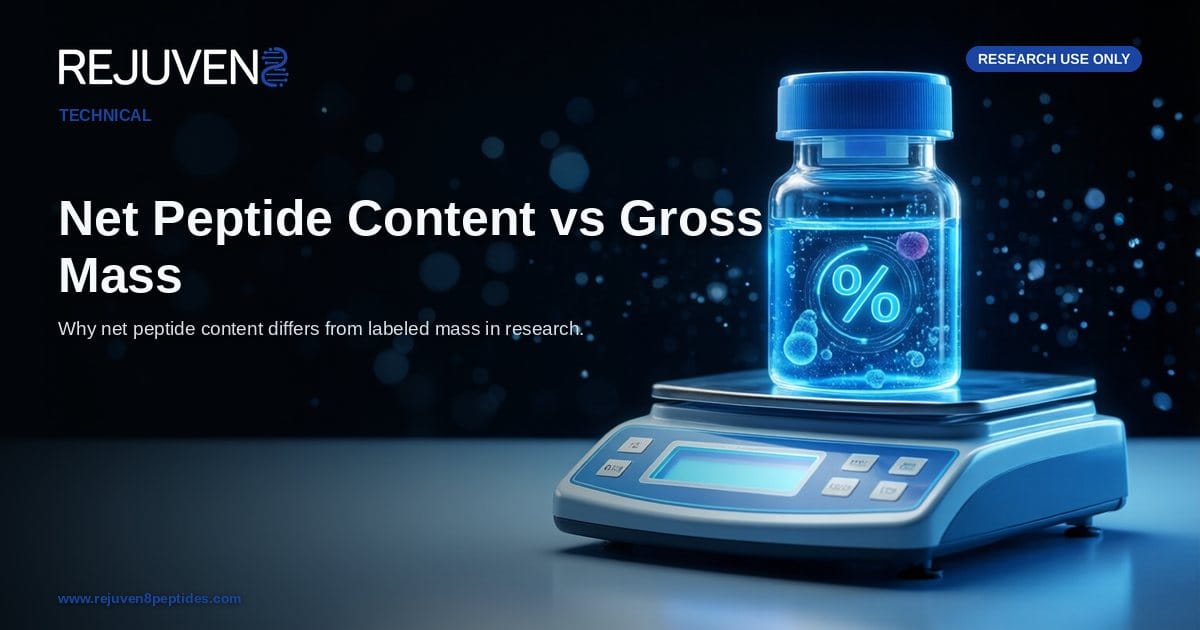
When a research peptide is supplied as a 10 mg vial, that figure describes the gross mass of lyophilized powder dispensed into the container, not the mass of peptide the container actually holds. The gap between the labeled weight and the true quantity of target molecule is captured by one specification: net peptide content. Reported as a percentage of the dry mass, net peptide content states how much of the weighed material is peptide backbone and how much is associated counterions, bound water, and residual salts left by synthesis and purification.
This distinction sits at the center of accurate research quantitation. Any measurement that depends on a defined amount of substance, from receptor binding assays and in-vitro dose-response curves to analytical calibration, inherits error directly from an unaccounted content gap. Knowing where the non-peptide mass originates and how it enters concentration and molar calculations is central to characterizing a peptide reference material. The sections below frame net peptide content within laboratory quantitation and documentation, for research use only, not for human consumption.
Gross Mass, Labeled Mass, and Net Peptide Content
Two numbers describe the solid in a peptide vial, and confusing them is a common source of quantitation error: the total weight of powder, and the weight of peptide within it.
What the label weight represents
The labeled mass, also called the gross mass or nominal fill weight, is the total weight of dried solid placed in the vial. It is convenient for dispensing, but it makes no claim about composition: a vial can be filled to a precise gross weight while still varying in how much of that weight is peptide versus non-peptide material.
What net peptide content isolates
Net peptide content, sometimes labeled peptide content or assay by mass, is the fraction of the gross mass attributable to the peptide itself. A content value of 80% means that in every 10 mg of powder, roughly 8 mg is peptide and about 2 mg is counterion, water, and salt. Content is typically determined by amino acid analysis or nitrogen determination, which quantify the peptide backbone independently of the accompanying mass.
The values below reflect commonly reported laboratory attributes and are provided for comparison only.
| Component of dry mass | Typical share | Origin | Common measurement |
|---|---|---|---|
| Peptide (net) | ~70 to 90% | The target molecule | Amino acid analysis, nitrogen determination |
| Counterions | ~5 to 20% | Ion pairing during purification | Ion chromatography, 19F NMR for trifluoroacetate |
| Bound water | ~1 to 10% | Hygroscopic uptake and lyophilization | Karl Fischer titration, thermogravimetry |
| Residual salts | ~0 to 5% | Buffers and reagents | Elemental analysis |
Where the Non-Peptide Mass Comes From
The mass separating net content from gross mass is not a related-peptide impurity but material chemically associated with the peptide or physically retained by the powder. Three categories account for most of it.
Counterions
Peptides carrying basic residues such as arginine, lysine, and histidine, together with the free N-terminus, hold a net positive charge and pair with negatively charged counterions. Reverse-phase HPLC purification commonly uses trifluoroacetic acid, so the isolated peptide often elutes as a trifluoroacetate salt. Each trifluoroacetate site adds roughly 113 g/mol of non-peptide mass. Where a lower-mass counterion is preferred, a salt exchange to acetate (approximately 59 g/mol per site) can be performed. The counterion burden scales with the number of basic sites in the sequence.
Bound water and moisture
Lyophilized peptides are hygroscopic and retain both structural and adsorbed water. Moisture content commonly falls in the low single digits by mass but rises with exposure to humidity, which is one reason vials are stored cold and kept sealed. Water is quantified by Karl Fischer titration or estimated by thermogravimetric analysis.
Residual salts and organics
Buffer components, trace synthesis reagents, and residual organic solvents can persist through workup and add a small further fraction, minor relative to counterions and water but still part of the mass that net peptide content excludes.
Net Peptide Content Is Not the Same as HPLC Purity
A frequent misreading of peptide documentation is treating HPLC purity and net peptide content as interchangeable: they answer different questions, and a sample can score high on one while scoring lower on the other.
HPLC purity is a relative measure: it reports the target peptide as a percentage of the total peak area among the peptide-related species the detector sees. Net peptide content is an absolute measure: it reports peptide as a percentage of the entire dry mass, counterions and water included. A preparation can be 99% pure by HPLC (very little related-peptide impurity) yet only 80% peptide by content (a fifth of the powder is counterion and water). A thorough guide to reading a peptide COA treats these as two separate line items, each constraining a different part of an experiment.
The values below reflect commonly reported laboratory attributes and are provided for comparison only.
| Metric | What it measures | Units | Reference point | Typical method |
|---|---|---|---|---|
| Net peptide content | Mass fraction that is peptide | % by mass | Total dry mass in the vial | Amino acid analysis, nitrogen determination |
| HPLC purity | Target as a share of detected peptide species | % by area | Sum of eluting peaks | Reverse-phase HPLC with UV detection |
Why Net Peptide Content Matters for Quantitation
Because concentration is amount divided by volume, an overstated amount overstates concentration. Preparing a stock from the labeled mass while ignoring content builds a fixed bias into every downstream dilution and derived parameter such as an EC50 or IC50. When lots differ in content, the same nominal preparation delivers different true concentrations, undermining reproducibility between batches and laboratories. Molar work compounds the issue, because the calculation must use the net (free-base) molecular weight and the actual peptide mass, not the salt-form weight of the whole powder.
The values below reflect commonly reported laboratory attributes and are provided for comparison only.
| Attribute | Representative value |
|---|---|
| Compound class | Synthetic peptide (polyamide) |
| Sequence length | ~10 to 45 amino acid residues |
| Net (free-base) molecular weight | ~1,000 to 4,500 g/mol (sequence dependent) |
| Common counterion | Trifluoroacetate (~113 g/mol per site) or acetate (~59 g/mol per site) |
| Typical net peptide content | ~70 to 90% by mass |
A worked content correction
Consider a vial with a labeled mass of 10 mg and a reported net peptide content of 80%. The actual peptide mass is 10 mg x 0.80 = 8 mg. If the powder is reconstituted with 2 mL of bacteriostatic water and the label figure is used directly, the assumed stock concentration is 10 mg / 2 mL = 5 mg/mL. The true peptide concentration is 8 mg / 2 mL = 4 mg/mL, an overestimate of 25% when the content correction is skipped. For a peptide with an approximate net molecular weight of 1,000 g/mol, that 8 mg is about 8 micromoles, giving roughly 4 mM in 2 mL rather than the 5 mM the label implies. Carrying the content percentage through the calculation keeps stated and delivered amounts aligned, separate from the choice of diluent volume covered in the bacteriostatic water reconstitution guide.
Reading Net Peptide Content on Documentation
On a complete certificate of analysis, net peptide content appears as its own entry, distinct from HPLC purity and the mass spectrometry result that confirms identity. A document that lists purity but omits content leaves the absolute quantity in the vial undefined. Cross-checking the stated content against a supplier’s published certificates is a practical verification step, and disclosure of content alongside purity is one of the markers discussed in guidance on choosing a research peptide supplier. For laboratories building quantitative methods, sourcing material with fully documented content and purity, such as the lab-tested inventory in the research peptide catalog, removes a recurring source of variance.
Frequently Asked Questions
What is net peptide content?
Net peptide content is the percentage of a lyophilized sample’s dry mass that is actual peptide, as opposed to the associated counterions, bound water, and residual salts. A content of 80% means about 8 mg of peptide in every 10 mg of powder. It is typically measured by amino acid analysis or nitrogen determination.
What is the difference between peptide content and peptide purity?
Peptide content is an absolute mass measure: peptide as a fraction of the total dry weight, including counterions and water. HPLC purity is a relative measure: the target peptide as a fraction of the peptide-related species the detector sees. A sample can be 99% pure by HPLC yet only 80% peptide by content, so the two figures are reported separately.
Why is the peptide mass less than the labeled vial weight?
The labeled or gross weight is the total powder dispensed, which includes non-peptide mass. Counterions from purification (often trifluoroacetate), water retained by the hygroscopic powder, and small amounts of residual salt all add to the weight without being peptide, so the net peptide mass is lower than the label.
How is net peptide content measured?
Common approaches include amino acid analysis, in which the peptide is hydrolyzed and its constituent amino acids quantified, and nitrogen determination by Kjeldahl or combustion. Complementary tests such as Karl Fischer titration for water and ion chromatography for counterions help account for the remaining mass.
How does net peptide content affect research concentration calculations?
Concentration is amount over volume, so using the labeled mass instead of the net peptide mass overstates concentration by the content gap. At 80% content, a stock assumed to be 5 mg/mL is actually near 4 mg/mL. Applying the content percentage, and using the net molecular weight for molar work, keeps the prepared concentration accurate.
Where is net peptide content listed on a certificate of analysis?
On a complete certificate of analysis it appears as a dedicated line, separate from HPLC purity and mass spectrometry. If a certificate reports purity but not content, the absolute amount of peptide in the vial is not fully defined, which is why documented content is worth confirming before quantitative use.