Research Use Only. The information presented here is for scientific and educational purposes. These compounds are not intended for human consumption, self-administration, or therapeutic use.
Introduction
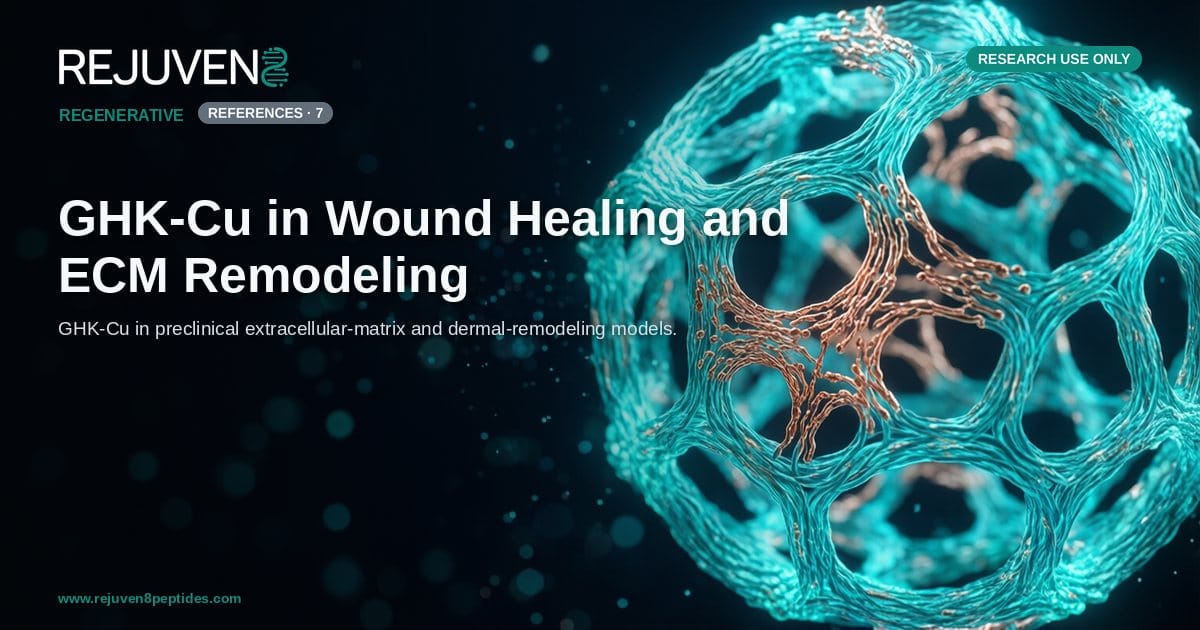
GHK-Cu is a naturally occurring copper-binding tripeptide (Glycyl-L-Histidyl-L-Lysine complexed with copper(II)) that has become a recurring subject in preclinical studies of wound repair and extracellular matrix (ECM) biology. First isolated from human plasma by Loren Pickart in the early 1970s, the molecule is frequently described in the literature as a matrikine: a matrix-derived signal that appears to influence how fibroblasts synthesize and reorganize structural proteins in cell-culture and animal models. Research attention centers on its relationship to collagen production, glycosaminoglycan deposition, and the enzymatic turnover that governs tissue remodeling.
This article summarizes how GHK-Cu is investigated within preclinical wound-healing and ECM-remodeling research models. Every mechanism described here reflects in-vitro, cell-culture, or animal-model observations reported by investigators, and none of it constitutes a claim about human outcomes. For laboratories evaluating regenerative-research compounds, GHK-Cu is often examined alongside other tissue-repair peptides described in our recovery research overview.
Molecular Identity of GHK-Cu
A Copper-Binding Tripeptide
The peptide backbone of GHK is short and well defined: three amino acids in the sequence glycine, histidine, and lysine. What distinguishes the molecule in research settings is its ability to chelate a single copper(II) ion. Structural studies describe coordination through the imidazole nitrogen of the histidine residue together with the terminal amine and an adjacent amide nitrogen, forming a stable square-planar copper complex. This chemistry is the reason GHK-Cu solutions display a characteristic blue tint and why the copper is treated as an integral part of the research molecule rather than an incidental additive.
Why the Copper Matters in Research Models
Copper is a required cofactor for several enzymes central to matrix biology, including lysyl oxidase (which participates in collagen and elastin crosslinking) and superoxide dismutase (an antioxidant enzyme). Investigators frequently frame GHK as a physiological copper carrier, and studies examine whether the peptide shuttles copper to cells in a form that can participate in these pathways. This dual identity, a signaling peptide bound to a catalytic metal, is what makes the complex an interesting probe for ECM-remodeling questions.
The values below reflect commonly reported laboratory attributes and are provided for comparison only.
| Attribute | Reported Value |
|---|---|
| Peptide sequence | Glycyl-L-Histidyl-L-Lysine (Gly-His-Lys) |
| Sequence length | 3 amino acids (tripeptide) |
| Approx. molecular weight (GHK) | 340.4 g/mol |
| Approx. molecular weight (GHK-Cu complex) | 403.9 g/mol |
| Compound class | Copper-binding matrikine (peptide-copper chelate) |
| Copper coordination | Cu(II) bound via histidine imidazole and terminal amine |
| Primary research focus | ECM remodeling, collagen synthesis, wound-model studies |
GHK-Cu in Wound-Healing Research Models
Dermal and Fibroblast Studies
Much of the foundational GHK-Cu literature uses cultured dermal fibroblasts, the connective-tissue cells responsible for producing structural matrix. In these in-vitro systems, researchers report changes in the expression of collagen and other matrix components when GHK-Cu is present in the culture medium. Because fibroblast activity is a rate-limiting step in the closure and reorganization of experimental wounds, these cell-level observations are treated as a mechanistic starting point rather than an endpoint.
Angiogenesis and Granulation-Tissue Models
Wound-repair biology also depends on the formation of new blood vessels and provisional granulation tissue. Animal-model and tissue-explant studies have examined whether GHK-Cu influences angiogenic signaling and the migration of cells into a wound bed. Investigators typically measure surrogate markers such as vessel density, cellular infiltration, or the deposition of new matrix within a defined observation window. These are controlled research readouts, and they describe model systems only, not clinical wound care in humans.
Extracellular Matrix Remodeling Pathways
Collagen, Elastin, and Glycosaminoglycans
The extracellular matrix is a composite of fibrous proteins (chiefly collagen and elastin) embedded in a hydrated gel of glycosaminoglycans and proteoglycans. Remodeling research asks how a signal changes the balance of synthesis and degradation across these components. Reported GHK-Cu studies describe modulation of collagen and glycosaminoglycan production in fibroblast cultures, which is why the peptide is often grouped with molecules studied for their effects on matrix architecture rather than on any single protein.
Matrix Metalloproteinase and TIMP Balance
Remodeling is not only about building matrix; it is equally about controlled breakdown. Matrix metalloproteinases (MMPs) are the enzymes that degrade matrix proteins, and their activity is held in check by tissue inhibitors of metalloproteinases (TIMPs). A recurring theme in GHK-Cu research is whether the peptide shifts the MMP-to-TIMP balance in a way that favors organized remodeling in laboratory models. Understanding this balance also underscores why supplier documentation matters: verifying identity and purity through a certificate of analysis, as outlined in our COA and purity guide, helps ensure that reported research results are attributable to the intended compound.
Comparative Research Context and Handling
GHK-Cu Among Recovery-Research Peptides
Within the broader category of tissue-repair peptides, GHK-Cu is usually studied along different mechanistic lines than the more widely discussed synthetic peptides. The comparison below is a research-framing summary, not a ranking of effectiveness. Copper-peptide blends such as the GLOW research blend also incorporate GHK-Cu alongside other regenerative-research compounds. The following values reflect commonly reported laboratory attributes and are provided for comparison only.
| Compound | Class | Primary preclinical research focus | Approx. molecular weight |
|---|---|---|---|
| GHK-Cu | Copper-binding tripeptide (matrikine) | ECM remodeling, collagen and glycosaminoglycan synthesis | 403.9 g/mol |
| BPC-157 | Synthetic pentadecapeptide | Angiogenic and tissue-repair signaling models | ~1419 g/mol |
| TB-500 | Thymosin beta-4 active fragment | Actin regulation and cell-migration models | ~889 g/mol |
Stability, Copper Oxidation, and Reconstitution Notes
GHK-Cu carries handling considerations that differ from copper-free peptides. The lyophilized powder is generally stored cold and protected from prolonged light and heat, since the coordinated copper can participate in oxidation reactions that alter the complex over time. Reconstituted solutions retain the signature blue coloration, and laboratories typically refrigerate them and minimize repeated freeze-thaw cycles to preserve integrity. As a worked example for concentration planning, reconstituting a 50 mg vial with 5 mL of bacteriostatic water yields a 10 mg/mL stock; the general mechanics of solvent handling are covered in our bacteriostatic water reconstitution guide. As with every item in this category, GHK-Cu is supplied for research use only, not for human consumption, and belongs strictly within a controlled laboratory setting. Additional regenerative-research inventory can be reviewed in the full research peptide catalog.
Frequently Asked Questions
What is GHK-Cu studied for in wound-healing research?
In preclinical and in-vitro research, GHK-Cu is studied as a copper-binding tripeptide that appears to influence fibroblast behavior, collagen synthesis, and extracellular matrix remodeling. All reported effects come from cell-culture and animal models and do not describe human outcomes.
How does GHK-Cu relate to collagen and ECM remodeling?
Laboratory studies report that GHK-Cu can modulate the synthesis of collagen, elastin, and glycosaminoglycans while influencing matrix metalloproteinase and TIMP activity. These observations position it as a research tool for studying matrix turnover, not as a therapeutic agent.
Why is GHK bound to copper?
The tripeptide GHK has a high affinity for copper(II) ions and coordinates them through its histidine and terminal amine groups. Researchers study this copper complex because copper is a cofactor for matrix enzymes such as lysyl oxidase, which makes the chelate relevant to ECM-remodeling investigations.
How is GHK-Cu handled and stored in a laboratory setting?
GHK-Cu is typically supplied as a lyophilized powder and stored cold and protected from light to limit copper-related oxidation. Reconstituted solutions carry a characteristic blue tint and are usually kept refrigerated with minimal freeze-thaw cycling. It is intended for research use only, not for human consumption.
How does GHK-Cu compare with BPC-157 and TB-500 in recovery research?
GHK-Cu, BPC-157, and TB-500 are studied along different mechanistic lines: GHK-Cu for ECM and collagen signaling, BPC-157 for angiogenic and tissue-repair pathways, and TB-500 for actin regulation and cell migration. They are frequently compared in preclinical recovery-research literature.
Is GHK-Cu intended for human use?
No. GHK-Cu offered for laboratory work is a research-use-only compound. It is not a drug, is not intended for human or veterinary use, and should be handled only within a controlled research environment.
References and Further Reading
- Pickart L. Research on the tripeptide GHK and copper in tissue-remodeling biology. PubMed: GHK-Cu tissue remodeling
- Pickart L, Margolina A. Studies on the regenerative and matrix-signaling actions of the GHK peptide. PubMed: GHK copper peptide skin
- Copper-peptide effects on fibroblast collagen synthesis in in-vitro research. PubMed: GHK-Cu collagen synthesis fibroblast
- GHK-Cu and matrix metalloproteinase modulation in remodeling models. PubMed: GHK-Cu matrix metalloproteinase
- Preclinical wound-model investigations of copper tripeptides. PubMed: GHK-Cu wound healing
- GHK influence on ECM-related gene expression in laboratory studies. PubMed: GHK gene expression extracellular matrix
- Copper transport, angiogenesis, and peptide research. PubMed: copper peptide angiogenesis