Research Use Only. The information presented here is for scientific and educational purposes. These compounds are not intended for human consumption, self-administration, or therapeutic use.
Introduction
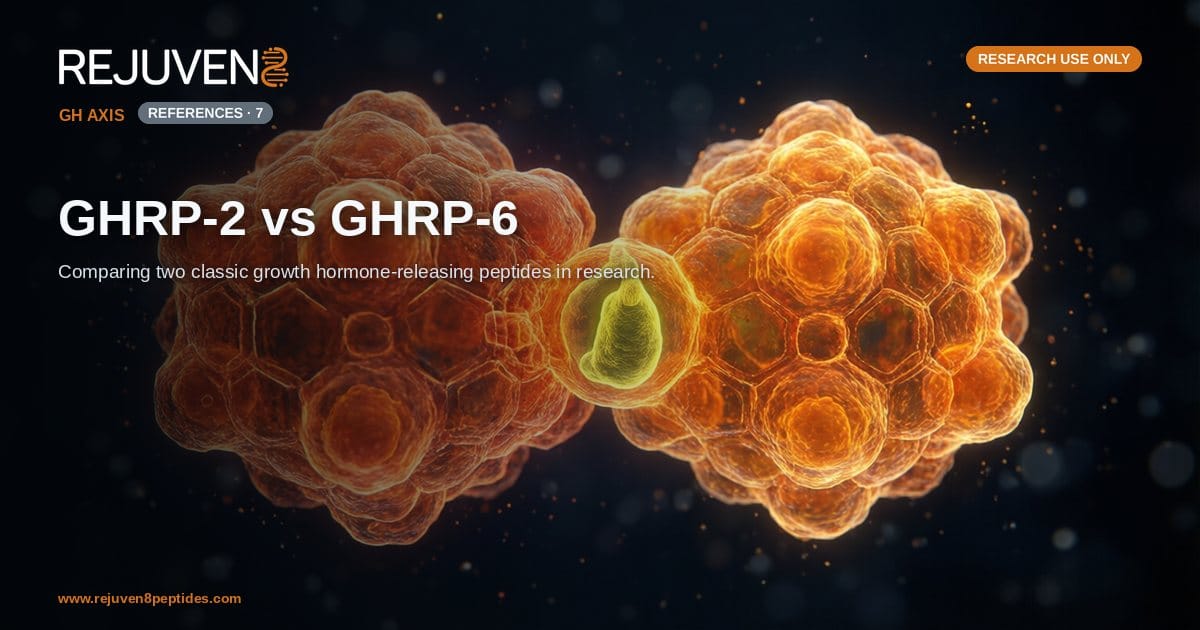
GHRP-2 and GHRP-6 are two of the earliest synthetic growth hormone-releasing peptides, a family of short compounds developed to probe how the pituitary gland can be prompted to release growth hormone. Both are six-residue peptides that act as agonists at the growth hormone secretagogue receptor type 1a (GHS-R1a), the same receptor later identified as the target of the natural hormone ghrelin. Because they engage this pathway, GHRP-2 and GHRP-6 are frequently grouped together in the literature as ghrelin receptor ligands and studied as reference tools for growth hormone axis signaling.
Although the two peptides share a receptor and a common design goal, they are not interchangeable. Their amino acid sequences differ, and the research signatures reported for each are distinct enough that investigators often compare them side by side. This article outlines what each peptide is, how their structures relate, and the comparative observations described for them in preclinical and in-vitro research. Everything below is framed around what these molecules are investigated for in laboratory models, not any human application.
What Growth Hormone-Releasing Peptides Are
The growth hormone-releasing peptides (GHRPs) emerged from structure-activity work led by Cyril Bowers and colleagues, who systematically modified small peptide fragments to find sequences that could stimulate growth hormone secretion. GHRP-6 was among the first well-characterized members of the class, followed closely by GHRP-2 (also referenced in the literature as pralmorelin). Unlike growth hormone-releasing hormone (GHRH), which acts on its own dedicated receptor, the GHRPs work through the secretagogue receptor and were pivotal in revealing that a second, ghrelin-linked pathway helps regulate growth hormone output.
The Ghrelin Receptor Connection
When ghrelin was identified by Kojima, Kangawa and colleagues as the endogenous ligand of GHS-R1a, it clarified why synthetic hexapeptides like GHRP-2 and GHRP-6 were active in the first place. Both peptides mimic aspects of ghrelin signaling at the receptor, which is expressed in the pituitary and hypothalamus. This is why the two compounds are often labeled ghrelin mimetics or secretagogues, and why appetite-related signaling, a hallmark of the ghrelin system, appears in research on both.
Structural and Molecular Comparison
Both peptides are amidated hexapeptides, meaning each is built from six amino acids with a modified carboxyl terminus, yet their sequences and molecular details set them apart. The values below reflect commonly reported laboratory attributes and are provided for comparison only.
| Attribute | GHRP-2 | GHRP-6 |
|---|---|---|
| Class | Growth hormone secretagogue (hexapeptide) | Growth hormone secretagogue (hexapeptide) |
| Amino acid sequence | D-Ala-D-2-Nal-Ala-Trp-D-Phe-Lys-NH2 | His-D-Trp-Ala-Trp-D-Phe-Lys-NH2 |
| Sequence length | 6 residues | 6 residues |
| Molecular formula | C45H55N9O6 | C46H56N12O6 |
| Approx. molecular weight | ~817.9 g/mol | ~873.0 g/mol |
| Primary target | GHS-R1a (ghrelin receptor) | GHS-R1a (ghrelin receptor) |
| Noted research feature | Comparatively strong GH release signal | Pronounced food-intake response in models |
A Shared Hexapeptide Framework
Both molecules terminate in a D-Phe-Lys motif with a C-terminal amide, a feature that contributes to receptor engagement and to resistance against rapid enzymatic breakdown compared with unmodified peptides. This shared backbone is part of why the two behave similarly at GHS-R1a in binding assays.
Where the Sequences Diverge
The most visible difference sits at the amino terminus. GHRP-2 opens with a D-Ala-D-2-Nal pairing that incorporates a bulky naphthylalanine residue, whereas GHRP-6 begins with His-D-Trp. These substitutions change the peptides’ molecular weight and are associated with the differing potency and secondary-signal profiles reported in comparative studies.
Comparative Research Signatures
Growth Hormone Secretion
In animal and cell-based models, GHRP-2 is frequently described as generating a stronger growth hormone secretory signal than GHRP-6 at comparable exposures. Investigators have used this difference to study dose-response relationships and receptor efficacy. Both peptides also show additive behavior when examined alongside GHRH, a finding that helped map the two-pathway model of growth hormone regulation.
Appetite and Metabolic Signaling
Because both compounds engage the ghrelin receptor, both have been observed to influence feeding behavior in rodent research. GHRP-6 in particular is noted for a marked orexigenic (appetite-stimulating) effect, making it a common tool for studying ghrelin-linked metabolic signaling. GHRP-2 also affects food intake in models, though comparative reports often place its appetite signal below that of GHRP-6 relative to its growth hormone effect.
Secondary Endocrine Signals
Research on both peptides has examined effects beyond growth hormone, including modest reported changes in cortisol and prolactin in some models. These secondary signals are one reason the two peptides are compared carefully, since their off-target profiles are part of what distinguishes their behavior at the receptor. For a broader view of adjacent tools, the recovery and tissue-repair peptide overview places secretagogues in context with other research classes.
Laboratory Handling and Sourcing Context
GHRP-2 and GHRP-6 are typically distributed as lyophilized (freeze-dried) powder in milligram-scale vials. A common laboratory step is reconstitution with bacteriostatic water: for example, adding 2 mL of bacteriostatic water to a 10 mg vial yields a working concentration of 5 mg/mL. Detailed technique is covered in the bacteriostatic water reconstitution guide. Reconstituted peptide is generally kept cold, protected from repeated freeze-thaw cycles, and used within a defined window to preserve integrity.
Purity matters in comparative work, because sequence-related impurities can confound receptor studies. Reviewing a certificate of analysis confirms identity and purity, and third-party certificates document independent testing. These materials are supplied for research use only, not for human consumption. Researchers can compare available secretagogues, including GHRP-2, across the full research peptide catalog.
Frequently Asked Questions
What is the main difference between GHRP-2 and GHRP-6 in research?
GHRP-2 and GHRP-6 are both synthetic hexapeptide growth hormone secretagogues that act on the GHS-R1a (ghrelin) receptor, but they differ in amino acid sequence and in the research signatures reported for them. In preclinical and animal models, GHRP-2 is often described as producing a comparatively strong growth hormone release signal, while GHRP-6 is frequently noted for a pronounced effect on food intake. Both remain research compounds studied for their signaling behavior.
Are GHRP-2 and GHRP-6 the same as ghrelin?
No. Ghrelin is an endogenous 28-amino-acid peptide hormone, whereas GHRP-2 and GHRP-6 are short six-amino-acid synthetic peptides. They are studied as ghrelin receptor agonists because they bind the same GHS-R1a receptor, which is why they are sometimes called ghrelin mimetics in the literature.
Which GHRP shows stronger growth hormone release in studies?
Comparative laboratory reports generally describe GHRP-2 as eliciting a somewhat greater growth hormone secretory response than GHRP-6 at equivalent exposures in animal and cell models. These observations are drawn from preclinical research and are provided for comparison only, not as any statement of human effect.
Do GHRP-2 and GHRP-6 affect appetite in animal models?
In rodent studies, both peptides have been observed to influence food-intake behavior through the ghrelin signaling pathway, with GHRP-6 in particular associated with a marked orexigenic (appetite-stimulating) response. This is a research observation about receptor signaling in animals and does not describe any human outcome.
How are GHRP-2 and GHRP-6 handled in a laboratory setting?
Both are typically supplied as lyophilized powder in milligram-scale vials and reconstituted with bacteriostatic water for in-vitro work. Cold storage and minimizing freeze-thaw cycles help preserve peptide integrity, and reviewing a certificate of analysis confirms identity and purity before any research use.
Can GHRP-2 or GHRP-6 be studied alongside GHRH analogs?
In research settings, secretagogues such as GHRP-2 and GHRP-6 are frequently examined together with growth hormone-releasing hormone (GHRH) analogs like Sermorelin or CJC-1295, because the two classes act on different receptors and have shown additive signaling in models. Any such pairing is strictly a laboratory research design.
References and Further Reading
- Bowers CY and colleagues. Structure-activity studies of growth hormone-releasing peptides. PubMed: Bowers growth hormone releasing peptide
- Kojima M, Kangawa K and colleagues. Ghrelin as the endogenous ligand of the growth hormone secretagogue receptor. PubMed: ghrelin growth hormone releasing acylated peptide
- Growth hormone secretagogue receptor (GHS-R1a) pharmacology. PubMed: growth hormone secretagogue receptor
- GHRP-2 (pralmorelin) growth hormone release research. PubMed: GHRP-2 pralmorelin growth hormone
- GHRP-6 growth hormone-releasing peptide studies. PubMed: GHRP-6 growth hormone releasing peptide
- Growth hormone-releasing peptides and food intake. PubMed: growth hormone releasing peptide food intake
- Synergy of GHRP and GHRH on growth hormone secretion. PubMed: GHRP GHRH synergy growth hormone