Research Use Only. The information presented here is for scientific and educational purposes. These compounds are not intended for human consumption, self-administration, or therapeutic use.
Introduction
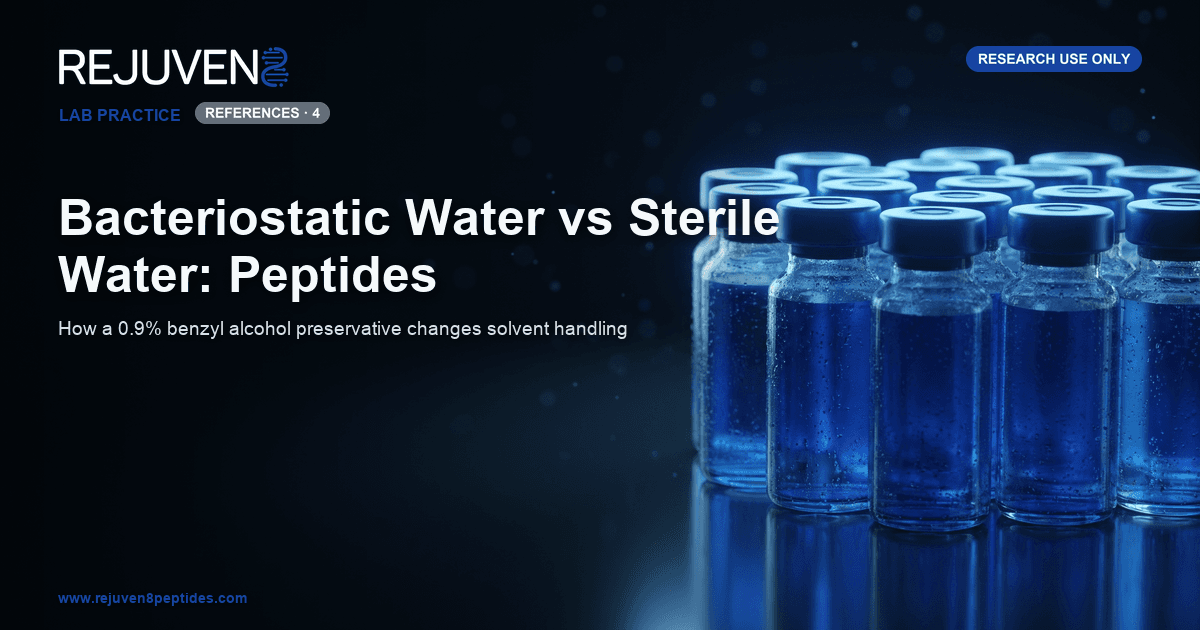
The choice between bacteriostatic water vs sterile water is one of the first decisions a laboratory makes when a lyophilized peptide needs to be brought into solution. Both are highly purified, sterile, non-pyrogenic grades of water, and both dissolve a freeze-dried peptide in exactly the same way. The difference lies in a single added ingredient: bacteriostatic water carries 0.9% benzyl alcohol (9 mg per mL) as a preservative, while sterile water carries no preservative at all. That one variable determines how long a vial can be re-entered, how it is packaged, and when a preservative-free alternative is called for.
This article compares the two solvents on composition, pH, tonicity, container format, and the stability of the reconstituted peptide, then walks through one concentration calculation and the storage conditions that follow reconstitution. The discussion is limited to laboratory handling of solvents such as Bacteriostatic Water 10mL paired with lyophilized research compounds. Every material described is for research use only, not for human consumption, and nothing here describes use in people or animals.
How Bacteriostatic Water Is Formulated
The 0.9% Benzyl Alcohol Preservative
Benzyl alcohol (C7H8O, approximately 108.1 g/mol) is an aromatic alcohol that partitions into microbial cell membranes and disrupts their organization, which slows or halts bacterial growth. At 0.9% it is present in large molar excess relative to any dissolved peptide, yet it remains fully miscible and visually undetectable. It also lends bacteriostatic water a mildly acidic character: the commonly reported pH is about 5.7, with an accepted range of roughly 4.5 to 7.0. Like sterile water, the solution is hypotonic, since it contains no dissolved salts or sugars to contribute osmotic pressure.
What “Bacteriostatic” Means and Does Not Mean
The prefix is precise. A bacteriostatic agent suppresses the multiplication of organisms introduced when a stopper is pierced; it does not sterilize a contaminated vial and it does not neutralize endotoxin. This is why preservative-containing solvents are supplied in multiple-entry vials, typically 10 mL or 30 mL, with a conventional working window of about 28 days after the first entry. Beyond that period the preservative is no longer assumed to keep pace with cumulative exposure, and the vial is retired regardless of how much remains. The bacteriostatic water reconstitution guide covers the general dissolution steps in more depth.
Sterile Water for Peptides: The Preservative-Free Option
Single-Entry Containers
Sterile water for peptides is purified water that has been sterilized and packaged without any antimicrobial additive. Its typical pH range is 5.0 to 7.0, and it is likewise hypotonic. Because nothing in the solution inhibits microbial growth once the seal is broken, sterile water is packaged for single entry: the container is opened, the required volume is withdrawn, and the remainder is discarded. That makes it a poor fit for drawing from one solvent vial across many days, but a good fit for an experiment that must exclude every non-peptide component from the final solution.
When Preservative-Free Solvent Is Chosen in Research
Formulation science supplies a clear reason to keep sterile water on the shelf. Benzyl alcohol, phenol, and related antimicrobial excipients have been shown to promote partial unfolding and aggregation of certain proteins in aqueous solution. Studies on recombinant interleukin-1 receptor antagonist from the Carpenter and Randolph groups in the early 2000s, later work on interferon alpha-2a, and a 2022 mechanistic study of antimicrobial excipients in peptide formulations describe the same theme: the excipient binds weakly to hydrophobic patches, shifts the conformational equilibrium, and accelerates aggregate formation in susceptible molecules. Short synthetic peptides with little tertiary structure are far less affected than folded proteins, but an aggregation-sensitive assay, a cell-culture system in which benzyl alcohol would be a confounder, or an HPLC method where the preservative peak could co-elute with a small analyte are all situations that call for sterile water. The peptide solubility and reconstitution chemistry article explains why some hydrophobic sequences need a co-solvent step before either water is added.
Bacteriostatic Water vs Sterile Water: Side-by-Side Comparison
The values below reflect commonly reported laboratory attributes and are provided for comparison only.
| Attribute | Bacteriostatic Water | Sterile Water |
|---|---|---|
| Base | Purified, sterile, non-pyrogenic water | Purified, sterile, non-pyrogenic water |
| Preservative | 0.9% benzyl alcohol (9 mg/mL) | None |
| Typical pH | About 5.7 (range 4.5 to 7.0) | About 5.0 to 7.0 |
| Tonicity | Hypotonic | Hypotonic |
| Container format | Multiple-entry vial (10 mL, 30 mL) | Single-entry vial or ampoule |
| Working window after first entry | About 28 days by convention | Same session; remainder discarded |
| Microbial growth suppression | Yes (bacteriostatic, not sterilizing) | No |
| Excipient-sensitive assays | Benzyl alcohol may be a confounder | No added excipient |
| Effect on dissolution chemistry | None beyond the pH contribution | None |
First, neither solvent changes how a peptide dissolves; solubility depends on the sequence, its counter-ion, and the final pH, not on the preservative. Second, a reconstituted vial runs on two independent clocks: the microbial clock set by the preservative and the chemical clock set by the peptide’s own degradation pathways. Bacteriostatic water addresses only the first. Verifying identity and purity against the batch certificate of analysis is the starting point for any stability comparison.
Reconstitution Math and Storage After Dissolution
One Worked Concentration Example
Concentration in mg/mL equals the mass of peptide in the vial divided by the volume of solvent added. Reconstituting a 10 mg lyophilized vial with 2 mL of bacteriostatic water yields 5 mg/mL, so every 0.1 mL of solution contains 0.5 mg of peptide. Using 1 mL instead doubles the concentration to 10 mg/mL; using 4 mL halves it to 2.5 mg/mL. A single 10 mL vial of bacteriostatic water therefore supports five such 2 mL reconstitutions within its 28-day window, while the 30 mL eBac Bacteriostatic Water format suits laboratories preparing many vials at once. Solvent is introduced slowly against the glass wall so the cake dissolves without foaming; shaking can shear or aggregate longer peptides.
Storage Conditions and Degradation Pathways
Once a peptide is in solution, temperature and time matter more than the solvent choice. Lyophilized material is normally held at -20 C or colder, protected from light and moisture. Reconstituted solutions are held at 2 to 8 C for short-term work; for longer storage the solution is divided into single-use aliquots and frozen so that repeated freeze-thaw cycles are avoided. The degradation routes that limit solution stability are well characterized: oxidation of methionine, cysteine, and tryptophan; deamidation of asparagine and glutamine, particularly in Asn-Gly motifs; acid-catalyzed hydrolysis at Asp-Pro bonds; and, for some sequences, cyclization or aggregation. None of these is prevented by benzyl alcohol, although the mildly acidic pH of bacteriostatic water sits close to the range in which many peptides are most stable. Temperature and container guidance appears in the peptide storage and handling reference.
The bacteriostatic water vs sterile water question, then, is not about which solvent is better in the abstract. Bacteriostatic water suits repeated entries into a single vial over several weeks. Sterile water suits single-session preparations and any experiment in which an added excipient would interfere with the measurement. Solvents are stocked alongside the lyophilized compounds in the research peptide catalog, all supplied for laboratory use only.
Frequently Asked Questions
Is bac water the same as sterile water?
No. Both begin as purified, sterile, non-pyrogenic water, but bacteriostatic water (bac water) contains 0.9% benzyl alcohol as a preservative and sterile water contains no additive. The preservative allows a bacteriostatic water vial to be entered repeatedly over about 28 days, whereas an opened sterile water container is used once and the remainder discarded.
Can sterile water be used for peptides?
Yes. Sterile water dissolves a lyophilized peptide exactly as bacteriostatic water does, since the preservative plays no role in dissolution. It is the preferred solvent when an experiment must exclude benzyl alcohol, for example in aggregation-sensitive assays or cell-culture work, with the limitation that the solution has no protection against microbial growth after the container is opened.
Why does bacteriostatic water contain 0.9% benzyl alcohol?
Benzyl alcohol at 0.9% (9 mg/mL) is a long-established preservative concentration that inhibits the growth of organisms introduced during repeated entries into a vial while remaining miscible with water and compatible with most dissolved peptides. It suppresses growth rather than sterilizing, which is why the term is bacteriostatic and not bactericidal.
How long does bacteriostatic water last once opened?
By laboratory convention a bacteriostatic water vial is retired about 28 days after its first entry, even if solvent remains, and it is kept at controlled room temperature or refrigerated between uses. A reconstituted peptide solution is a separate question: its usable life depends on the peptide’s own stability and is typically managed by refrigeration at 2 to 8 C or by frozen single-use aliquots.
Does benzyl alcohol affect peptide stability?
For most short synthetic peptides the effect is negligible. Formulation studies have shown that benzyl alcohol and related preservatives can promote unfolding and aggregation of certain folded proteins, so preservative-free sterile water is chosen when a molecule is known to be sensitive or when aggregation state is the variable under study. Benzyl alcohol does not prevent oxidation, deamidation, or hydrolysis, which are controlled by temperature, pH, and storage time.
Is bacteriostatic water for research use only?
Yes. The bacteriostatic water and sterile water discussed here are laboratory solvents supplied for the reconstitution of research peptides. They are provided for research use only, not for human consumption, and nothing in this comparison describes use in people or animals.
References and Further Reading
- Carpenter, Randolph and colleagues (University of Colorado) on the mechanism of benzyl alcohol-induced aggregation of recombinant interleukin-1 receptor antagonist in aqueous solution, 2004. PubMed: benzyl alcohol induced aggregation interleukin-1 receptor antagonist
- Mechanistic studies of antimicrobial excipients (benzyl alcohol, phenol, and related preservatives) and aggregation in peptide formulations. PubMed: antimicrobial excipient induced aggregation peptide benzyl alcohol
- Manning, Borchardt and colleagues on the chemical degradation pathways of peptides and proteins in solution, including deamidation, oxidation, and hydrolysis. PubMed: peptide stability deamidation oxidation hydrolysis solution
- Studies of benzyl alcohol as an antimicrobial preservative, including membrane-disruption mechanisms and preservative efficacy testing. PubMed: benzyl alcohol preservative antimicrobial efficacy