Research Use Only. The information presented here is for scientific and educational purposes. These compounds are not intended for human consumption, self-administration, or therapeutic use.
Introduction
The short answer to is nad a peptide is no. Nicotinamide adenine dinucleotide is a dinucleotide coenzyme, built from two nucleotides joined tail to tail through a pyrophosphate bridge. It contains no amino acids and no peptide bonds, which are the two features that define a peptide. The two molecule types belong to entirely separate chemical families, and no amount of shared shelf space changes that.
The question is worth answering carefully rather than dismissing, because the confusion has a real source: research suppliers routinely catalog NAD+ alongside peptides, both arrive as lyophilized powder in a sealed vial, both are reconstituted the same way, and both are stored cold. This article draws the chemical line clearly, explains where the overlap in laboratory practice genuinely lies, and shows where NAD+ and peptide research compounds actually intersect at the level of biology. Everything described concerns laboratory and animal model work. These materials are supplied for research use only, not for human consumption.
What Defines a Peptide
A peptide is a chain of amino acids linked by peptide bonds, which are amide linkages formed between the carboxyl group of one residue and the amino group of the next, releasing water in the process. Three properties follow from that definition and are worth stating precisely, because each one fails for NAD+.
First, a peptide has a primary sequence: an ordered list of residues read from the N-terminus to the C-terminus, which is why peptides are written as Gly-Glu-Pro or in single-letter code. Second, its properties are largely determined by the side chains of those residues, giving each sequence its own charge, solubility, and folding behavior. Third, peptides are built by ribosomal translation in cells or by solid-phase synthesis in a laboratory, both of which add one residue at a time. By convention, chains up to roughly 50 residues are called peptides and longer ones are called proteins.
Is NAD a Peptide? What the Molecule Actually Is
NAD+ is assembled from two nucleotide halves. One half is nicotinamide mononucleotide: the nicotinamide base attached to a ribose sugar carrying a phosphate. The other half is adenosine monophosphate: adenine attached to its own ribose and phosphate. The two phosphates are joined into a pyrophosphate bridge, which is the bond that makes it a dinucleotide rather than two separate nucleotides.
Its behavior follows from that architecture. The nicotinamide ring is the business end for redox chemistry, accepting a hydride ion to become NADH and releasing it to return to NAD+, a cycle that carries electrons through glycolysis and the mitochondrial electron transport chain without consuming the molecule. Separately, the glycosidic bond between nicotinamide and the rest of the molecule can be cleaved by sirtuins, PARPs, and CD38, which spend NAD+ permanently and release nicotinamide as a product. No peptide does either of these things, because neither reaction has anything to do with amide-linked amino acids.
The values below reflect commonly reported laboratory attributes and are provided for comparison only.
| Property | NAD+ | A representative research peptide |
|---|---|---|
| Chemical class | Dinucleotide coenzyme | Amino acid polymer |
| Building blocks | Nicotinamide, adenine, two riboses, two phosphates | Amino acid residues |
| Defining bond | Pyrophosphate bridge and N-glycosidic bond | Peptide (amide) bond |
| Has a primary sequence | No | Yes |
| Molecular formula | C21H27N7O14P2 | Varies by sequence |
| Approximate molecular weight | ~663.4 g/mol | ~300 Da to over 5000 Da |
| Typical origin | Enzymatic biosynthesis, chemical or fermentation manufacture | Ribosomal translation or solid-phase synthesis |
At roughly 663 g/mol, NAD+ happens to sit in the same mass range as a short peptide such as a pentapeptide, which is one more reason the two get filed together. Mass alone is not a classification.
Why “NAD+ Peptide” Is Such a Common Search
The phrase persists because the two are handled identically at the bench. Both are supplied as sterile lyophilized powder, both are reconstituted with bacteriostatic water before use, both are kept refrigerated or frozen and protected from repeated freeze-thaw cycles, and both are documented by HPLC purity figures on a batch certificate. Supplier catalogs organize by workflow rather than by chemistry, so NAD+ commonly appears under a general research compound heading next to genuine peptides.
Reconstitution Math Is Where the Difference Shows
The handling similarity ends at the arithmetic. NAD+ vials are supplied at 100 mg and 1000 mg, far larger masses than a typical peptide vial, so the concentrations involved differ by an order of magnitude. As a worked example, reconstituting a 1000 mg vial with 10 mL of bacteriostatic water yields a 100 mg/mL stock, and converting that to molarity uses the 663.4 g/mol figure rather than a sequence-derived mass. General reconstitution technique is covered in the bacteriostatic water guide and there is no need to repeat it here.
Stability Considerations Are Also Distinct
NAD+ in aqueous solution is sensitive to alkaline conditions and degrades over time in ways that differ from peptide degradation, which is typically driven by oxidation of susceptible residues, deamidation, or enzymatic cleavage. Solutions are generally prepared fresh, kept cold, and shielded from prolonged warm storage. Identity for a small molecule like this is confirmed against a defined formula and CAS identity rather than by sequence confirmation, a distinction worth understanding when reading a certificate of analysis.
Where NAD+ and Peptides Genuinely Intersect
The chemistry is unrelated, but the biology is not. Several research peptides are studied in the same mitochondrial and metabolic territory that NAD+ occupies, which is the legitimate reason they appear in the same experiments.
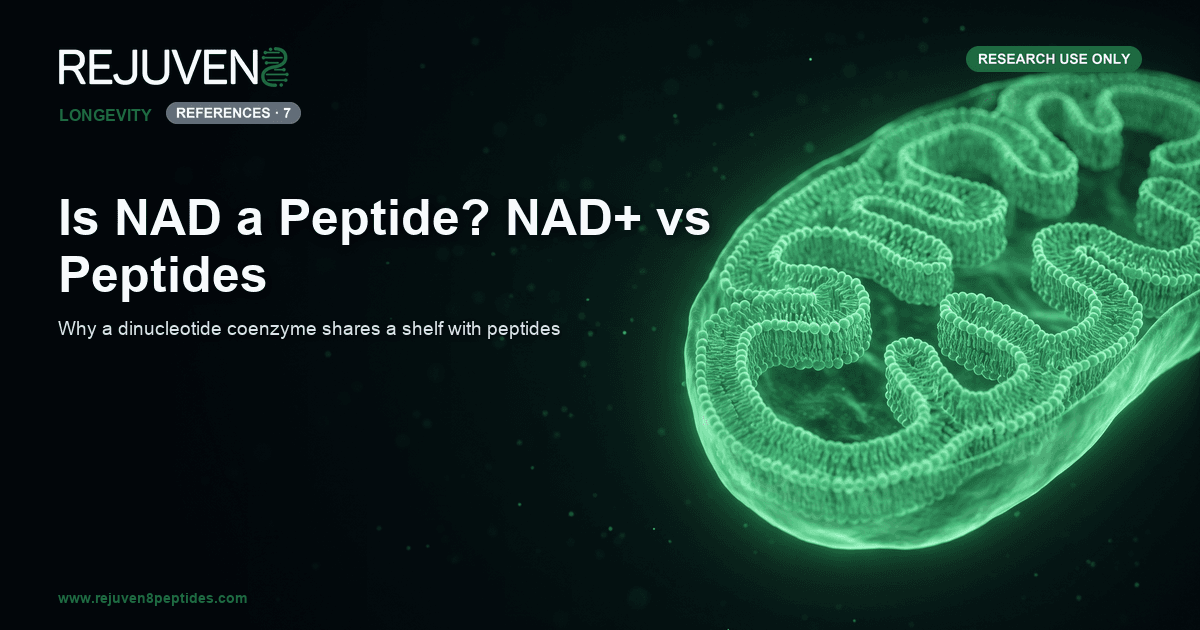
MOTS-c is a mitochondrial-derived peptide encoded in mitochondrial DNA and investigated for its association with AMPK signaling and metabolic regulation in cell and animal models, an axis that runs adjacent to NAD+-dependent sirtuin activity. SS-31 is a short tetrapeptide studied for its interaction with cardiolipin in the inner mitochondrial membrane, where the electron transport chain that NAD+ feeds is located. In a study of mitochondrial function, a coenzyme and a peptide can be independent variables acting on the same system.
Sirtuins are the clearest meeting point. These NAD+-dependent deacylases require the coenzyme as a substrate, and their activity connects NAD+ availability to transcriptional programs including the PGC-1alpha axis studied in mitochondrial biogenesis models. Recent reviews of NAD+ metabolism, NAMPT-mediated salvage, and mitochondrial quality control published through 2025 continue to develop this territory. NAD+ and the mitochondrial peptides sit near each other in the research catalog for that reason. So the answer to is nad a peptide stays no on chemistry while remaining yes on shared research territory, and keeping those two answers separate is what makes an experiment interpretable.
Frequently Asked Questions
Is NAD a peptide?
No. NAD+ is a dinucleotide coenzyme made of nicotinamide mononucleotide joined to adenosine monophosphate through a pyrophosphate bridge. It contains no amino acids and no peptide bonds, so it does not meet the definition of a peptide, which is a chain of amino acids linked by amide bonds.
What is NAD+?
NAD+ is nicotinamide adenine dinucleotide, a coenzyme present in all living cells. It carries electrons in redox reactions by cycling between NAD+ and NADH, and it also serves as a consumed substrate for enzyme families including sirtuins, PARPs, and CD38. Its molecular formula is C21H27N7O14P2 with an approximate weight of 663.4 g/mol.
Why is NAD+ sold alongside research peptides?
Because the laboratory workflow is the same. NAD+ and peptides both arrive as lyophilized powder in sealed vials, are reconstituted with bacteriostatic water, are stored cold, and are documented by HPLC purity testing. Catalogs group by handling and research context rather than by chemical class.
What is the difference between a nucleotide and a peptide?
A nucleotide is built from a nitrogenous base, a sugar, and one or more phosphate groups, and nucleotides link through phosphodiester or pyrophosphate bonds. A peptide is built from amino acids linked by peptide bonds and has a defined primary sequence read from N-terminus to C-terminus. They are separate chemical families with different synthesis routes and different analytical methods.
Does NAD+ have an amino acid sequence?
No. Because it is not a peptide, NAD+ has no residues and no sequence to report. Its identity is defined by a molecular formula and structure rather than by sequence confirmation, which is why identity testing for it differs from the sequence-based confirmation used for peptides.
Is NAD+ intended for human use?
No. NAD+ is supplied strictly as a laboratory research material for research use only and is not intended for human consumption, self-administration, or therapeutic use. All findings referenced here derive from in-vitro systems and animal models.
References and Further Reading
- Structure and biochemistry of nicotinamide adenine dinucleotide as a redox coenzyme. PubMed: nicotinamide adenine dinucleotide structure coenzyme
- NAD+-dependent sirtuin enzymes and their role in cellular regulation. PubMed: NAD sirtuin deacetylase
- NAMPT and the NAD+ salvage pathway, including reviews published through 2025. PubMed: NAMPT NAD salvage pathway
- NAD+ metabolism and mitochondrial function in preclinical aging models. PubMed: NAD metabolism mitochondria aging
- Peptide bond chemistry and the classification of peptides and proteins. PubMed: peptide bond chemistry classification
- MOTS-c as a mitochondrial-derived peptide studied in metabolic regulation. PubMed: MOTS-c mitochondrial derived peptide
- Mitochondria-targeted peptides and cardiolipin interactions in the inner membrane. PubMed: mitochondria targeted peptide cardiolipin