Research Use Only. The information presented here is for scientific and educational purposes. These compounds are not intended for human consumption, self-administration, or therapeutic use.
Introduction
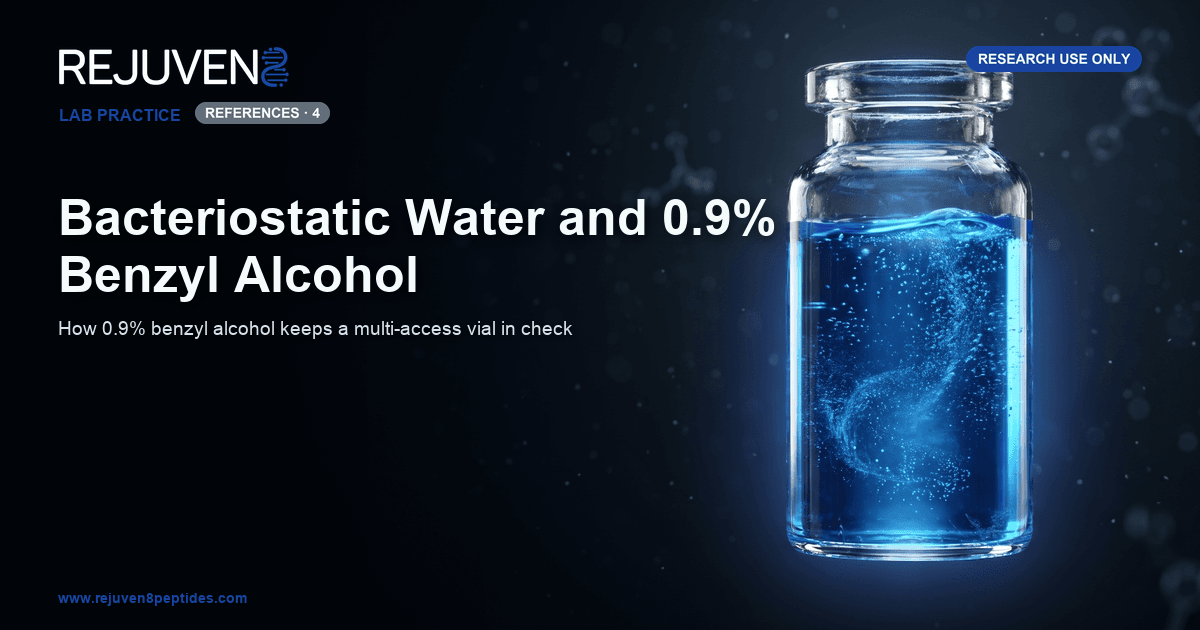
Bacteriostatic water is one of the most common reagents on a peptide research bench, and the single ingredient that separates it from plain sterile water is benzyl alcohol at a concentration of 0.9% (9 mg per mL). That addition is what allows a sealed vial to be punctured repeatedly over several weeks while remaining suitable for reconstituting lyophilized research peptides. The word bacteriostatic describes the intended action precisely: the preservative holds bacterial growth in check rather than sterilizing the solution outright.
This article examines the chemistry of benzyl alcohol, the membrane-level mechanism by which it suppresses microbial growth, the reasoning behind the 0.9% figure, and how the preservative interacts with peptides in solution. The material discussed here is for research use only, not for human consumption.
What Benzyl Alcohol Is
A Small Aromatic Alcohol
Benzyl alcohol (C6H5CH2OH, also called phenylmethanol) is the simplest aromatic alcohol: a benzene ring carrying a single hydroxymethyl group. Its amphiphilic structure is central to its preservative behavior. The benzene ring is lipophilic and partitions readily into cell membranes, while the hydroxyl group keeps the molecule modestly water soluble, with roughly 4 g dissolving in 100 mL of water. The 0.9% used in bacteriostatic water sits well below that ceiling, so the preservative stays fully dissolved even when refrigerated. Because the concentration is expressed as weight per volume, a 10 mL vial of Bacteriostatic Water 10mL holds about 90 mg of benzyl alcohol and a 30 mL format such as eBac Bacteriostatic Water 30mL about 270 mg, while every milliliter drawn from either carries the same 9 mg into the peptide vial it reconstitutes.
The values below reflect commonly reported laboratory attributes and are provided for comparison only.
| Attribute | Reported Value |
|---|---|
| Chemical name | Benzyl alcohol (phenylmethanol) |
| Class | Aromatic primary alcohol; antimicrobial preservative and cosolvent |
| Molecular formula | C7H8O |
| Approximate molecular weight | 108.1 g/mol |
| Water solubility | About 4 g per 100 mL at 20 C (roughly 4% w/v) |
| Concentration in bacteriostatic water | 0.9% w/v (9 mg/mL) |
| Octanol-water partition (log P) | About 1.1 |
How a Bacteriostatic Preservative Works
A bactericidal agent kills organisms within a defined contact period. A bacteriostatic agent suppresses growth and division so that a few contaminating cells cannot expand into a colony. Benzyl alcohol at 0.9% acts in the second way, and the mechanism is physical as much as chemical.
Membrane Partitioning and Disordered Lipid Packing
Benzyl alcohol is classified as a membrane-active preservative. Its lipophilic ring inserts between the fatty acid chains of the bacterial cytoplasmic membrane, increasing membrane fluidity and disordering the tightly packed bilayer; biophysicists have long used it as a reference membrane fluidizer in model systems. Inside a bacterium the disorder has consequences: the membrane leaks ions and small metabolites, the proton gradient that powers ATP synthesis becomes harder to maintain, and membrane-bound enzymes lose the ordered lipid environment they depend on. At higher concentrations the molecule also denatures proteins, but at 0.9% the membrane effect is the dominant mechanism described in the excipient literature.
Why Growth Suppression Is the Design Goal
Given days of contact, benzyl alcohol does reduce viable counts, which is why effectiveness testing follows log reductions over weeks rather than minutes. The design intent, however, is containment of the small, incidental contamination that repeated septum punctures can introduce, not sterilization of a solution that was contaminated to begin with. A cloudy vial should be discarded rather than trusted to the preservative; the bacteriostatic water reconstitution guide covers septum hygiene and withdrawal technique.
Spectrum
Benzyl alcohol is most reliably active against Gram-positive bacteria, moderately active against Gram-negative organisms, and only modestly active against yeasts and molds, with greater activity reported in mildly acidic solutions such as unbuffered bacteriostatic water.
Why the Concentration Is 0.9 Percent
Several constraints converge on the same number. The first is an efficacy floor. Antimicrobial effectiveness testing challenges a preserved solution with standardized inocula of Staphylococcus aureus, Escherichia coli, Pseudomonas aeruginosa, Candida albicans, and Aspergillus brasiliensis, then follows viable counts at 7, 14, and 28 days. For the most stringent class of aqueous preparations, bacterial counts must fall by at least 1.0 log at day 7 and 3.0 log at day 14 with no increase through day 28, while yeasts and molds must show no increase at any interval. Benzyl alcohol at 0.9% in an unbuffered aqueous vehicle meets those criteria; lower concentrations lose their margin against Gram-negative organisms such as Pseudomonas.
The second constraint is solubility: at roughly a quarter of saturation, 0.9% remains a true solution even when cold. The third is vehicle neutrality, since at this level the solvent’s viscosity, density, and pH stay close to those of plain water. Finally, the figure carries decades of pharmacopeial precedent. The table below compares common aqueous vehicles; these values reflect commonly reported laboratory attributes and are provided for comparison only.
| Vehicle | Preservative | Tonicity | Access Pattern |
|---|---|---|---|
| Sterile water | None | Hypotonic | Single access; remainder discarded |
| Bacteriostatic water | 0.9% benzyl alcohol | Hypotonic | Multiple withdrawals, commonly up to 28 days after first puncture |
| Bacteriostatic 0.9% sodium chloride | 0.9% benzyl alcohol | Isotonic | Multiple withdrawals, commonly up to 28 days after first puncture |
Benzyl Alcohol, Peptide Stability, and Storage
Interactions With Peptides and Proteins
Formulation scientists have long studied how benzyl alcohol affects proteins, because the preservative shares the solution with the molecule of interest. For several larger proteins, including recombinant interferon alpha-2a and interleukin-1 receptor antagonist, benzyl alcohol has been reported to promote partial unfolding and aggregation, and a 2025 study reported that it worsened freeze-thaw-induced aggregation of a monoclonal antibody. Other work has described preservative-induced self-association of small peptides that reverses on dilution. The effect is molecule-specific and concentration-dependent.
Short synthetic research peptides of roughly 3 to 50 residues lack the folded tertiary structure these pathways exploit and are routinely reconstituted in bacteriostatic water, but the record is a reminder that the preservative is not inert toward the solute, and groups working with aggregation-prone sequences may prefer sterile water for single-use experiments. The peptide solubility and reconstitution chemistry article discusses solvent selection in more depth.
Oxidation of the Preservative Itself
Benzyl alcohol slowly oxidizes in air and light to benzaldehyde, which in turn oxidizes to benzoic acid. Analytical laboratories quantify benzaldehyde by HPLC-UV as a degradation marker in preserved solutions. Oxidation is slow in a sealed, refrigerated, light-protected vial, but every puncture admits fresh oxygen into the headspace, which is one reason a 28-day working life after first puncture is the common laboratory convention. Storing the vial in its carton at 2 to 8 C and wiping the septum before each withdrawal limit both microbial and chemical drift.
A Worked Reconstitution Example
Reconstituting a 10 mg vial of a lyophilized research peptide with 2 mL of bacteriostatic water yields a peptide concentration of 5 mg/mL (10 mg divided by 2 mL). The same 2 mL carries 18 mg of benzyl alcohol (2 mL multiplied by 9 mg/mL), so the finished solution contains 0.9% benzyl alcohol alongside the peptide. Using 1 mL or 4 mL instead gives 10 or 2.5 mg/mL of peptide while the benzyl alcohol content stays fixed at 9 mg per mL. Reconstituted solutions are generally refrigerated, protected from light, and aliquoted when a study spans weeks; the peptide storage and handling guide expands on these conditions.
In summary, 0.9% benzyl alcohol is what turns sterile water into a bacteriostatic solvent suitable for repeated access, and its membrane mechanism and slow oxidation explain why the reagent is refrigerated, light-protected, and retired after about four weeks. Researchers sourcing preserved water alongside research peptides should confirm that each lot ships with sterility documentation; the guide to reading a certificate of analysis explains how to interpret those records.
Frequently Asked Questions
What does bacteriostatic mean?
Bacteriostatic describes an agent that suppresses bacterial growth and reproduction without necessarily killing the organisms outright. In bacteriostatic water, 0.9% benzyl alcohol disrupts bacterial membranes enough to keep incidental contaminants from multiplying between withdrawals.
Why does bacteriostatic water contain exactly 0.9% benzyl alcohol?
The 0.9% (9 mg/mL) figure meets antimicrobial effectiveness criteria against standard bacterial and fungal challenge organisms over 28 days, sits well below benzyl alcohol’s solubility limit of about 4%, leaves the vehicle close to plain water in pH and viscosity, and carries decades of pharmacopeial precedent.
Is “bacterial static water” the same thing as bacteriostatic water?
Yes. “Bacterial static water” is a common misspelling of bacteriostatic water that appears in searches. Both refer to sterile water preserved with 0.9% benzyl alcohol; the correct term derives from the Greek stasis, a standstill, because the preservative halts bacterial growth.
Does benzyl alcohol affect peptide stability?
It can, depending on the molecule. Formulation studies have reported that benzyl alcohol promotes aggregation of some larger proteins and reversible self-association of certain peptides. Short research peptides are routinely reconstituted in bacteriostatic water, but aggregation-prone sequences may suit sterile water for single-use work.
How long can a vial of bacteriostatic water be kept after the first puncture?
A working life of about 28 days after first puncture is the common laboratory convention, provided the vial is kept at 2 to 8 C, protected from light, and accessed with aseptic technique. Each puncture admits oxygen that slowly oxidizes the preservative and adds to the contamination load it must contain.
What is the difference between bacteriostatic water and sterile water?
Sterile water contains no preservative and is intended for a single access. Bacteriostatic water is sterile water to which 0.9% benzyl alcohol has been added so the container can be entered multiple times. Both are hypotonic and contain no sodium chloride.
References and Further Reading
- Excipient literature on benzyl alcohol as an antimicrobial preservative, including spectrum and pH dependence. PubMed: benzyl alcohol antimicrobial preservative
- Biophysical studies of benzyl alcohol as a membrane fluidizer. PubMed: benzyl alcohol membrane fluidity
- Formulation research on benzyl alcohol-induced aggregation and self-association of proteins and peptides, including a 2025 monoclonal antibody freeze-thaw study. PubMed: benzyl alcohol protein aggregation
- Analytical work on oxidation of benzyl alcohol to benzaldehyde and benzoic acid in preserved solutions. PubMed: benzyl alcohol benzaldehyde degradation