Research Use Only. The information presented here is for scientific and educational purposes. These compounds are not intended for human consumption, self-administration, or therapeutic use.
Introduction
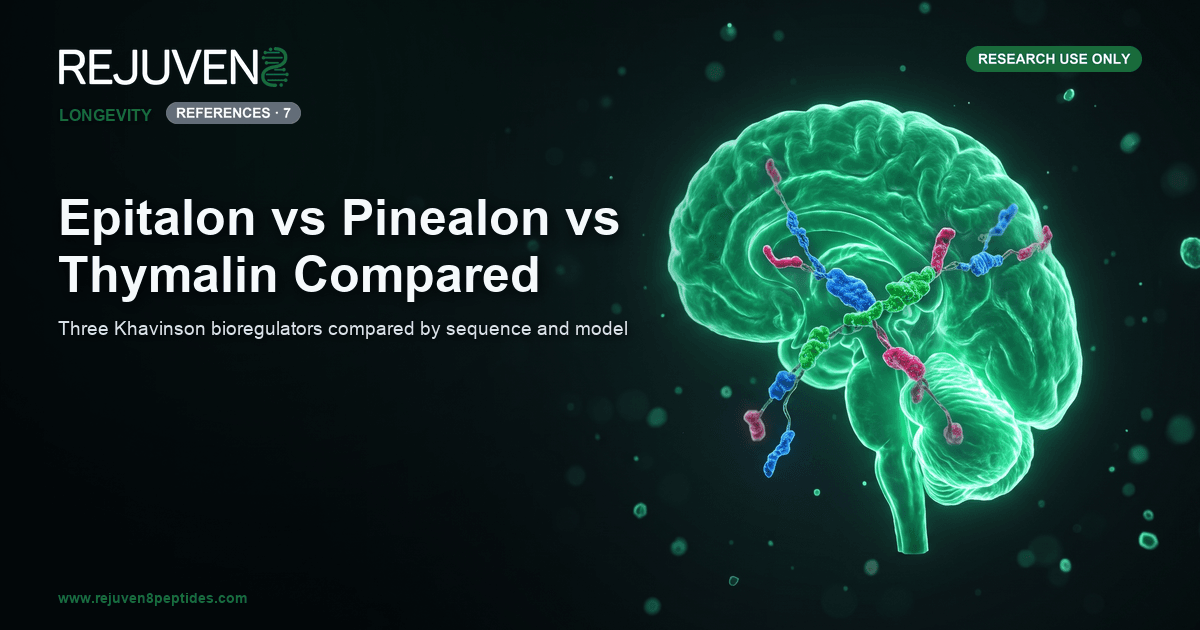
Epitalon, Pinealon, and Thymalin are three of the most frequently referenced compounds in the peptide bioregulator literature, a body of work built over several decades at the St. Petersburg Institute of Bioregulation and Gerontology under Vladimir Khavinson. They are often grouped together as interchangeable examples of one idea, which obscures how different they are. Two are defined synthetic sequences of four and three residues; the third is not a single molecule at all, but a fractionated polypeptide preparation from thymus tissue.
This comparison separates them by molecular identity, by the tissue system each is associated with, and by the preclinical models in which each has been studied. All three are laboratory materials, supplied for research use only, not for human consumption, and every observation summarized below comes from cell culture or animal experiments rather than from any human outcome.
What Are Khavinson Peptides?
The bioregulator concept began with tissue extracts. Preparations were made from thymus, pineal, and other organs, and fractions with apparent activity were narrowed to short peptide sequences that could be synthesized directly. The resulting compounds are commonly called cytogens when they are defined synthetic sequences, and cytomedins when they remain complex preparations from tissue.
The proposed mechanism sets this family apart from peptide hormones. Rather than binding a cell-surface receptor and initiating a second-messenger cascade, ultrashort peptides are hypothesized to cross the plasma and nuclear membranes, reach chromatin, and interact with specific promoter sequences to influence transcription. Computational docking studies have proposed binding sites in the promoters of genes including CASP3, SOD2, GPX1, APOE, and GAP43, and cell-culture work has examined downstream signaling such as the ERK1/2 pathway under oxidative stress. This model remains a hypothesis, not an established mechanism, and it is described further in the research peptide catalog listings for this class.
Epitalon: The Pineal Tetrapeptide
Epitalon (also written epithalon or epithalamin-derived) is a synthetic tetrapeptide with the sequence Ala-Glu-Asp-Gly, molecular formula C14H22N4O9, and a molecular weight near 390 Da. It was developed as a defined synthetic counterpart to epithalamin, a pineal extract, which is why the literature associates it with pineal and neuroendocrine biology.
Epitalon draws most of the attention this family receives, largely because of the endpoints it has been studied against: telomerase activity and telomere length in cell culture, melatonin-related and circadian signaling, and gene expression in aging cell and rodent models. Anisimov and Khavinson published animal lifespan and tumor-incidence work that established the geroprotector framing applied to the class. It is the compound most often used as the reference point when a new short peptide is characterized, and Rejuven8 lists it as a standalone research item, Epitalon, in 50 mg lyophilized vials.
Pinealon: The Neural Tripeptide
Pinealon is the tripeptide Glu-Asp-Arg, abbreviated EDR, with a molecular weight near 418 Da. Despite the name, its research profile is neural rather than pineal in emphasis: the published work concentrates on neuronal cell cultures and rodent central nervous system models rather than on melatonin biology.
The reported experiments are relatively specific. Khavinson and colleagues examined reactive oxygen species and cell viability in cerebellar granule cells and PC12 cultures. Arutjunyan and colleagues studied oxidative stress endpoints in rat offspring from hyperhomocysteinaemic dams. Mendzheritskii and colleagues used 18-month-old rats under acute hypoxia, reporting changes in cytokine profiles and caspase-3. Kraskovskaya and colleagues examined dendritic spine density in neuronal cultures and, later, in induced neurons derived from elderly donor fibroblasts, alongside markers of oxidative DNA damage. Where telomere endpoints have been measured, effects attributed to Pinealon are described as more modest than those reported for Epitalon, one reason the two are studied as complements rather than substitutes.
Thymalin: A Polypeptide Complex, Not a Single Sequence
Thymalin is categorically different from the other two. It is a cytomedin: a fractionated preparation obtained from thymus tissue, typically of calf or bovine origin, consisting of multiple low-molecular-weight polypeptide components rather than one defined sequence. Components cited in the literature fall below roughly 10 kDa, and reviews have identified short peptides within the fraction including the dipeptides Glu-Trp (thymogen) and Lys-Glu (Vilon) and the tripeptide Glu-Asp-Pro.
Its research context is thymic and immune rather than neural. Khavinson, Linkova, Chalisova, and Ivko reviewed the molecular aspects of its activity in Biology Bulletin Reviews in 2021, describing the constituent peptides as influencing gene expression associated with heat-shock proteins, cytokines, and cell differentiation, proliferation, and apoptosis. Because Thymalin is a mixture, no single molecular weight or sequence can be stated for it, with direct consequences for laboratory work: identity cannot be confirmed by a single expected mass, and lot-to-lot consistency becomes a more prominent variable than for a synthetic tetrapeptide.
Epitalon vs Pinealon vs Thymalin Compared
The values below reflect commonly reported laboratory attributes and are provided for comparison only.
| Attribute | Epitalon | Pinealon | Thymalin |
|---|---|---|---|
| Class | Synthetic tetrapeptide (cytogen) | Synthetic tripeptide (cytogen) | Polypeptide complex (cytomedin) |
| Sequence | Ala-Glu-Asp-Gly | Glu-Asp-Arg (EDR) | No single sequence |
| Sequence length | 4 amino acids | 3 amino acids | Mixed fractions |
| Approximate molecular weight | About 390 Da | About 418 Da | Multiple fractions, components commonly below about 10 kDa |
| Molecular formula | C14H22N4O9 | Not consistently reported | Not applicable (mixture) |
| Tissue association | Pineal | Neural (brain) | Thymus |
| Source | Chemically synthesized | Chemically synthesized | Fractionated from thymus tissue |
| Principal studied endpoints | Telomerase and telomere length, circadian and melatonin-related signaling, gene expression in aging models | Oxidative stress in neuronal cultures, dendritic spine density, cytokine and caspase-3 markers in aged rodents | Gene expression tied to cytokines, heat-shock proteins, and cell differentiation in immune models |
| Identity verification | Mass spectrometry against a single expected mass | Mass spectrometry against a single expected mass | Fraction profiling; no single expected mass |
Read as a group, the table makes the practical distinction clear. Epitalon and Pinealon are defined molecules that can be verified, weighed, and dissolved to an exact concentration. Thymalin is a preparation, and any experiment using it inherits the compositional variability of the fraction rather than the precision of a synthetic sequence.
Selecting Among Them and Handling in the Laboratory
Selection follows the tissue system under investigation rather than any ranking. Neuronal culture and central nervous system models point to Pinealon; pineal, circadian, and telomere-related endpoints point to Epitalon; thymic and immune-model work points to Thymalin, with the understanding that a mixture behaves as a mixture. A study comparing two of them holds everything else constant, which for compounds of such different mass means matching molar rather than mass concentration.
All three arrive lyophilized and are stored frozen until reconstitution, then held refrigerated in single-use aliquots to limit freeze-thaw cycling; the storage and handling guide covers the temperature detail, and the reconstitution guide covers diluent volume and concentration math. Very short peptides dissolve readily in aqueous diluent, a point developed in the reconstitution chemistry guide. Documentation matters most for the tissue-derived preparation: a synthetic tripeptide or tetrapeptide is confirmed against one expected mass, a complex fraction cannot be, so a lot-specific certificate of analysis and the interpretation skills covered in the COA guide carry more weight there. Whether a study centers on Pinealon, Epitalon, or Thymalin, all three remain research use only, not for human consumption, and are handled strictly within controlled laboratory settings.
Frequently Asked Questions
What is Pinealon?
Pinealon is a synthetic tripeptide with the sequence Glu-Asp-Arg (EDR) and a molecular weight near 418 Da, developed within the Khavinson peptide bioregulator program. Despite its name, its published research profile is largely neural, concentrating on neuronal cell cultures and rodent central nervous system models rather than on pineal hormone biology.
What is the difference between Epitalon and Pinealon?
Epitalon is a tetrapeptide, Ala-Glu-Asp-Gly, near 390 Da, associated with pineal biology and studied against telomerase, telomere length, and circadian endpoints. Pinealon is a tripeptide, Glu-Asp-Arg, near 418 Da, studied mainly in neuronal cultures and aged rodent models for oxidative stress and dendritic spine endpoints. Where telomere measures have been compared, effects reported for Pinealon are the more modest of the two.
Is Thymalin a single peptide?
No. Thymalin is a fractionated polypeptide preparation from thymus tissue, consisting of multiple low-molecular-weight components rather than one defined sequence. Reviews have identified short peptides within the fraction, including the dipeptides Glu-Trp and Lys-Glu and the tripeptide Glu-Asp-Pro, but the preparation as a whole has no single molecular weight.
What are Khavinson peptides?
Khavinson peptides, also called peptide bioregulators, are short peptides and tissue-derived peptide fractions studied at the St. Petersburg Institute of Bioregulation and Gerontology. Defined synthetic sequences in the family are termed cytogens and complex tissue preparations are termed cytomedins. The proposed mechanism involves interaction with gene promoter regions rather than cell-surface receptor binding.
How do these three compounds differ in laboratory verification?
Epitalon and Pinealon are synthetic sequences whose identity can be confirmed by mass spectrometry against a single expected mass, near 390 Da and 418 Da respectively, with purity assessed by HPLC. Thymalin is a mixture, so no single expected mass applies and lot-to-lot compositional consistency becomes the more important documentation question.
Are Epitalon, Pinealon, and Thymalin intended for human use?
No. All three are laboratory research materials supplied for research use only, not for human consumption or self-administration. The published record for each consists of in vitro and animal-model studies.
References and Further Reading
- Khavinson V and colleagues on the short peptide bioregulator concept and proposed peptide-DNA interaction at gene promoter regions. PubMed: Khavinson short peptides gene expression bioregulator
- Anisimov VN and Khavinson V on peptide bioregulators as geroprotectors in animal lifespan and tumor-incidence studies. PubMed: Anisimov Khavinson peptide bioregulators geroprotector
- Studies of Epitalon (Ala-Glu-Asp-Gly) and telomerase activity, telomere length, and gene expression in cell and rodent models. PubMed: epitalon epithalon telomerase telomere
- Khavinson V and colleagues on the EDR tripeptide (Pinealon), reactive oxygen species, and cell viability in cerebellar granule and PC12 cultures. PubMed: EDR peptide Pinealon neuroprotection oxidative stress
- Kraskovskaya N and colleagues on dendritic spine density and neuronal morphology in cultures exposed to the EDR tripeptide. PubMed: Kraskovskaya EDR peptide dendritic spines neurons
- Khavinson V, Linkova N, Chalisova N and Ivko O on Thymalin and molecular aspects of its biological activity, Biology Bulletin Reviews (2021). PubMed: Thymalin immunocorrection molecular biological activity
- Comparative work on thymus-derived peptide preparations and defined thymic peptides in immune model systems. PubMed: thymic peptide preparation thymalin thymogen immune models