Research Use Only. The information presented here is for scientific and educational purposes. These compounds are not intended for human consumption, self-administration, or therapeutic use.
Introduction
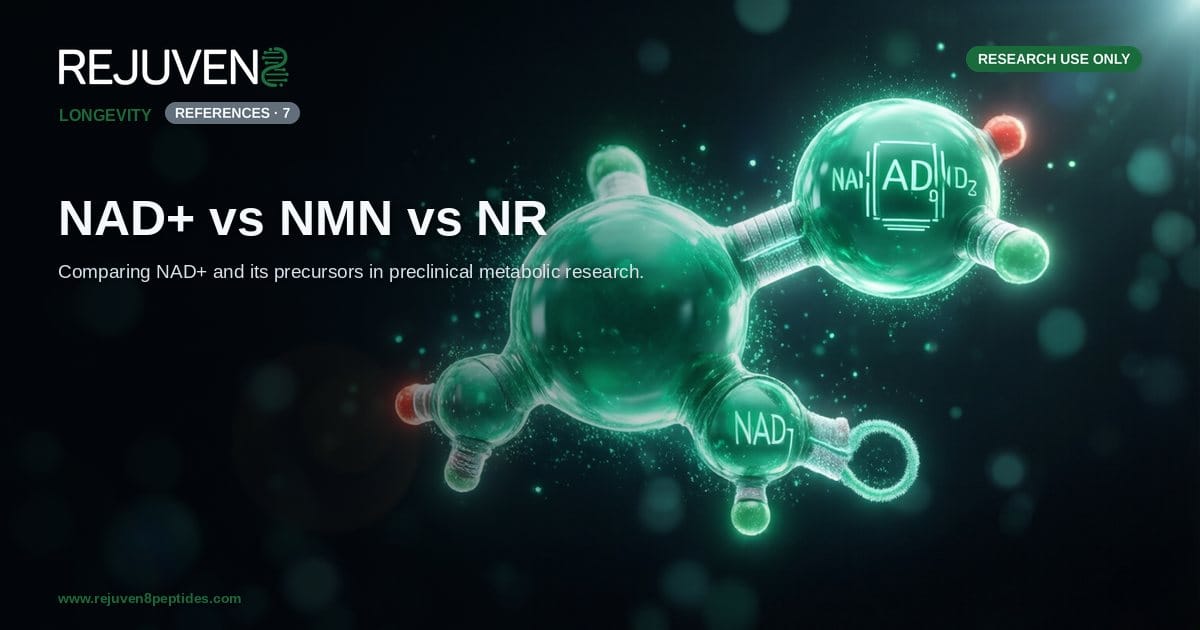
Nicotinamide adenine dinucleotide (NAD+) is one of the most extensively studied coenzymes in cellular biology, acting as a central carrier of electrons in redox reactions and as a required substrate for several families of signaling enzymes. Because intracellular NAD+ pools are dynamic and have been reported to shift across preclinical aging models, considerable research attention has turned toward the molecules that feed NAD+ biosynthesis. Two of these, nicotinamide mononucleotide (NMN) and nicotinamide riboside (NR), sit directly on the salvage pathway that regenerates NAD+ from its breakdown products.
This article compares NAD+ and its two most-studied precursors as research materials, outlining their molecular identities, the enzymatic steps that connect them, and the experimental contexts in which each is investigated. The framing throughout is strictly preclinical: the discussion concerns what these compounds are studied for in vitro and in animal models, not any human application. All three are offered for research use only, not for human consumption, and the NAD+ research material referenced here is one example of how such compounds are cataloged for laboratory work.
The NAD+ Metabolome and the Salvage Pathway
NAD+ does not exist in isolation. It sits at the center of a network of biosynthetic and consuming reactions collectively described as the NAD+ metabolome. Understanding where NMN and NR fit requires a brief look at how cells maintain their NAD+ supply and why depletion draws so much research interest.
NAD+-consuming enzymes
Several enzyme families cleave NAD+ as part of their catalytic cycle rather than simply shuttling electrons. The sirtuins (SIRT1 through SIRT7) are NAD+-dependent deacylases studied in connection with mitochondrial biogenesis, transcriptional regulation, and the PGC-1alpha axis. PARPs (poly ADP-ribose polymerases) consume NAD+ during DNA-damage signaling, and the glycohydrolase CD38 degrades both NAD+ and NMN. Because these enzymes continually draw down the NAD+ pool, cells rely on salvage synthesis to replenish it.
The salvage route
In the salvage pathway, nicotinamide released by NAD+-consuming enzymes is recycled back into the pool. NAMPT (nicotinamide phosphoribosyltransferase) is the rate-limiting enzyme that converts nicotinamide to NMN, while NMNAT (nicotinamide mononucleotide adenylyltransferase) enzymes attach an adenylyl group to NMN to form NAD+. NR enters this route one step earlier, phosphorylated to NMN by nicotinamide riboside kinases (NRK1 and NRK2). This ordering, NR to NMN to NAD+, is the reason the three compounds are so frequently discussed together in the literature.
Molecular Identity: NAD+, NMN, and NR Compared
Although the three molecules share the nicotinamide moiety, they differ substantially in size, class, and position within the biosynthetic sequence. The values below reflect commonly reported laboratory attributes and are provided for comparison only.
| Attribute | NAD+ | NMN | NR |
|---|---|---|---|
| Full name | Nicotinamide adenine dinucleotide | Nicotinamide mononucleotide | Nicotinamide riboside |
| Molecular class | Dinucleotide coenzyme | Mononucleotide | Pyridine nucleoside (vitamin B3 derivative) |
| Approx. molecular weight | 663.4 g/mol | 334.2 g/mol | 255.2 g/mol (free base) |
| Phosphate groups | Two | One | None |
| Position in pathway | Terminal cofactor | Direct precursor | Upstream precursor |
| Associated enzyme | Consumed by sirtuins, PARPs, CD38 | Converted by NMNAT | Converted by NRK1 / NRK2 |
The descending molecular weight from NAD+ to NR mirrors the pathway itself: moving upstream, the molecule sheds the adenylyl group and then a phosphate, leaving NR as the smallest and structurally simplest of the three. These differences in charge and size have direct consequences for how each compound is handled and how readily it is thought to enter cells, which is a recurring theme in comparative NAD+ research.
How the Precursors Differ in Research
Cellular uptake
A persistent question in NAD+ research concerns how each molecule crosses the cell membrane. NR is generally described as entering cells through nucleoside transporters before intracellular phosphorylation. For NMN, a dedicated transporter (Slc12a8) has been reported in certain mouse tissues, although the extent to which NMN is first dephosphorylated to NR before uptake remains an active area of investigation. NAD+ itself is a large, charged molecule, so its direct movement across intact membranes is more limited, and much NAD+ research therefore focuses on precursor delivery as the practical route to raising intracellular levels.
Stability and handling
As research materials, these compounds are typically supplied as lyophilized powders. NAD+ and its precursors are hygroscopic and sensitive to heat and repeated freeze-thaw cycles, so laboratories generally store them cold, sealed against moisture, and reconstitute only the quantity a protocol requires. General guidance on preparing solutions is covered in the bacteriostatic water reconstitution guide, and reported purity should always be checked against the batch certificate of analysis before any experimental use.
Study endpoints
Across the preclinical literature, NAD+ precursors are examined as tools for elevating intracellular NAD+ in cell and animal models, with common readouts including sirtuin activity, mitochondrial function markers, and direct tissue NAD+ quantification. Comparisons between NMN and NR frequently center on which precursor most efficiently raises NAD+ in a given tissue, a result that varies with cell type, transporter expression, and overall experimental design rather than resolving to a single winner.
NAD+ in the Broader Longevity Research Toolkit
NAD+ biology intersects with several other compound classes examined in mitochondrial and metabolic research. Mitochondrial-targeted peptides such as MOTS-c and SS-31 are studied alongside NAD+ pathways for their roles in cellular energetics, while glutathione is investigated as a redox cofactor. Researchers assembling a longevity-focused panel often catalog these materials together, and the recovery and tissue-repair overview outlines how related compounds are grouped for comparison.
For NAD+ specifically, verified sourcing matters as much as the molecule itself. Because precursor identity and purity directly shape experimental reproducibility, batch certificates and careful supplier vetting are standard parts of any serious research workflow. The full catalog of comparable compounds is available in the research peptide shop.
Frequently Asked Questions
What is the difference between NAD+, NMN, and NR?
NAD+ is the active coenzyme, while NMN and NR are precursors that cells convert into NAD+ through the salvage pathway. NR is phosphorylated to NMN by nicotinamide riboside kinases, and NMN is then adenylylated to NAD+ by NMNAT enzymes. In short, NR and NMN are studied as upstream inputs to the same NAD+ pool.
Is NMN or NR the better NAD+ precursor in research?
Preclinical studies do not point to a single answer, because the more efficient precursor depends on cell type, tissue, and experimental design. Comparisons typically measure how much each raises NAD+ in a specific model rather than declaring one universally superior.
Why do NAD+ levels change in aging research models?
Reported declines in NAD+ within aging models are commonly attributed to increased consumption by enzymes such as CD38 and PARPs alongside altered salvage-pathway activity. This observation is one reason precursor delivery is a frequent focus of laboratory investigation.
How do the molecular weights of NAD+, NMN, and NR compare?
NAD+ has an approximate molecular weight of 663.4 g/mol, NMN about 334.2 g/mol, and NR roughly 255.2 g/mol as the free base. The differences reflect the loss of the adenylyl and phosphate groups as you move upstream in the pathway.
How are NAD+ and its precursors stored in a laboratory?
These materials are typically supplied as lyophilized powder and are hygroscopic and heat-sensitive, so they are generally kept cold, sealed against moisture, and protected from repeated freeze-thaw cycles. Solutions are usually prepared only as a protocol requires.
Can NAD+ be studied directly instead of through a precursor?
NAD+ can be used directly in research, but its large, charged structure limits how readily it crosses cell membranes. For that reason many cell and animal studies favor precursors such as NMN and NR to raise intracellular NAD+.
References and Further Reading
- Overviews of NAD+ metabolism and its reported shifts in preclinical aging models. PubMed: NAD+ metabolism aging
- Imai and colleagues on nicotinamide mononucleotide biology and NAD+ biosynthesis. PubMed: nicotinamide mononucleotide NAD
- Brenner and colleagues on nicotinamide riboside as an NAD+ precursor via the NRK pathway. PubMed: nicotinamide riboside NAD precursor
- Literature on sirtuins as NAD+-dependent deacylases. PubMed: sirtuin NAD-dependent deacetylase
- Studies of the NAMPT-driven salvage pathway. PubMed: NAMPT NAD salvage pathway
- Reports on the Slc12a8 NMN transporter in mouse tissue. PubMed: Slc12a8 NMN transporter
- Research on NAD+ precursors and mitochondrial function. PubMed: NAD precursor mitochondrial function