Research Use Only. The information presented here is for scientific and educational purposes. These compounds are not intended for human consumption, self-administration, or therapeutic use.
Introduction
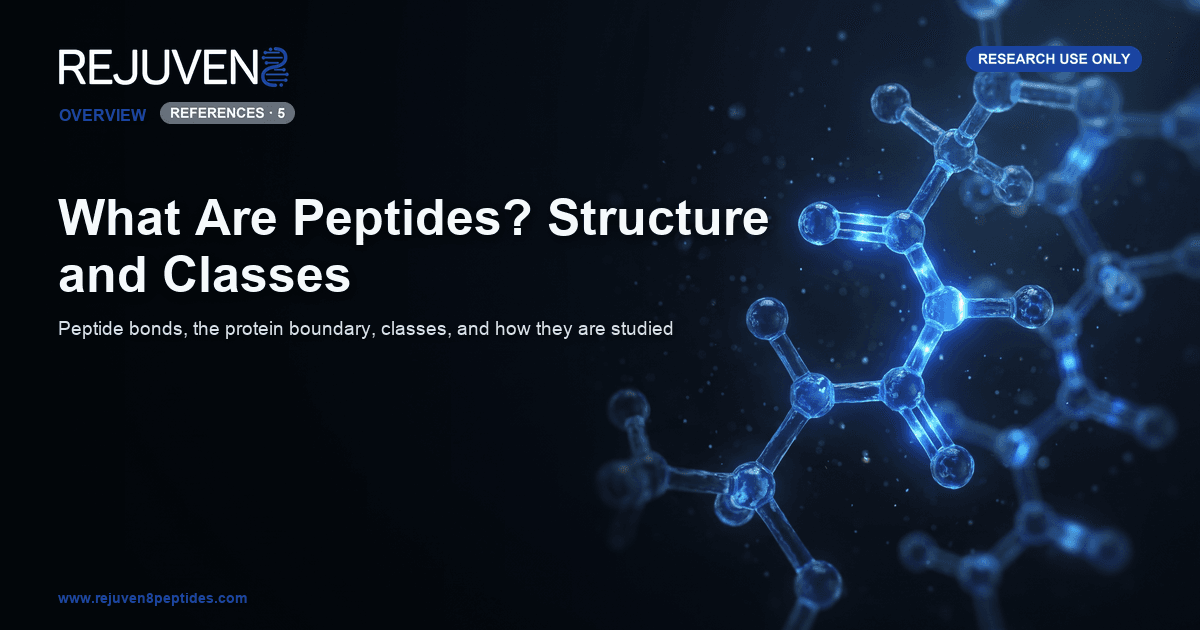
The direct answer to what are peptides is a chemical one: a peptide is a chain of amino acids joined by peptide bonds, the amide linkage formed when the carboxyl group of one amino acid condenses with the amine group of the next, releasing water. The word describes a class of molecule and a type of bond. It says nothing on its own about what a given sequence does, because the behavior of a peptide depends entirely on which amino acids appear, in what order, and what shape the resulting chain adopts.
That definition sets up everything else. This overview covers how peptides are structured and named, where the boundary with proteins lies, the major functional classes researchers work with, how peptides act at the cellular level, and the chemistry used to make and characterize them in the laboratory. Compounds referenced here are laboratory materials supplied for research use only, not for human consumption, and nothing below describes use in people.
What Are Peptides Made Of? Structure and the Protein Boundary
The Peptide Bond and Chain Directionality
Every amino acid has an amine end, a carboxyl end, and a side chain that distinguishes it from the other nineteen standard residues. Linking them produces a backbone of repeating N-C-C units with side chains projecting outward. The peptide bond has partial double-bond character, which makes it planar and rigid and restricts rotation to the two bonds flanking each alpha carbon. That constraint is the reason peptide chains fold into a limited set of local shapes, such as helices and turns, rather than into arbitrary geometries.
A chain has direction. By convention a sequence is written from the free amine end (the N-terminus) to the free carboxyl end (the C-terminus), so Gly-Glu-Pro and Pro-Glu-Gly are different molecules. Residue numbering follows the same direction, which is why fragment names identify a span of the parent sequence.
Where Peptides End and Proteins Begin
There is no sharp dividing line. A common working convention counts chains of roughly 2 to 50 amino acids as peptides and longer chains as proteins, but the boundary is contextual rather than formal, and IUPAC nomenclature defines peptides by their amide linkage rather than by a residue count. Size does track with behavior: short chains often remain flexible in solution, while longer ones fold into stable tertiary structures with defined interior cores. The values below reflect commonly reported laboratory attributes and are provided for comparison only.
| Term | Typical Length | Structural Character | Research Example |
|---|---|---|---|
| Dipeptide or tripeptide | 2 to 3 residues | Minimal structure; chemistry driven by side chains | Glutathione (gamma-Glu-Cys-Gly) |
| Oligopeptide | ~4 to 20 residues | Flexible; may adopt transient helices or turns | BPC-157 (15 residues) |
| Polypeptide | ~20 to 50 residues | Recognizable secondary structure | Thymosin beta-4 (~43 residues) |
| Protein | >50 residues (contextual) | Folded tertiary structure, often multi-domain | Insulin precursor, antibodies |
The molar mass follows directly from the sequence, since each residue contributes its own mass minus the water lost at each bond. The peptide molecular weight reference works through that calculation, and the nomenclature guide covers how sequences, fragments, and analogs are written.
Functional Classes of Research Peptides
Because the category is defined by chemistry rather than by function, researchers organize peptides by the biology they engage. Four broad groupings account for most laboratory work.
Signaling and Hormone-Derived Peptides
Many endogenous signaling molecules are peptides: insulin, oxytocin, amylin, and the incretins among them. Research analogs in this group are built to engage a defined receptor, most often a G protein-coupled receptor (GPCR), and are characterized by binding affinity, potency at a signaling readout, and selectivity across the receptor family. Structural work in this area is dense, and cryo-electron microscopy structures of class B GPCRs bound to their peptide ligands have made the binding mode of this family unusually well described.
Regenerative and Matrix-Associated Peptides
A second group is studied in tissue-repair models: fragments and analogs associated with angiogenesis, extracellular matrix remodeling, and cell migration. The copper-binding tripeptide GHK-Cu, the thymosin beta-4 derivative TB-500, and the pentadecapeptide BPC-157 belong here, and the recovery and tissue-repair overview compares their studied mechanisms.
Antimicrobial and Host-Defense Peptides
Antimicrobial peptides are short, usually cationic and amphipathic sequences found across nearly all organisms. Their mechanisms differ fundamentally from receptor agonism: many act physically, partitioning into and permeabilizing microbial membranes, while others reach intracellular targets. This remains a largely preclinical field, with much recent effort directed at stability and at reducing activity against host cells.
Intracellular and Mitochondrial-Derived Peptides
A newer category comprises short peptides encoded within mitochondrial or previously overlooked open reading frames, such as MOTS-c and humanin, studied for metabolic stress signaling rather than surface-receptor binding. Their targets are intracellular, which raises questions about membrane crossing that receptor-targeted peptides never face.
How Peptides Are Studied in the Laboratory
Synthesis
Nearly all research peptides are made by solid-phase peptide synthesis (SPPS), the method introduced by Bruce Merrifield in the 1960s. The C-terminal residue is anchored to a resin bead, and the chain is extended one residue at a time through cycles of deprotection and coupling, with protecting groups masking reactive side chains until the end. Because each cycle is imperfect, longer sequences accumulate deletion by-products, which is why purity falls as length rises and why chromatographic purification is standard. Method development continues: 2026 reports describe greener coupling reagents, alternative solvent systems, and elevated-temperature procedures that shorten cycle times and cut waste.
Modification and Stabilization
Unmodified linear peptides are cleaved quickly by peptidases. Medicinal chemistry answers this with a well-established toolkit: cyclization and macrocyclization to lock a conformation, D-amino acid substitution and N-methylation to resist proteolysis, lipidation with a fatty acid or fatty diacid to promote albumin binding, and PEGylation to increase hydrodynamic size. Lactam stapling, which bridges two side chains to enforce a helix, is an active area in 2026 literature. Each modification changes molecular weight and physical behavior, which is why an analog’s mass rarely matches the sum of its natural residues.
Identity, Purity, and Handling
Two analytical methods dominate characterization. Reversed-phase HPLC separates the target from related impurities and reports purity as a percentage of peak area, while mass spectrometry confirms identity by matching the measured mass to the mass calculated from the sequence. Together they answer the two questions that matter: is this the right molecule, and how much else is in the vial. The guide to reading a peptide certificate of analysis explains how those numbers are presented, and published certificates of analysis show what lot-level documentation looks like in practice. Physical handling follows from chemistry: lyophilized material is stored cold and dry, solutions are prepared as described in the reconstitution chemistry reference, and repeated freeze-thaw cycles are avoided because oxidation, deamidation, and aggregation all proceed faster in solution.
The through-line across all of this is that the answer to what are peptides is structural rather than functional. What a sequence does in a model system depends on its residues, its modifications, and the target it engages, which is why every compound in the research catalog is described by its studied mechanism rather than by the category it belongs to.
Frequently Asked Questions
What is a peptide in simple terms?
A peptide is a short chain of amino acids linked by peptide bonds, the amide linkage formed when the carboxyl group of one amino acid joins the amine group of the next. The term describes the chemistry of the molecule, not any particular function, since behavior depends on the specific sequence and its modifications.
What is the difference between a peptide and a protein?
Only length, and the boundary is a convention rather than a rule. Chains of roughly 2 to 50 amino acids are usually called peptides and longer chains proteins. Short chains tend to stay flexible in solution, while longer ones fold into stable tertiary structures, but both are built from the same amino acids and the same peptide bond.
What are peptides made of?
Amino acids. Each contributes an amine group, a carboxyl group, and a distinguishing side chain, and the peptide bond links them into a directional backbone written from the N-terminus to the C-terminus. Research peptides are typically assembled by solid-phase peptide synthesis, one residue at a time on a resin support.
How do peptides work at the cellular level?
It depends on the class. Signaling peptides bind cell-surface receptors, frequently G protein-coupled receptors, and trigger second-messenger cascades. Antimicrobial peptides act physically on membranes. Mitochondrial-derived peptides such as MOTS-c act on intracellular pathways. Sequence and structure determine receptor affinity and selectivity, so small changes can substantially alter behavior.
Why are research peptides chemically modified?
Because unmodified linear peptides are degraded rapidly by peptidases. Cyclization, D-amino acid substitution, N-methylation, lipidation, and PEGylation are used to resist proteolysis, extend circulation in animal models, or lock a peptide into an active conformation. Each modification alters molecular weight and physical properties.
How is peptide purity determined?
Chiefly by reversed-phase HPLC, which separates the target peptide from related impurities and reports purity as a percentage of total peak area, alongside mass spectrometry, which confirms that the measured mass matches the mass calculated from the sequence. A lot-specific certificate of analysis presents both.
References and Further Reading
- IUPAC nomenclature and definitions for peptides, amino acids, and the peptide bond. PubMed: IUPAC nomenclature peptides amino acids
- Merrifield’s solid-phase peptide synthesis and subsequent method development, including 2025 to 2026 work on greener reagents, solvents, and elevated-temperature methods. PubMed: solid-phase peptide synthesis method development
- Reviews of peptide stabilization chemistry: cyclization, macrocyclization, stapling, D-amino acids, N-methylation, lipidation, and PEGylation. PubMed: peptide stability cyclization lipidation PEGylation
- Structural studies of class B G protein-coupled receptors in complex with their peptide ligands. PubMed: class B GPCR peptide ligand cryo-EM structure
- Reviews of antimicrobial and host-defense peptides, covering membrane-permeabilizing and intracellular mechanisms. PubMed: antimicrobial peptides mechanism review