Research Use Only. The information presented here is for scientific and educational purposes. These compounds are not intended for human consumption, self-administration, or therapeutic use.
Introduction
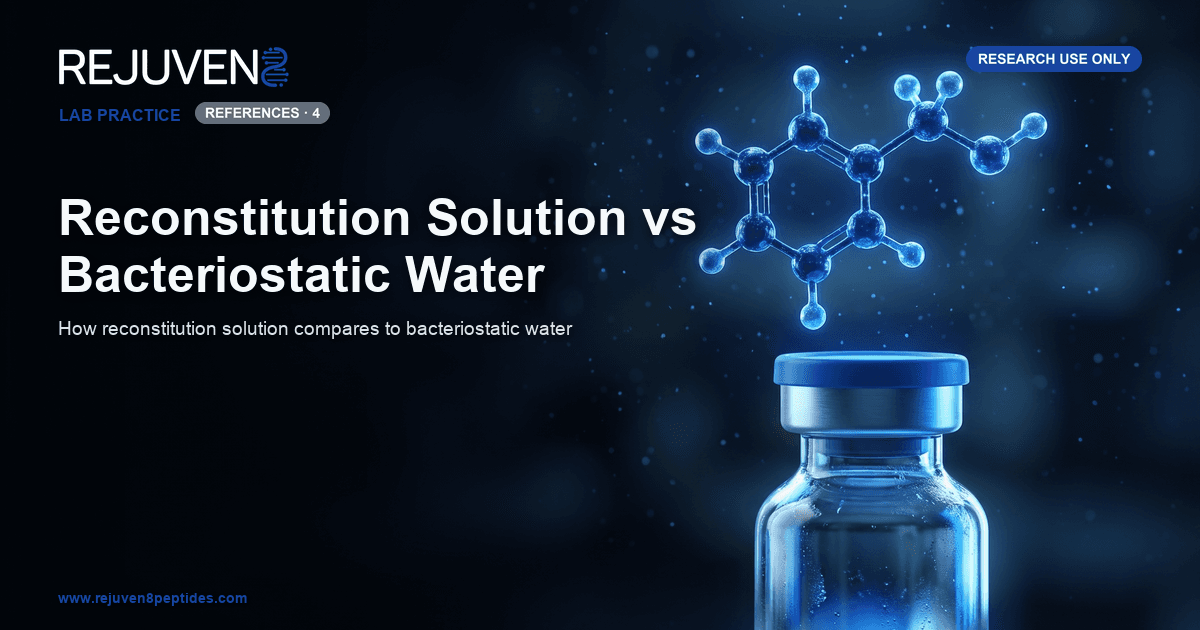
Lyophilized research peptides arrive as a freeze-dried cake that must be returned to solution before any laboratory measurement can be made. The liquid used for that step is generically called a reconstitution solution, a term that appears on supplier catalogs and vial labels with little consistency. In some listings it means preservative-free sterile water. In others it means bacteriostatic water, which is sterile water containing 0.9% benzyl alcohol. A smaller group of products under the same name contain dilute acetic acid, sodium chloride, or mannitol. The chemistry inside the bottle, not the name on the label, determines how a peptide behaves once dissolved.
This article defines the term, explains how the common formulations differ, and works through the concentration math and storage conditions laboratories apply to reconstituted material, with bacteriostatic water as the reference point. All material discussed here is supplied for research use only, not for human consumption, and the handling notes describe laboratory practice only.
What Is Reconstitution Solution?
A Category Name, Not a Single Formula
Reconstitution is the act of dissolving a lyophilized solid back into a liquid at a known concentration, and a reconstitution solution is any sterile, particle-free liquid selected for that purpose. The phrase is a category label, like “buffer”: it describes the function of the liquid, not its contents. Four families of liquid account for nearly everything sold under the name.
- Sterile water, preservative-free. Purified water with no additives and no capacity to suppress microbial growth once the stopper is punctured, so it is handled as a single-use liquid.
- Bacteriostatic water. Sterile water with 0.9% w/v benzyl alcohol (9 mg per mL), which permits repeated withdrawals from one vial over a limited working period.
- Acidified diluents. Sterile water, with or without benzyl alcohol, containing roughly 0.1% to 0.6% acetic acid, giving a pH near 4 to 5.5 for peptides that dissolve poorly at neutral pH.
- Saline-based diluents. 0.9% sodium chloride, sometimes with 0.9% benzyl alcohol added; the salt raises ionic strength.
Because the same words can describe four chemically different liquids, a notebook entry that says only “reconstituted in 2 mL reconstitution solution” is incomplete. Rejuven8 lists its diluent by contents, as Bacteriostatic Water 10mL, with the same formulation in a larger 30 mL eBac vial.
Is Reconstitution Solution the Same as Bacteriostatic Water?
Sometimes, and the only way to know is to read the composition. When a product labeled reconstitution solution declares sterile water plus 0.9% benzyl alcohol and nothing else, it is bacteriostatic water under a different name and the two are interchangeable. When the label lists acetic acid, sodium chloride, mannitol, or no preservative at all, the product belongs to a different class. The values below reflect commonly reported laboratory attributes and are provided for comparison only.
| Diluent | Composition | Preservative | Typical pH | Working life after first puncture |
|---|---|---|---|---|
| Bacteriostatic water | Sterile water + 0.9% benzyl alcohol | Yes | About 4.5 to 7.0 | Commonly limited to 28 days, refrigerated |
| Sterile water (preservative-free) | Purified water only | No | About 5.0 to 7.0 | Single use |
| Acidified diluent | Sterile water + 0.1% to 0.6% acetic acid, with or without benzyl alcohol | Variable | About 4.0 to 5.5 | Depends on preservative |
| Bacteriostatic saline | 0.9% sodium chloride + 0.9% benzyl alcohol | Yes | About 4.5 to 7.0 | Commonly limited to 28 days, refrigerated |
Where the Formulations Diverge
Acetic acid lowers pH, which increases the net positive charge on peptides rich in lysine, arginine, and histidine and improves their solubility; the same acidic environment slows deamidation of asparagine and glutamine side chains, which runs fastest at neutral to alkaline pH. Mannitol, when present, is a bulking agent and cryoprotectant rather than a preservative. Sodium chloride raises ionic strength, which can screen the electrostatic repulsion that keeps peptide molecules apart and encourage aggregation of hydrophobic sequences. The reconstitution chemistry guide covers charge, pH, and salt effects in more depth.
Benzyl Alcohol: The Chemistry That Defines Bacteriostatic Water
Molecular Identity and Mechanism
Benzyl alcohol (C7H8O, molecular weight about 108.1 g/mol) is an aromatic alcohol that is moderately water-soluble, roughly 4 g per 100 mL at room temperature, so the 0.9% concentration used in bacteriostatic water sits well below saturation. The word bacteriostatic is precise. Benzyl alcohol partitions into microbial membranes, disturbs their organization, and interferes with the processes a bacterium needs to divide. At 0.9% it suppresses proliferation of organisms introduced during a stopper puncture rather than sterilizing the contents; it is not sporicidal, so aseptic handling remains mandatory.
Interaction With Peptides and Proteins
Pharmaceutical-science groups, including researchers at the University of Colorado, have reported that benzyl alcohol can promote partial unfolding and aggregation of certain proteins in solution, with interleukin-1 receptor antagonist and interferon alpha-2a as well-studied examples. Short synthetic peptides have far less tertiary structure to unfold, so the effect is rarely a concern in the 1 to 5 kDa range, but a preservative is not chemically inert. In vitro workflows that add reconstituted peptide directly to cultured cells often prefer a preservative-free diluent for a related reason: benzyl alcohol interacts with mammalian cell membranes too, adding a variable unrelated to the peptide under study.
Reconstitution Math: One Worked Example
Concentration follows a single relationship: concentration (mg/mL) = peptide mass (mg) divided by diluent volume (mL). The lyophilized cake adds negligible volume. For a 10 mg vial reconstituted with 2 mL of bacteriostatic water:
10 mg / 2 mL = 5 mg/mL, or 500 micrograms in every 0.1 mL withdrawn. The same vial reconstituted with 1 mL gives 10 mg/mL, and with 4 mL gives 2.5 mg/mL. The values below reflect commonly reported laboratory attributes and are provided for comparison only.
| Peptide in vial | Bacteriostatic water added | Resulting concentration | Benzyl alcohol introduced (at 9 mg/mL) |
|---|---|---|---|
| 5 mg | 1 mL | 5 mg/mL | 9 mg |
| 10 mg | 1 mL | 10 mg/mL | 9 mg |
| 10 mg | 2 mL | 5 mg/mL | 18 mg |
| 10 mg | 4 mL | 2.5 mg/mL | 36 mg |
The final column is worth noting: at 2 mL, the solution contains 18 mg of benzyl alcohol alongside 10 mg of peptide, so the preservative outweighs the analyte. That ratio is normal, but it is a reason to record the diluent wherever a preservative could interfere. A single 10 mL vial supports about five 2 mL reconstitutions. Transfer technique is covered in the bacteriostatic water reconstitution guide.
Storage Temperatures and Stability Factors
Sealed bacteriostatic water is stored at controlled room temperature, typically 20 to 25 C, with an expiration date measured in years. Once the stopper has been punctured, laboratory convention moves the vial to 2 to 8 C and limits its working life, most often to 28 days. Cloudiness, particles, or discoloration at any point are grounds for discarding the vial regardless of date.
Once a peptide is in solution, its stability depends on temperature, pH, light, and freeze-thaw cycling far more than on the presence of a preservative. Refrigeration at 2 to 8 C is the usual condition for a working stock, and stability varies by sequence; peptides containing methionine, cysteine, tryptophan, asparagine, or glutamine are the most susceptible to oxidation and deamidation. Stocks meant to last longer than a few weeks are commonly aliquoted into single-use volumes and frozen at -20 C or below, and light-sensitive compounds are kept in amber or foil-wrapped containers, as detailed in the peptide storage and handling guide. Stability data mean little unless the starting material is verified, so a lot-specific certificate of analysis belongs in the record alongside the diluent lot number. Whatever a supplier calls its reconstitution solution, composition, concentration, and storage history should all be traceable; diluents appear beside the peptides they dissolve in the Rejuven8 research peptide catalog.
Frequently Asked Questions
What is reconstitution solution?
Reconstitution solution is a general term for any sterile liquid used to dissolve a lyophilized (freeze-dried) peptide into a solution of known concentration. Depending on the supplier, it may be preservative-free sterile water, bacteriostatic water containing 0.9% benzyl alcohol, an acidified diluent with dilute acetic acid, or a sodium chloride solution. The composition on the label, not the name, determines how it behaves.
Is reconstitution solution the same as bacteriostatic water?
Only when the stated composition is sterile water plus 0.9% benzyl alcohol with no other additives. Many products sold as reconstitution solution match that description and are interchangeable with bacteriostatic water. Products containing acetic acid, sodium chloride, mannitol, or no preservative are different formulations.
Why does bacteriostatic water contain benzyl alcohol?
Benzyl alcohol at 0.9% (9 mg per mL) suppresses the growth of microorganisms introduced when a vial stopper is punctured, which allows repeated withdrawals from the same vial over a limited working period. It inhibits proliferation rather than sterilizing the contents, so aseptic handling is still required.
How is peptide concentration calculated after reconstitution?
Concentration in mg/mL equals the peptide mass in the vial divided by the volume of diluent added. A 10 mg vial reconstituted with 2 mL of bacteriostatic water yields 5 mg/mL; the same vial with 1 mL yields 10 mg/mL, and with 4 mL yields 2.5 mg/mL.
How should bacteriostatic water be stored after opening?
Sealed vials are kept at controlled room temperature, about 20 to 25 C. After the first puncture, laboratory convention is to refrigerate the vial at 2 to 8 C and discard it after a limited working life, commonly 28 days, or sooner if the liquid becomes cloudy or shows particles.
References and Further Reading
- Roy, Randolph, Carpenter and colleagues (University of Colorado) on benzyl alcohol-induced aggregation of interleukin-1 receptor antagonist in reconstituted lyophilized formulations. PubMed: benzyl alcohol aggregation interleukin-1 receptor antagonist lyophilized
- Studies of benzyl alcohol as a preservative in multi-use aqueous formulations, including its interaction with proteins such as interferon alpha-2a. PubMed: benzyl alcohol preservative protein unfolding
- Robinson and colleagues and later groups on the pH dependence of asparagine and glutamine deamidation in peptides. PubMed: asparagine deamidation peptide pH dependence
- Reviews of lyophilized peptide formulation and solution-state stability, including bulking agents such as mannitol and the effects of ionic strength on aggregation. PubMed: lyophilized peptide reconstitution stability excipients