Research Use Only. The information presented here is for scientific and educational purposes. These compounds are not intended for human consumption, self-administration, or therapeutic use.
Introduction
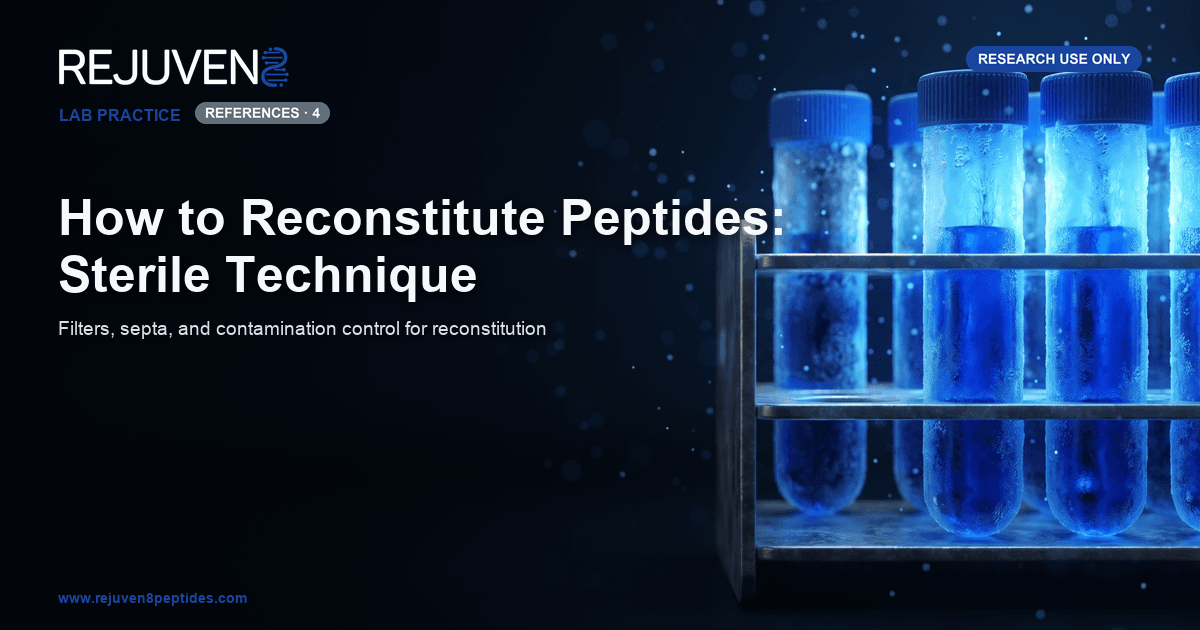
Learning how to reconstitute peptides well is less about the arithmetic of concentration than about keeping the preparation clean. A lyophilized peptide is sterile in its sealed vial, but the moment a septum is pierced or a solvent is drawn, the preparation is only as clean as the technique around it. Contamination does not just spoil a single vial: it introduces microorganisms and endotoxin that can confound any assay in which inflammatory state, cell viability, or reproducibility is at stake. This article covers the sterile technique that surrounds reconstitution, the filters, septa, and workspace controls that keep a research peptide solution trustworthy from the first entry to the last.
The chemistry of dissolving a peptide, solvent choice, solubility, and pH, is covered in companion guides; the focus here is contamination control. Everything described is laboratory practice for research use only, not for human consumption, and none of it concerns administration of any kind. It concerns preparing and preserving a clean stock solution on the bench.
Why Sterile Technique Matters in Reconstitution
Two distinct hazards make aseptic handling worthwhile. The first is microbial contamination: bacteria or fungi introduced during handling can multiply in a reconstituted vial, degrading the peptide and invalidating downstream work. Bacteriostatic water slows that growth with its benzyl alcohol preservative, but it inhibits rather than sterilizes, so it buys time only when technique is otherwise sound. The bacteriostatic water guide covers how that preservative works and why an opened vial has a limited working window.
The second hazard is endotoxin. Gram-negative bacteria shed lipopolysaccharide, a heat-stable molecule that is not removed by ordinary sterilization and is a potent confounder in cell-based and animal research. Because endotoxin survives autoclaving and other processes that kill live organisms, preventing its introduction, rather than trying to remove it later, is the practical strategy. Both hazards point to the same conclusion: contamination control at reconstitution is part of the experiment, not a preliminary to it.
The Clean Workspace and Aseptic Setup
Sterile technique begins before any vial is opened. A wiped-down, uncluttered surface, ideally within a laminar-flow hood or biosafety cabinet for work where sterility is critical, limits the airborne and surface particles that reach an open vial. The values below reflect commonly reported laboratory practices and are provided for comparison only.
| Element | Common laboratory practice |
|---|---|
| Work surface | Wiped with 70% isopropyl alcohol, allowed to dry before use |
| Airflow | Laminar-flow hood or biosafety cabinet for sterility-critical work |
| Gloves | Fresh gloves, wiped with 70% isopropyl alcohol, not touching pierced surfaces |
| Consumables | Single-use sterile syringes and needles, one per entry |
| Vial closures | Septum swabbed with alcohol and allowed to dry before each entry |
| Solvent | Sterile, drawn with a fresh needle to avoid cross-contamination |
The recurring principle is one-directional cleanliness: consumables move from sterile packaging to the vial and are not reused. A single-use syringe per entry costs little and removes the most common route by which organisms are carried between vials. Everything drawn into a solution should come from a verified sterile source, which is why solvent quality matters as much as syringe quality; bacteriostatic water is stocked as Bacteriostatic Water 10mL for exactly this role.
Septa and Vial Access
The rubber septum is the single point where the outside world meets the sterile interior, so it deserves specific attention. Before every entry, the septum is swabbed with 70% isopropyl alcohol and allowed to dry, since alcohol needs contact time and evaporation to work and a wet septum can carry droplets inward.
Coring and needle choice
Coring, the punching of a small rubber fragment into the vial when a needle is inserted at the wrong angle, is a preventable contamination and particulate problem. Inserting the needle bevel-up at an angle and applying gentle pressure reduces the risk. Minimizing the number of entries reduces it further: each puncture is an opportunity for both coring and microbial ingress, which is one reason a solution is often divided into single-use aliquots rather than drawn repeatedly from one vial.
Limiting entries
Preservative-containing solvents tolerate multiple entries better than preservative-free ones, but no vial gains from unnecessary punctures. Planning how many draws an experiment truly requires, and aliquoting accordingly, is a technique decision that protects both sterility and the peptide.
Filtration: 0.22 Micron Filters and When to Use Them
When a solution must be rendered sterile after preparation, or when a starting material’s sterility is uncertain, membrane filtration is the standard tool. A 0.22 micron syringe filter retains bacteria and larger particulates as the solution is pushed through, and 0.1 micron membranes are used where the smallest organisms are a concern. Two points are worth keeping straight. First, filtration removes organisms and particulates but does not remove endotoxin, which is small enough to pass a sterilizing-grade membrane, so a filtered solution can still carry endotoxin from earlier contamination. Second, membrane chemistry matters: low-protein-binding materials such as PES (polyethersulfone) or PVDF are preferred for peptides, because a peptide can adsorb to some membranes and be lost from a dilute solution during filtration. For dilute or precious peptides, pre-wetting the filter and accounting for hold-up volume reduces that loss. Filtration is a corrective and protective step, not a substitute for clean technique upstream.
How to Reconstitute Peptides Using Sterile Technique
With the workspace and consumables prepared, the reconstitution itself is a short, deliberate sequence. Swab the septum and let it dry; draw sterile solvent with a fresh needle; add the solvent slowly down the inner wall of the vial rather than onto the powder, which limits foaming and shear; and swirl gently rather than shaking, since agitation at the air-liquid interface can unfold sensitive sequences. Then label the vial with concentration and date and store it cold.
The concentration math is a single division: concentration (mg/mL) = peptide mass (mg) / solvent volume (mL). Reconstituting a 10 mg vial with 2 mL of solvent yields 5 mg/mL, so a 0.1 mL draw contains 500 micrograms (mcg). Choosing the solvent volume so that convenient draw volumes match the quantities an experiment needs reduces the number of manipulations, and fewer manipulations mean fewer contamination opportunities. Once reconstituted, refrigerated storage protected from light is standard, and single-use aliquots frozen for longer holding limit both freeze-thaw and repeated septum entries; the storage and handling guide details those temperatures, and the deeper solvent chemistry is in the reconstitution chemistry guide. Learning how to reconstitute peptides with disciplined sterile technique keeps a research stock solution defensible, and the solvents and materials for it sit in the broader research catalog, strictly for laboratory use.
Frequently Asked Questions
How are peptides reconstituted using sterile technique?
Prepare a clean workspace, swab the vial septum with 70% isopropyl alcohol and let it dry, draw sterile solvent with a fresh single-use syringe, add it slowly down the inner wall of the vial, swirl gently rather than shaking, then label and refrigerate. The sterile technique around the steps is what protects the preparation, not the mixing itself.
Why swab the vial septum before every entry?
The septum is the one point where the sterile interior meets the outside. Swabbing it with 70% isopropyl alcohol and letting it dry removes surface organisms and gives the alcohol the contact and evaporation time it needs. A wet or unswabbed septum can carry contaminants inward on the needle.
Does a 0.22 micron filter make a peptide solution endotoxin-free?
No. A 0.22 micron membrane retains bacteria and particulates but not endotoxin, which is small enough to pass through. Filtration sterilizes against organisms but does not remove endotoxin, so preventing endotoxin introduction through clean technique and verified materials is the practical approach.
What filter membrane is best for peptides?
Low-protein-binding membranes such as PES or PVDF are generally preferred, because peptides can adsorb to some materials and be lost from dilute solutions during filtration. Pre-wetting the filter and accounting for hold-up volume further reduces loss when the peptide is dilute or limited.
How can contamination be minimized when reconstituting?
Use single-use sterile syringes and needles (one per entry), swab the septum each time, insert the needle at an angle to avoid coring, and minimize the number of entries by aliquoting into single-use volumes. Working in a laminar-flow hood for sterility-critical steps adds a further layer of protection.
Is any of this intended for human use?
No. Sterile technique here is laboratory practice for preparing research peptide solutions for in-vitro and preclinical study. The materials discussed are for research use only and are not intended for human consumption or self-administration.
References and Further Reading
- Guidance on aseptic technique and contamination control when handling multi-entry vials and preparing solutions. PubMed: aseptic technique vial contamination control
- Studies of sterilizing-grade membrane filtration (0.22 micron) and its limits, including endotoxin passage. PubMed: 0.22 micron membrane filtration sterilization
- Endotoxin detection and the limulus amebocyte lysate approach in laboratory preparations. PubMed: endotoxin limulus amebocyte lysate testing
- Research on peptide adsorption to filter membranes and low-protein-binding material selection. PubMed: peptide adsorption filter membrane protein binding